
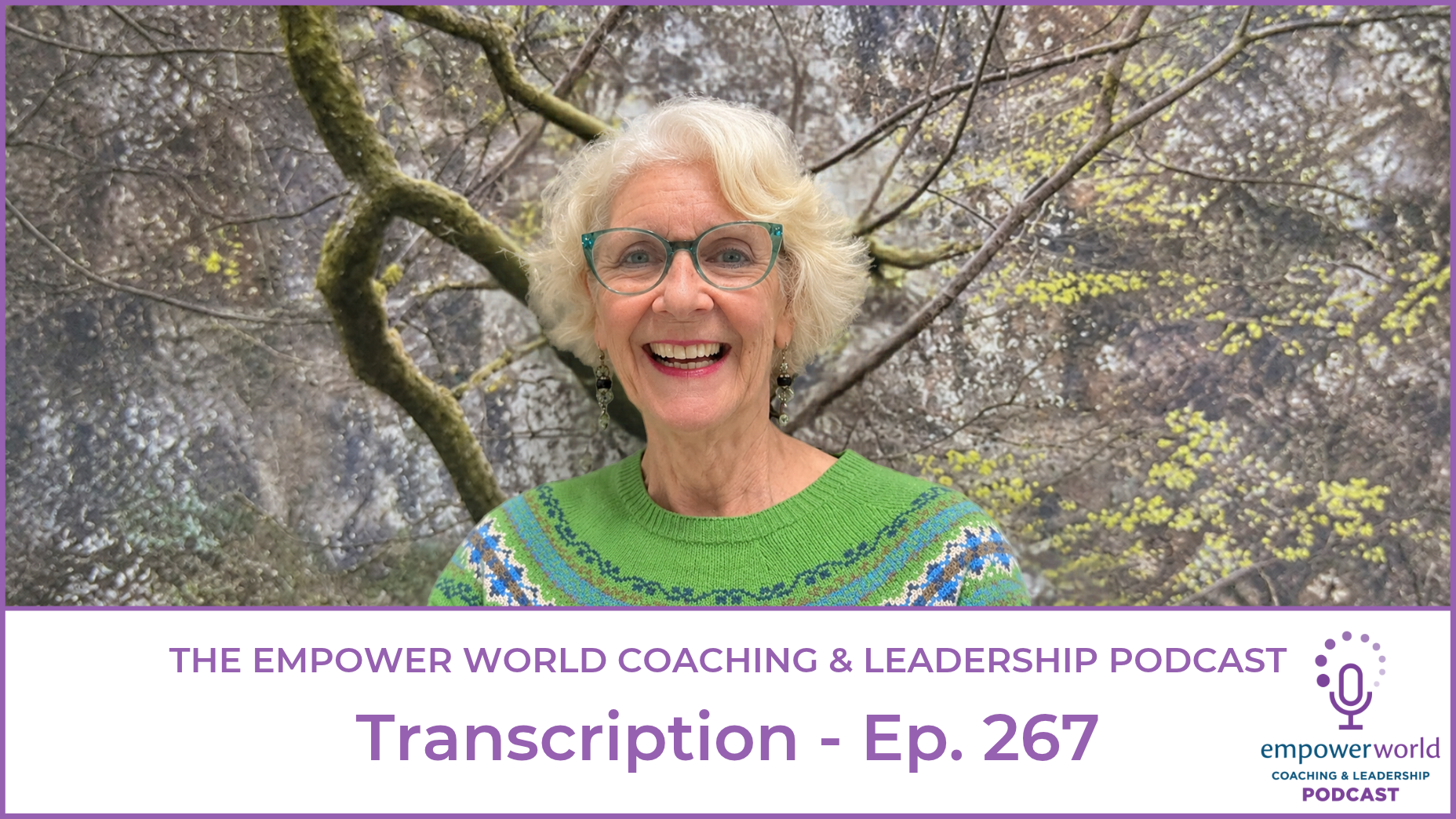
Alison Oddey
Author, Voice Artist, Creative Change-Maker, NLP Trainer & Coach.
Marie Quigley: Hello, and welcome to Empower World, the Coaching and Leadership Podcast. As you know, my name is Marie Quigley, and today I'm not with my lovely business partner, Jeanine. I am with the amazing Alison Oddey. Alison is an author, a voice artist, a creative change maker-I want to hear more about that-with over three decades of experience helping people develop, grow, and reconnect with their fullest potential. Alison is also an NLP coach, a neuro-linguistic practitioner coach, a master practitioner, and trainer. Alison, that's a lot of information in a short few sentences. So first of all, welcome to the show.
Alison Oddey: Thank you so much, Marie.
Marie Quigley: You're welcome, and I'd love to hear-maybe if there's something I've missed out-what would you like to share with our listeners before we begin our conversation today, Alison?
Alison Oddey: Well, I think you've described me in so many different ways, and I feel, in my creative life experience so far, I've had many identities. So I'm here today, obviously, to talk about this audiobook, Awaken Now, Feel Fully Alive, which I've created from scratch and written specifically for listeners, as opposed to readers. And I'm really excited and very grateful to you, to Marie, to be able to have this lovely conversation with you.
Marie Quigley: Great. I'm so excited, because we had a conversation a couple of weeks ago where we reconnected-we connected over my book, which you read. And you read the last chapter, which invited us to have tea together. And you took the opportunity to have tea with me, and then you shared what you were doing. I'm fascinated that you've chosen to go for the audiobook, so I want to know about that. But before we delve into that, name the title again, Alison, of your book.
Alison Oddey: Awaken Now. Feel Fully Alive.
Marie Quigley: Awaken Now, Feel Fully Alive. I mean, that's a powerful title all on its own. So how come you got to the stage where you decided the audiobook was potentially the best way forward, rather than the written word, which is where I began my work as a writer?
Alison Oddey: Well, simply put, I was involved with what's called the 10X community a few years ago, which was run by Jean Early and Nishish Shah. And I loved the whole experience of being part of the 10X community. After the first year of doing it, I was so amazed that I had been able to achieve this 10X challenge that I'd set myself in the first year. And I thought, I'd like to keep going with this, almost to test out that-once you get the whole understanding of 10X, that I could do it again. So I did a second year, and this was when I chose to challenge myself with creating the audiobook from scratch and voicing it. And the second thing, really, in the whole journey of this for me, is I'm very-it's very important to me to always be learning and understanding myself. During the process of creating it, I came to suddenly realize that I'd chosen this because I wanted to be listened to, and I wanted to be heard.
Marie Quigley: Gosh, a core need for us as human beings, isn't it? To be listened to and be heard. I notice I've got shivers down my back thinking about that, Alison, and particularly with the way we are in the world at the moment, that desire to be listened to and to be heard. I think that's an essential part of it. It's, I think, so important in so many people's lives. Before we go into the book, because I think our listeners might find this interesting-so I know Jean Early, you know Jean Early, and I met Jean Early through Sue Knight, who we discovered you also were part of her community. Before we go on, so that they understand, what is the 10X community?
Alison Oddey: Well, the 10X community, I think, arose from when Jean and Nishav decided to put this together, and I was invited by Nishif to join the community because I'd met him in other capacities. I think that the first year, we were a particular group of people; I was the only person from the UK in the community, and that's one of the reasons I found it so rich, because I was just meeting people from across the world. So the first year, we were obviously experimenting with everything that Jean and Nishib were offering us, and the focus clearly was on: come up with something that you don't think you could ever achieve, go into the unknown, and do it. And then in the second year, we had some more people-it was a slightly different group-and so Jean was still continuing, obviously, to teach it to us and for us to experiment and explore, which are key things in my life that have always been really important. And one other thing was that we had one-to-one coaching with Jean through the process as well-opportunities for it. And it was really in a one-to-one with him that he said to me-because I had been sending the community poems that I recorded, poems I love; I've got a love of poetry-and he had found this fascinating, and then I was starting to write my own poetry and so on. And he said to me, when I talked about what I'd like to do, he just said to me, "You know, you've got such a poetic vision of the world. Go out and do this idea that you want to do." And I remember saying, "Well, I don't know how people-" I was putting up some resistance, probably, and he said, "Listeners will find you." I've always remembered that. They'll find you. And now here I am at this point with the whole thing done. And I think that was a really key moment for me, because I'd never considered myself as poetic. I'd never really thought that much about my creativity, and I think from that moment on of doing this 10X course, I've come to see who I really am. And it sounds a bit-I don't know what it sounds like, actually, but I know that I was struck by it. I'd never really thought of myself in this particular way, and of course, by doing and creating the piece, I've come to really learn who I am.
Marie Quigley: Well, that sounds a powerful-Jean sounds like he gave you a powerful reflection of who you are inside. And I'm-you know, I always wondered what the 10X community was about, so you've explained it clearly, that you come together, but also the 10X, it's like living your life tenfold, ten times. That's what I am now understanding, which I didn't before, Alison, so thank you for sharing that. And it looks like it's ramped up your ability to create, to perform, to bring your unique capacity to the world in the form of this beautiful audiobook that we're going to explore now.
Alison Oddey: Thank you, Marie. It's beautifully put.
Marie Quigley: So let's have a-it's got a beautiful title. And what was the catalyst for making it audio versus written? What happened in that process?
Alison Oddey: Well, I think further to what I've just explained from that coaching one-to-one conversation. What happened next for me was I decided to explore just writing differently, because my first book, which is called Devising Theatre-devising, whether it's theatre or any other area that you're working with, it's about starting from something but not knowing where you're going with it. And that is very like the idea of going into the unknown. And that is a process I've always been part of for most of the work I've done. And so-I'm going to have to ask you to just remind me what the question is here, Marie.
Marie Quigley: I was just wondering how you decided to go for the audio versus the written.
Alison Oddey: So, because I'd committed to that audiobook, and at that point, you see, I hadn't worked out for myself-this is because of what we've already talked about-so I decided to put myself in a different working capacity, and I decided for about a month to get up and be at my desk for 6am, which is not my normal way of working, and work for two hours, just writing freely. And I also put on music without words, unknown tracks, just continuous music. And it was through doing that that I actually found myself writing early parts of any of the memoir sections. So that was something I had no idea I was going to do, and then I was constantly writing poetry throughout the process. So that was already coming in, and then I was thinking about the coaching as well, and how I could use-how I could encourage a listener to self-coach, in a way. But I have to make clear that this was all at the start, and I really didn't know how this would end up. And knowing how it has, I could never have predicted where I got to in the end.
Marie Quigley: How fascinating. So what I'm hearing is you're combining a mix of poetry, prose, memoir, and a coaching approach to help the listener maybe bring some questions that they're thinking for themselves and explore them for themselves-so a self-coaching, as you so rightly said. So I'm thinking about the chapters, the-how does it work with an audiobook that might be different to the written process?
Alison Oddey: Well, in this audiobook, I have not used the term "chapters." I've used "threads." You have Thread 1 to 25, basically. So that's one thing. The second thing was to take the idea of some of those original poems I told you about that I recorded-and obviously people in the community liked some of them a lot-and so I chose my sort of favourite ones from that, and I used the titles of the poems as the thread headings. And then I was obviously bringing the listener in and using, if you like, the lens or the frames of the different genres to give them a different experience of themselves. Because one of the things, Marie, I've found when thinking about the publishing of this is-in today's world, and I think we've probably spoken about that in our last conversation, generally about publishing-it's quite one genre, or two at the most, but the idea of crossing through and into different genres is an impossible task at the moment to be popular.
Marie Quigley: Well, what do you mean by that? For the listener who might be curious about that, can you say more about that difficult task of combining that?
Alison Oddey: Yes, I think it is because we've become a culture and a world where we're so instant, and we spend time going from one thing to the other quite quickly. And therefore, if people are defining-however a listener decides, if they're an audiobook person anyway-obviously, you decide the sort of things you like, or what you're looking for, and this requires listeners to be open to the whole experience of this, because it does cross through these different genres. And in the end, it's still going to be a unique experience for every listener, because they're still going to be at the starting point where they know what they like, or they may discover they're very open to going with the flow at the beginning. And of course, once a listener really engages, it's about their journey, not mine, but I'm a voice companion to them on that journey. And my story that's evolving, my reframe of my whole life, will be in tandem with what actually they're choosing to pick up in their own threads of what's going on for them right now.
Marie Quigley: Yeah, love that. So if I'm facing a challenge that might be different to what you're explaining in the book, or sharing in the book, or creating poetry or music around in the book, I may not resonate fully with what you're sharing, but if I look at my own life, it will be able to teach me lessons about myself and my experiences-or not even teach lessons, perhaps bring awareness to myself in a different way, because I have a different capacity as I'm listening to you. Is that what I'm hearing, Alison?
Alison Oddey: That's exactly right, and I think it is about a self-awareness, a self-discovery in some ways, and they could be quite small things at the start, or they could be some of the kind of human experiences we've all been through in different ways.
Marie Quigley: Wow, it sounds very powerful. And I know another connection that we both have is Arslan Atha, who's the kind of mastermind behind the scenes at Empower World and Empower World Coaching and Leadership Podcast. He does all the work to support things to move efficiently and effectively, and anybody who's trained at Empower World knows Arslan well, and you know Arslan well too, so much so that you have used his beautiful music as part of your audiobook. So tell us more about that, because I was so happy to hear that.
Alison Oddey: Yes, well, I met Arslan whilst I was doing Sue Knight's Master Practitioner course. And I just felt this instant connection with him. He was a guest on Sue's course, and I contacted him afterwards. I was fascinated by when he was talking about his music, because I love all kinds of music. And he sent me a track, which was a beautiful acoustic number, and I just loved it. And so I then started tuning in to his music. So that was kind of the beginning of it. And also, I was doing my Master Practitioner model at the time, which was called Choose Yourself First. And I wanted to model him with other people as well, but I wanted to model him for so many things, which I did, and that was really how we got to know each other, and still do converse, etc.
And then when I was in the rig recording studio at a point-quite early on, I suppose-one day I was just literally in there, and I suddenly got the idea for a particular song, which might be fascinating to bring in, if I could, and I contacted him. Bless him, he gave me-he said, "No, that's fantastic, Alison, go ahead." And then, with the producer of the audiobook and the sound engineer, we explored and experimented how we could deconstruct the song and then how we could weave it into this journey that I was creating. And it really was a wonderful process. It took me back to all the devising projects I've done in the past, because I had no idea how this was going to work. But I just thought, this is a song that always makes me happy, whatever's going on in my life. And I just thought it would be great for the listener, who would not come to hear the song until the very end, but just have somehow this music being there-the magic of Arslan, and music, and sound. Sound's obviously very important in audio. And so we basically deconstructed it and experimented an awful lot. And I'm very pleased with what we've come up with, and I think it works really well. And I think that's one of the reasons it's a different kind of audiobook, because you've got the music, you've got the sounds. For example, because of the 10X, which obviously comes into this journey, there are moments where we have a beautiful moment of Arslan's voice, which becomes an indicator to the listener that we're now going into some kind of reflection, or some questions. And there's space for people to think about very much them, wherever they are at that moment on the journey.
Marie Quigley: Wow, so it sounds so beautiful, it sounds clever, and it also sounds incredibly creative-the way you've woven these different aspects of sound, words, emotions into creating a really powerful experience for the listener. Now, I have to be honest with our listeners: I haven't experienced it, and I'm looking forward to listening to it when it comes out. If you could give me and the listeners-because I feel quite blind as I'm exploring this as well, and fascinated, Alison-what might we experience at the beginning of the book that might tell us a little bit about what it's like in this experience?
Alison Oddey: At the beginning of the book, you hear a bit of the song at the start. I think the one citation I've used at the start is Ralph Waldo Emerson's: "You can only find peace in yourself." And I know I've probably just misquoted that, but for me, it's only you that can find peace with yourself. And then we go into a short poem by Rumi. So for listeners that don't know who Rumi is, Rumi was a 13th-century Persian Sufi poet. And I love his work, I love all sorts of aspects of it, but there's a beautiful short piece that I do at the start which is really the theme throughout, which is about when seeking love, that's not the way to go; it's about breaking down all the barriers within yourself, and then you'll find love. And I just think that it's very beautiful, it's very short, and at the end of the audiobook, we meet another very short piece by him. And I'm not going to give that away, what that is at the moment. So you get that, and then there's a poem, my first poem in it, The Celestial Sky, and immediately you get the deconstructed sound that comes in with that, and then you're taken on a bit of a universe-type journey into, then, perhaps, who this person speaking is, their start of their journey. And then we're off, really. And it's about being open, just going with it. And then I think listeners will know if they're getting something from it that's going to keep them curious, and not knowing where they're going, because that's no different to the 10X. It's about being bold, brave, courageous, step into the unknown, see what happens.
Marie Quigley: Oh, fascinating. I'm looking forward to stepping into it when it's launched, and we will talk about the publishing date in a little bit, Alison. What I'm also interested in-because I know when our listeners are thinking about these podcasts, they're also interested in the learning that the person exploring this has had. So what was the journey like of creating this for you, and what has changed for you in yourself at the end of the process?
Alison Oddey: Well, I think it's been the most challenging creative process I've ever done. That's the first thing. But it's been wonderful, because there's been the whole process, obviously, of writing it, thinking about, from the very beginning, the listener and what they're listening to. There's been the process of being the voice artist of it, which has brought me a lot of joy, but it's extremely-it's a very skilled job to be a really good voice artist, I believe. And like any new identity, there's lots of learning; you need some experiences, and I'm sure with everything, you get better as you go. And then the actual recording process, again, especially because we were experimenting, exploring with that music, with the audio soundtrack. But also other things. For example, one of my favourite things for me personally is that I managed to record the lesser-spotted woodpecker when I was in some ancient woodlands down in Sussex, and that was on my mobile phone, and it's in there at some point. From a technology point of view, I had no idea-I thought, you know, it's my phone. And it's just lovely for me to hear that, because that was a very meaningful moment there when I was creating. So yes, I think that in terms of where I am right now, it has completely consolidated for me at this moment the importance of reframing my life as I wanted to share this as a creative experience-a life of being creative. But in that reframe for me, it's not about going into whatever my ups and downs in life were, of which I've had many, like every human being does, but in a way that it would enable that listener to think about things that come with our-whether we have loss, or grief, or we lose a job, or we change our relationship, whatever the things are, or something much smaller, just about thinking about our daily life and being present. At one point I was thinking, what's my premise for the audiobook? And I made it "live well now," and that's the point. And so it's very pertinent to me to share that with you, because we are in a very changing world at this moment. There's so much uncertainty about where we're going, and yet we can see repeated patterns in wars and behaviours and habits and so on. And I just thought, if a listener can find their own ways to ensure on a daily basis that you've got something you can think, "That has been the best thing today"-that kind of idea of joy, or feeling peaceful, or calm, or whatever it is, because everybody's different. And that's also the point of it: that we're all unique, and we're all going to relate in our own perceptions of this listening experience, but we can all choose to change something to make our life different in whatever way.
Marie Quigley: And it sounds like, as you've completed the 10X, as you've stepped up into the courage to create this new version-because as you said, you've always been a creative practitioner-and now this is something different that you're bringing to the world. It sounds like you are living that premise of living well now. What does that give you, Alison?
Alison Oddey: Oh, it gives me hope that we can get through whatever we're going to go through next. It gives me comfort. It gives me joy in the sense that I have been developing, I suppose, my own ways of staying positive, being optimistic, enjoying life. I'm a great one for that, and I feel lighter for the experience of doing all this. I've always enjoyed fun and being playful, laughing-I love laughing-and living as well as I can. And I love people, and I love connecting with people, and I think that's why I really enjoy coaching so much, and meeting people. And that 10X community really showed that to me, because I saw other people's perceptions of me, which absolutely surprised me. And I think this is the same as if you've never thought about poetry, or you think you know what poetry is-you might be surprised. And the same with the music, and the whole-I've always loved doing new things, Marie, and I've always loved learning. And obviously, whenever you do a new thing, it takes time, doesn't it? And you have to choose whether you're going to practice doing something, or-but once you start getting into this, and I think I can remember when I was on Sue Knight's call, one of her courses. I always like to have an espresso coffee in the morning, and I've got a collection of little cups that I've collected, and I think, which cup shall I have it in? And they're just simple choices. But once I started realizing-because it comes up in the audiobook-that whatever, even if you've just got some coffee, you can make it a time when you really do stop doing something, or just enjoy the moment. I think it's about that, and there must be moments in the day when you just enjoy them. And that's partly because we are in this crazy world where we rush around and do all these things, and I see younger people getting quite burnt out with it, because that's what they've kind of grown up with-the instant world. Whereas, as I say in the audiobook, in my world of black and white television, colour came into nothing. So I think it's just about finding new things for yourself that take you further on your lifetime journey of learning.
Marie Quigley: Yeah, I love that, and resonate with it in so many ways. I remember a conversation with a group of mums whose children were all a bit older, and one of them said, "I don't remember a lot of my children's childhood, because I just wasn't present." And how we can miss important moments in our life because we're worried, or we're thinking about tomorrow, or we're concerned that we're not good enough, clever enough, beautiful enough, whatever it may be. And actually, we have enough in this moment if we can stop and pay attention to it. And it sounds like those lessons that you've learned and put into this audiobook are something we all need to pause and listen to. And I'm thinking-I love audiobooks. I love what happens to my body when I listen to audiobooks. It's a very different experience to me than reading a book. So thank you for bringing it to us in this way that we can experience your work.
I know there are listeners out there-coaches, leaders, people who would like to maybe get into coaching and development-who might have something they'd like to bring to the world, but they're not part of a community such as 10X, or they don't know how to move into something they want to do. What advice would you like to leave them with as we start closing off today's conversation, Alison?
Alison Oddey: Well, I think I'd love to say to them to just think about always having one point in the day-and I don't mean in a fixed way-but where you just allow yourself time to be with yourself, whatever that might mean for you. Because some people are immediately going to think mindfulness, or meditation, or journaling, all these different opportunities we have to get together with ourselves. I'd just say find a time where you just maybe have silence, or stillness, or just being in a space, but yourself, with yourself. And I think that chimes very much with everything you've just said about the mother's experience. I'm a mother, and I remember rushing around all the time because I was full-time working, had my son. And it's very easy to not even give yourself that. And that's about discovering what works for you, because we're all different, and not just that, our routines are very different. But if you can start doing that and just get into that, however that is, you can cultivate it, grow it, and that will bring you-excuse me, I'm now going hoarse. I think it's because that's really important.
Marie Quigley: Yeah, beautiful. I love that idea of cultivating, because it takes practice, all of this, doesn't it, when we have these busy lives. When is the audiobook launched, Alison, and where can people find it?
Alison Oddey: It's going to come out on November the 11th. And it's going to be first on Spotify, so it'll be available on Spotify on the 11th of November. And then I think in a week or two, certainly in November, it will be available on Audible as well.
Marie Quigley: Fantastic. And if-I'm sure people will want to know more about you, Alison, not just about the book, but who you are and the work you do-how can people get in touch if they want to?
Alison Oddey: The best way is through LinkedIn.
Marie Quigley: So, Alison Oddey on LinkedIn.
Alison Oddey: Yes, Alison Oddey on LinkedIn, and you'll find me.
Marie Quigley: Well, thank you for a wonderful conversation, Alison. Remind us of the name of the audiobook again, so we have it in our hearts and our minds when we're closing this session.
Alison Oddey: It's Awaken Now, Feel Fully Alive. And I'd like to say, Marie, for any listener that gets through the book, I think in a year's time, you could see your life very, very differently if you commit to listening and finding your own way to get to where you want to be in life. And thank you so much, Marie, for listening to me and for giving me the opportunity to talk about it. It's meant a great deal.
Marie Quigley: Oh, you're most welcome, Alison. I'm really looking forward to listening to the book myself, and I'm sure many more conversations will come from this. Thank you so much.
Alison Oddey: Thank you, Marie. Thank you.
Marie Quigley: Thank you, listeners. We hope you've enjoyed today's conversation. If you have, we'd love you to share with your communities, people that may not have got access to this, or may want to be part of this community but haven't yet heard of us. If you've got conversations you'd like us to talk about, let us know. If you like what we're doing, spread the word, because the more and more people that we can connect to, the bigger difference we can make. Thank you for listening, as always, with love and gratitude. Have a wonderful day.


