
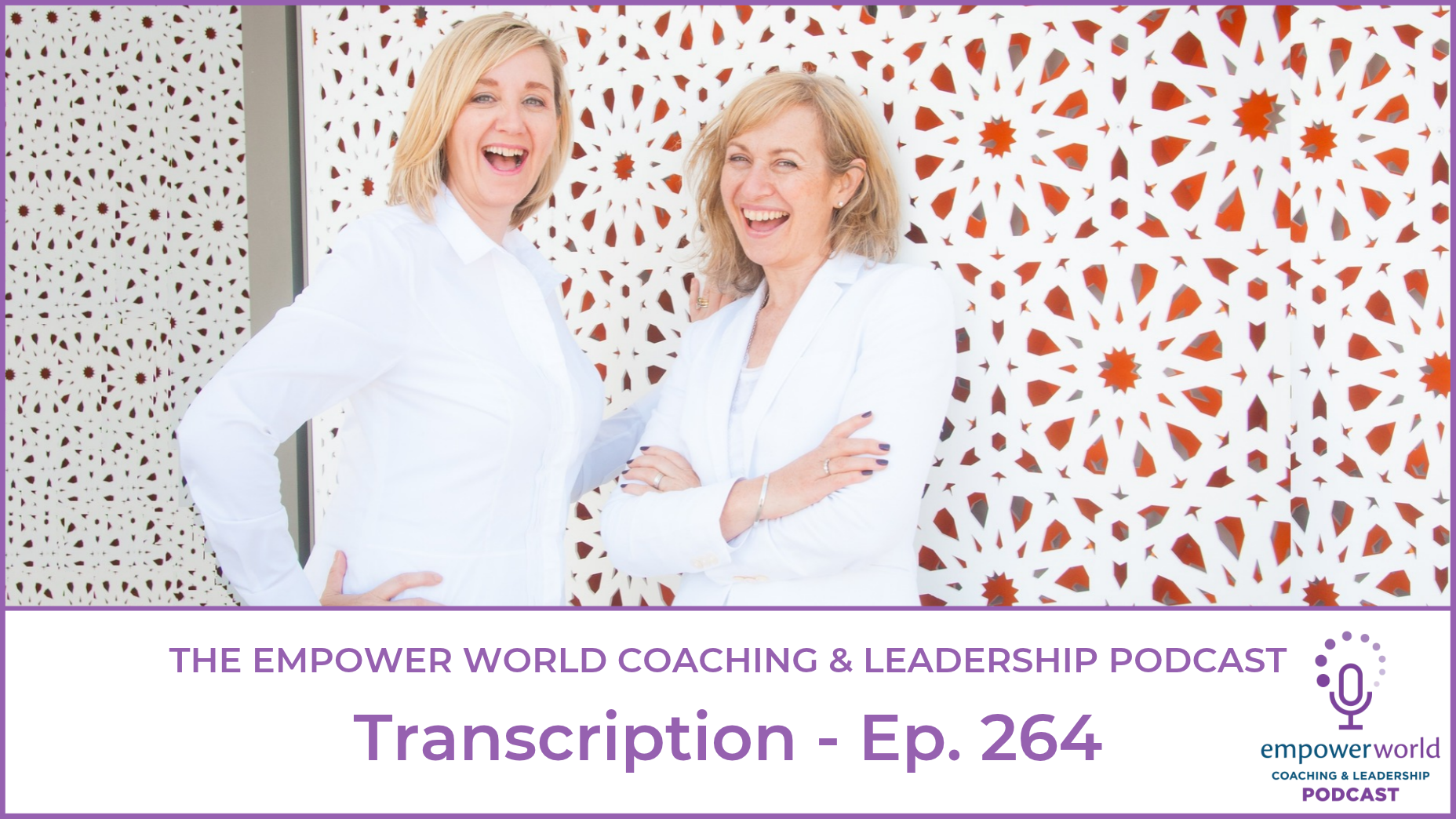
Jeanine Bailey & Marie Quigley
Co-Founders of Empower World
Jeanine Bailey: Hello, listeners! Welcome to the next episode of the Empower World Coaching and Leadership Podcast, and today I am here, myself, Jeanine Bailey, with the new author-if I can say that-Marie Quigley, my former co-founder of Empower World, and of course, co-host of the Empower World Coaching and Leadership podcast. I'm delighted to be with you, Marie, on the launch of your brand new, exciting book, Fierce Love. Congratulations, and I'm just going to give you a cheer.
Marie Quigley: Thank you.
Jeanine Bailey: Many others are.
Marie Quigley: Thank you, Jeanine. It's funny, as I was coming on here, because of course we normally come on together to talk about a topic or something, and I felt really nervous coming on as a guest, so that's a funny experience, but thank you. I really appreciate your support and generosity, as always.
Jeanine Bailey: Oh, I am just so proud of-if I'm allowed to say that-so proud of you!
Marie Quigley: You can say it.
Jeanine Bailey: That you've-like my sister, my best friend, my child, it feels like that-that you've made this happen, and it's been a dream, I know, for you to write a book for a very, very, very long time, and I know we've been kind of trying to plan to do one, and it's in the making, but it's been a challenge for me to find that time, so I am so, so pleased that you found that time to be able to create this, because it really is a wonderful coaching resource for all coaches. All coaches should have this book on their bookshelf, and not sitting on the bookshelf waiting to be read, but to actually be read. So, again, congratulations, Marie, on making this happen.
Marie Quigley: Thank you, Jeanine. As you say, it has been a long-held dream. I remember sitting beside you in our training rooms and saying that it was absolutely something I wanted to create. We do have a book in the making that is ours and our program. And I just took the bull by the horns this last year, because I thought, if I'm going to make it happen, I have to commit, I have to make it a priority, and that's what I did this year. So, it's been a really beautiful, challenging, interesting journey, for want of a better word, writing this book, which actually is not the book that I thought I was going to write. It's emerged from a year of thinking about it and then writing it down in different ways. It's emerged into a very different book than I first spoke to the publishers about, so that's interesting.
Jeanine Bailey: So, Marie, what was the inspiration behind this book, Fierce Love?
Marie Quigley: Well, as I say, as I was writing the first version of it, I was looking at lots of different things that I wanted to share with coaches to help them learn about their own practice, and then I remembered that one coach asked me a question when I was doing a demo about how I held compassionate space but was still at the same time able to challenge the client quite dramatically. That question stuck with me, and as I was writing the book, I brought this coach to mind, and it made me go back through a lot of my reflective diaries, and I thought, how do you do this? How do you translate what happens in a session, naturally, that I think naturally happens, but how do you translate it so that other coaches may be able to take this on? And it took me back to memories, memories with my own life, as well as with client cases.
Fierce Love wasn't the terminology that I originally was thinking about using. Actually, I initially thought about it being A Return to Love, because I think coaching is a lot of the time now focused on models and structures, which are essential in helping us hone our skills, but we forget about how important this deep connection to another human being is. And that allows so much courage to happen when we have trust and connection. I think of our own partnership, Jeanine. We've had a lot of trust and connection in our partnership that has allowed us to be brave in our conversations with each other, to challenge each other's thinking, to help us think outside of the box. And as I was writing these stories down-and actually, I was writing for one coach, the coach that asked me the question, thinking that potentially nobody else would pick this book up, that if she picked the book up, it would help answer that question: how do you challenge while at the same time being compassionate? That's a long, long way around saying that's what happened as I was writing. That question kept coming to mind.
Jeanine Bailey: It's a great question that your coaching partner asked you to bring to light, because that is something that, obviously through our partnership, we've been able to watch each other coach others in the room, and that is something I noticed that you did so beautifully, Marie-to be able to hold that space. I believe it often comes down to, internally, how we appreciate the things that we believe, the signals that we-the energy that emerges from us as coaches that can land with another, and the way that you acknowledge another through the coaching process, hold the space, while asking those questions in a way that lets people know that it's safe to really lean into vulnerability and courage and find truth. A beautiful skill, which, when we train new coaches, we potentially often hear: coach is asking a question, someone responds in a vulnerable way, a courageous way, and then the coach moves on to the next question-but perhaps my hand is going along, a surface question, instead of holding that space, acknowledging, and then asking something that takes them more deeply into that awareness that's starting to emerge.
Marie Quigley: Yeah, I love how you name that, because that is the first lesson of my book: that it begins with us. It begins with us as coaches, what we believe about ourselves, what we tell ourselves, how courageous we are. We bring our stories that we've held as little girls, or boys, or whoever we are bringing up through our childhood. They translate; some of them we're able to let go and shift off, and others we take on board. I'm very honest, I hope, in my book, in the case studies, because I share a lot of the things that I did wrong-some of my fears, and instead of love, I was definitely in a state of fear. You particularly read the first case study, Jeanine. I was getting in the way of my wonderful client, which I call an explorer in the book. I was getting in the way of them exploring and doing their own work because of my own fears. And so I had to come back to myself and say, who am I in this work? What do I want to create? What are my values, my beliefs, my purpose? And how do I bring them fully into the coaching? Instead of-and I talk about this-the armor that I may have put on to be an, in quotes, executive coach with my suit and my briefcase walking in. I think that the more human we are, wherever we're coaching, the deeper connection we can have. And therefore, the courage for the explorer to do their own work and traverse the land-the internal land-becomes braver because we are able to do that ourselves.
Jeanine Bailey: And again, I really appreciate that courage to share those cases where it hasn't gone to plan, it hasn't gone the way that you've wanted, because it really supports the reader to recognize this is not about perfection. This is a journey. And it is learning from each of those wonderful clients that we work with, and potentially, yes, we may recognize that some of them didn't go as well as we hoped, but what is here to learn, and what can we master in support of who we are as a coach, and of course, the people we work with.
Marie Quigley: And in the final chapter, I talk about gathering the lessons, and the point of that is not to say that we're going to be perfect, because we aren't. So there are always new lessons to learn. We talk about this when we've been training coaches, that the pursuit of mastery is never-ending. Now, this is not about perfection. This is really about becoming more self-aware. I don't know that we can ever be completely self-aware, but I know the 15 lessons I've included in the book-and there could have been many more lessons, however, I had a word count that I had to keep-but the 15 lessons that have landed in the book, I'm still learning them. They still come back to help me discover something new. So, I'm certainly not writing this book as somebody who's, oh, I've got these lessons, and they're in the bag, I'll never have to learn them again. In fact, as I was rewriting the final chapter, which is very different from-you were one of the first readers, Jeanine, my final chapter is different to your version, because I actually had to learn some lessons and readjust as I was writing the final chapter, and I realized, oh my goodness, I am learning these lessons by writing this chapter. And I think it's important for us, it doesn't matter how many years coaching we've had, to be vulnerable, to be courageous, so that newer coaches know that there is no such thing as perfection in this work we do. But there are incredibly brave conversations and brave work that we can do with ourselves, exploring our light, exploring our shadows, and really understanding more and more about who we are.
Jeanine Bailey: Yes, beautifully said, and yes, I'm going to have to go back and read that chapter with my book-which is actually my two books, which are on the bookshelf. But it's so right, Marie, when you say that, that we're always learning, we're always, always learning, and I love this quote, which I can't quote right now, I can't remember the exact quote and who said it, but it's a quote by an extraordinary woman who says, you know, we can't help but be changed by the conversations that we have. And I believe that's the same for when we write something or read something as well. They're all stories, and when we come back to them, we can have a different perspective, and the story will change again, so I can appreciate how that last chapter would have changed through such an outpouring of experiences and the life that you've had as a coach, which is getting on-not that you're old, Marie, but you're an experienced, very experienced coach, so there will be so much wisdom to share, but also to keep learning from.
Marie Quigley: Yeah, and the process of writing the book was such a learning experience as well. I thought I had written the book, and then I would go to sleep, and I'd wake up and think, oh, that lesson has to be in, or I'd go for a walk-and when I walk, I'm in nature, or I've got some woods behind me that I'll walk in, and I've got a beautiful lake that actually has no water in it at the moment, sadly, but I used to walk beside it-and in that nature environment, a new or more concrete lesson that absolutely had to be in the book came, and that was a fascinating experience. So, listening to the wisdom of myself, my body, not just my mind, but my body, my spirit, my soul speaking, that was an important process, and one, initially, I didn't quite understand. But as I listened more and more, I realized the jigsaw had missing pieces at one point-I think maybe draft 32, I thought, oh, I'm done here-but this kept evolving. And I think it was draft 72 that finally it came together, with lots of editing and lots of cutting out things that actually weren't essential to have in the book. Let's be honest, this is not a complicated book. It's not an academic book. It's a very, I hope, real book, with real stories about my personal life and my client work, real, practical things that I think, and I hope, will help coaches integrate some of these lessons, if they want to, into their own work.
Jeanine Bailey: Yes, and it's just a powerful way to share your incredible wisdom and experience and knowledge with coaches who potentially don't need to go through a program to experience, because what I really appreciate is just the real-life examples that you do bring to life, and that help normalize situations, but also enhance a way to enhance situations as well, coaching experiences. So, Marie, I know that I don't want you to give away too much out of your book, because we want people to invest in the knowledge and the wonderful resource that you've created for coaches. And you were speaking about those 15 lessons. If you chose a lesson that you'd like to share with our listeners today, a little bit, what would you share?
Marie Quigley: Well, I think it has to come back to that first lesson: It begins with you, which is Lesson 1 of the book. And what I'd love coaches to think about is, who are you in the work that you're doing? Where are you avoiding some of your patterns? Where are you bringing some of your patterns in that aren't serving your work? Where are some of your beliefs stopping you being brave? Maybe, like me, one of the case studies is I'm working with a very brilliant explorer, and I have beliefs that I'm not good enough, I'm not clever enough, to be able to work with him, and it really stops me having brave conversations. And when I come back to myself and learn about my own patterns and beliefs, and are able to meet them with love, but also invite them just to step outside of the room while I do this work, then we started to have really brave conversations. So that is what I would love coaches to do. It begins with you, and actually, I think that's-if we don't begin with us, then the rest of the lessons can never come into fruition, because it all begins with us.
Jeanine Bailey: And again, I absolutely resonate with that, Marie, and we're the foundation. And love. For you, for the listeners, what does the love mean in coaching?
Marie Quigley: It's a great word, because it's quite controversial, isn't it? Using love for many people is a bit unusual, especially when we think about the ethics of how we work as coaches. And this isn't a love that is romantic. This is, if we take the Greek word agape, or the focus that I look at it in my book, which comes from the Irish philosophy of anam cara, so that means soul friend. And love here means-and actually, it can't be love without fierce for me, so this combination of fierce and love together means that we can support others. We can, at the same time, with compassion and connection, be really courageous in the type of questions and reflections and experiences we can offer the explorers we work with. So, love on its own actually can sometimes get in the way, because we can be too caring, we can be rescuing, we might not bring up something that we think may upset the client because we think they can't handle it. But combined with fierce, then the two things can be really powerful.
Jeanine Bailey: They truly can, can't they? It's finding that beautiful balance, that spectrum that lets the partner know that they are naturally creative, resourceful, and whole.
Marie Quigley: So that's a really good point, Jeanine. If you're a fierce coach and you're forgetting the other-the compassion and the connection-then maybe there's something missing there too, because and fierce coaches, in my first case, is what I was trying to be: direct, really moving hard, fast forward, moving towards success, and actually it wasn't fulfilling for me, because I was leaving those more compassionate and caring parts out of my work, but combined, they really made a difference.
Jeanine Bailey: And so, Marie, for those that are listening, what is it that you would like to share about maybe the experience of writing, maybe about the messages that you have created in this book, or something else, or maybe it's a combination?
Marie Quigley: There were so many lessons that I learned writing this book, as there have been in my life, my life journey. I share some personal stories in my book. Every chapter, every lesson begins with a lesson from my own life. I'd like coaches to look at your own lives and think about the lessons you've learned, and perhaps how do you translate those into the work you do? Because it's interesting to do that. Go back through your pictures-we were talking about you going back through old pictures before we joined our call. Go back through old pictures, old memories, old reflections, and find moments that matter to you, and see how the lessons you learned in those moments could be translated into your own work to deepen your own awareness. I would say that.
Jeanine Bailey: And again, thank you for sharing that, and I remember going through our mentoring program pre-questionnaire. And we did bring a whole lot of questions together. And Marie, I remember you brought in those life questions to support coaches to think about their life experience combined with the mentoring experience and embodying the competencies. So, and I was just looking at that the other day as we're doing a mentoring program, and so there you were.
Marie Quigley: Who'd have known? I mean, I can't recall that, but isn't that interesting that you've brought it to the table? You must send me a copy of that.
Jeanine Bailey: I will, I will. And anyone who joins the mentoring program can also have access.
Marie Quigley: There you go, yeah, yeah.
Jeanine Bailey: Marie, again, I just really thank you for being you.
Marie Quigley: Thank you, Jeanine, that's very generous, and a reflection of yourself as well.
Jeanine Bailey: No, that's very generous. So, thank you. Thank you for being you. Courageous. Loving. Compassionate, experienced, and very generous with the knowledge that you've brought into your book, so really, thank you for bringing it all together for the world to have a taste of that. So, thank you.
Marie Quigley: You're welcome, and thank you for inviting me as a guest on this podcast, so I can share it. And of course, you can buy the book anywhere you buy your books from, go check it out. I've also, which I'm really delighted, I've created some little companion cards to go with the book. They've just arrived in, and my son helped me build them and create them and get them printed. And these companion cards are to go along with the book, and do some self-reflection, and also for your explorers that you work with, do some-maybe invite them to open these questions, and see what comes out of your thinking. Just a little gift to go along with that.
Jeanine Bailey: Fantastic, Marie. And I'm guessing people can find your book very easily by just googling, finding it online. Is it in any stores at the moment?
Marie Quigley: It won't be in stores, if you want to order it from a store, go and do that, but it is definitely online.
Jeanine Bailey: Brilliant. And we'll include the links with the podcast, so thank you. Thank you, Marie. And listeners, please do-this is an Australian saying-do yourself a favor. Go get the book.
Marie Quigley: Thank you, very kind.


