
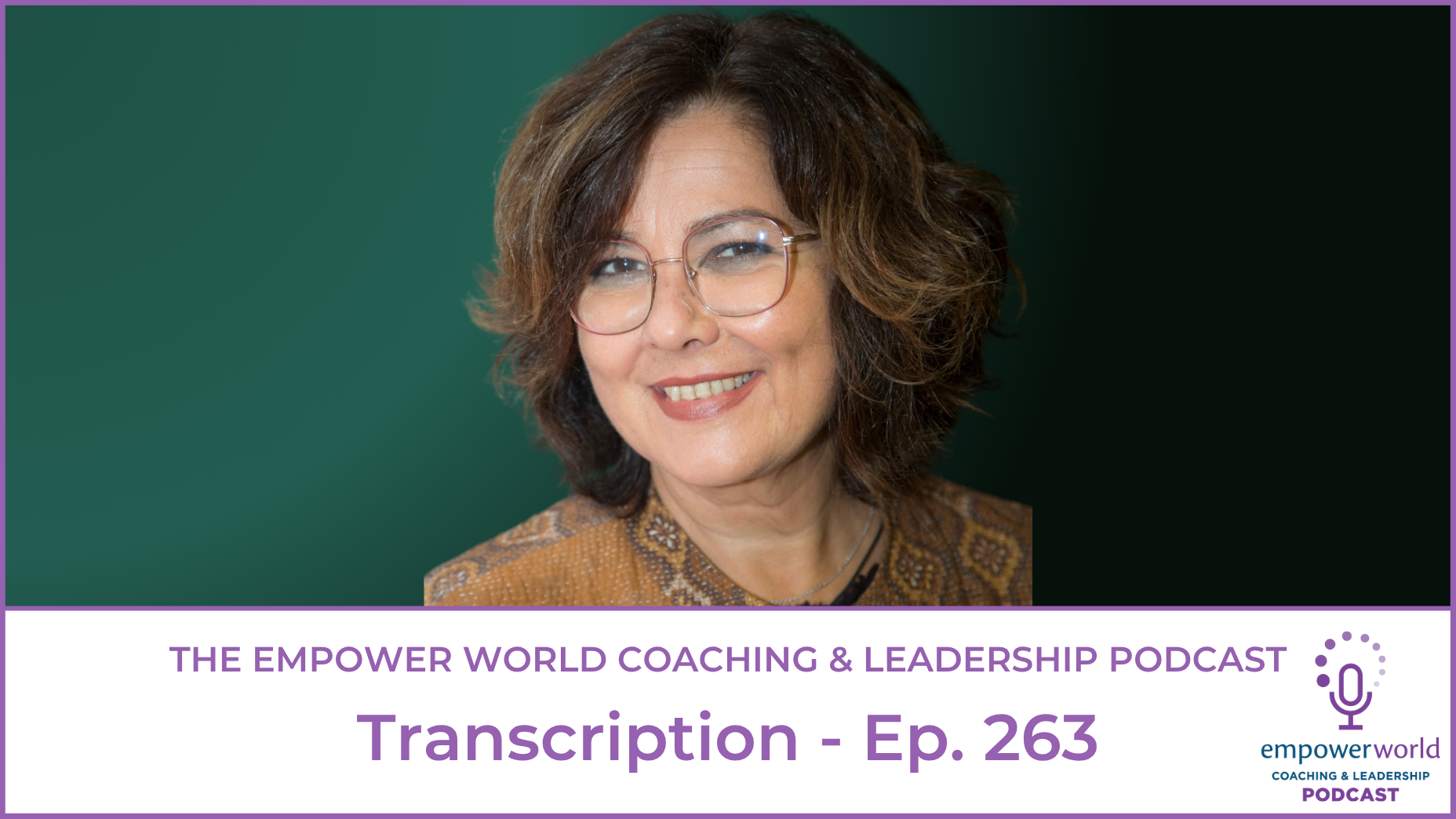
Andra Morosi
Seasoned International Executive Coach, Coach Supervisor
Jeanine Bailey: Hello and welcome to the next episode of the Empower World Coaching and Leadership Podcast. Today, I am really delighted to be with a coach, a supervisor, and so much more than that, but also someone I believe is my friend, colleague, and peer, Andra Morosi. Andra, I'm so happy to have you here on our podcast. We've known each other for quite some time now. I think it might have been at the beginning of COVID. We met online, we've met through the American Coaching Supervision Network, the Climate Coaching Alliance. We connected, we knew that we wanted to get to know each other more, so we certainly met online one-on-one on numerous occasions, we did some work together, and I was so lucky to have you come and visit me in Australia after COVID a few years ago with your son, so that was an absolute delight to meet face-to-face, as you're based in France and I was in Australia at the time. So welcome, Andra. Thank you for saying yes to being here.
Andra Morosi: And thank you for inviting me, Jeanine. Always a pleasure to interact with you in any context, whether it's in Europe, in Australia, online. It's a privilege, and I feel that there is something magical that happens when we interact, and I hope we're going to experience some of that in our podcast, in our conversation this morning.
Jeanine Bailey: I trust we will, Andra, and I'm certainly planning to come and see you very soon in France, but again, happy that we're here having this conversation. We had quite a lengthy conversation before we came online, and I knew quite a bit about you, but I learned so much more in our conversation, and I'm just really struck by the skills, the experience, the knowledge, the magic that you do create through all of your focus. One of the things that we talked about, in terms of what we'll focus on today, is working with what is here, what is emerging. I appreciate there were so many different topics that we could have focused on, and perhaps we'll bring you back to focus on those as well, but as we spoke about this, it seemed important for you to bring this in, as you have been so active in so many different lines of work. It feels like you're on this journey of new growth, new experiences once again, and so I really want to thank you for bringing in this topic, because I believe it's so important for us as coaches and supervisors to really work with our clients with what is here, what is emerging. So, Andra, over to you to introduce yourself, because there are so many things I could bring in, but I'd love for you to share with our audience a little bit about yourself before we start to go into that conversation of emergence.
Andra Morosi: Of course. So, what can I say about myself? I'm an executive coach and a team coach, a supervisor of coaches and leaders. I've been in this field of work for almost 20 years. However, I was sharing with you, Jeanine, that I don't come from the business world at all, despite the fact that I work with senior executives and board teams and project teams worldwide-international groups, multinationals. I started as a secondary school teacher, and then a university teacher, and I consider myself a linguist. I think my professional story is so connected to my life story. But I'm not the only one in that case, am I? Early on in my life, I started wondering about identity, culture, belonging, humanity, traveling, otherness. I was in my 20s when I started that reflection.
I was sharing with a friend recently that coaching started for me when I was 21. I decided, after having fought my parents for having immigrated to New Zealand when I was a teenager, leaving communist Romania, and not being asked whether I wanted that, given the irreversible dimension of it, and then projecting that it was for my own good and my brother's good. I was a rebel, and I didn't accept that, and I was blaming my parents, and I was in a defensive position all the time, until age 21, when I decided to go back to Romania, taking risks, but owning the decision that I wanted to make my life outside of my country of birth. When I say that's when coaching started for me, it's that that's the first time when I had the feeling that I had to go for making a conscious choice. I knew, intuitively, that my life would change, and that there was a burden that I would carry all my life had I not done that.
To cut a long story short, after 3 months in Romania, I was totally healed. I thanked my parents. I became a true Kiwi! Well, not really. Then history brought me to France, given the fact that I've studied anthropology, linguistics, religious studies, film history and criticism, women's studies, and I had a French major-French Language, Literature, Communication, and Civilization-as well as German and Italian. So I came to France as a Kiwi, as an English teacher, as an English assistant, back in the 80s. And I stayed. Never left. However, with some episodes in the US, in South Africa, in Italy, but always loving France and with an intention to grow roots in this country, which for me is the country of my soul. I have 3 passports. I love living in France, even though I'm not fully French, or I'm not just French.
As a coach, I work a lot. I set up my own company in 2009, and it's International Milestones-coaching, training, and consulting, and I would add supervision, after having trained as a supervisor about 10 years ago. The international dimension in my work is really important. I love diversity, I love complexity, and of course the multicultural, the multi-referential, or the multi-contextual dimension in global teams, but also in the work with leaders who have to coordinate remotely, several nationalities as part of one, for example, HSE team in the energy sector that I'm working with in the nuclear sector at the moment. I'm thinking of this client-it's something that makes me really happy about bringing the focus on complexity, where leaders try to simplify, to just go back to basics, or pretend it's, "Oh, there is diversity, but it's the group that comes first, and we have to just apply the corporate culture regardless." But we know that things don't happen like that.
So I've had my company since 2009, and I love-I used to travel a lot for work, occasionally going to one place for just two days to shadow a leader. I'm thinking of Moscow. I worked with a Russian leader working with a big pharma international company, and so I had to see him in meetings, and being capable of flying in just for 2 days in Moscow-this is part of my past life, when I was traveling a lot. These days, I do more remote work, and I travel less, because I'm much more mindful and aware of carbon footprint, and the systemic dangers in terms of climate change, the loss of biodiversity, and all the bad news that we have to witness about our future as humankind. That moves me. I'm just being aware of how emotional I get just talking about that, and that's the reason why I left the very corporate part of myself and the Paris, center of Paris-based office in La Défense to move to Normandy and build my Green Cube office, coaching office, at the back of my beautiful garden, and coach more remotely, and nourish my inner self and my way of working with everything that I have around me, and bring more of that into the corporate world. I think there's a need for that. What do you think?
Jeanine Bailey: Yes, absolutely, Andra, and I really appreciate you sharing your journey. Again, I'm learning a bit more about you, and what I really appreciate-and what I know of you-is that you've certainly lived a vast experience, a depth of experience. The pace-I'm getting a sense that the pace was fast, there were, potentially, I'm making this up, but here, there, and everywhere, so to speak, and I guess with that real desire to make a difference, to support leaders to be even more conscious of how they lead and empower others. I get that sense of that pushing, and making things happen. And what I get a sense of you now, especially as we've spoken a few times this year, is where you are really appreciating being in your garden. That there is this journey of slowing down, and just letting things come in as they're meant to. It's kind of like trust-trusting that what's meant to be will come to you, and again, connecting with what's important to you: nature, biodiversity, culture, cultural diversity, etc. It feels much more comfortable.
Andra Morosi: It's funny you mention trust, because last night I was just finishing an article on trust in international teams as the foundation. And indeed, you don't declare trust, you allow it to set in, and you feed trust. Trust is a process. That's the end of my article. It's not something you put on a poster like we see in a lot of organizations. Trust takes groundedness, and it takes presence. It's an ongoing process that is an important element in international teamwork, for instance, but also in interpersonal-but also in connecting with a total stranger who says, "I want to work with you, I don't know why, but yeah, there's something that is there." And there are other people who are like, "I chose another coach because I didn't get that thing." We choose each other. Sometimes I'm observing myself, that I don't create conditions for that coachee, potentially, to choose me, because I don't imagine myself working with that person. So we mutually-do you feel that?-we mutually choose one another, and it's not just, "I need to work, I work with anyone." I like to get pleasure and resonance in the work I do with people. And people choose you because you're you.
I go back to the famous tagline of the Coaching Supervision Academy, a quote from Edna Murdoch, a great lady of supervision, and apparently she mentioned this in a conversation with another senior coach in the UK, about "Who you are is how you coach. How you lead, how you supervise, how you work." So it's so important to be in that place of inquiry about what's the difference that makes the difference about me, and how am I similar and different to these other senior coaches that I meet at ICF, EMCC, the federations of our profession. It's so wonderful to connect with people, but each time you observe this diversity with a new eye. And there is modeling, there is, "Oh, I like this," there is feedback, but there's always something that, in the mirror, you learn about yourself, to say, "Aha, I'm learning that this unconscious competence I have is coming to the surface, and I can turn it into a conscious competence. I can speak about it. I can say to someone, this is the kind of coach I am, and this is what I feel I'm really good at." So I like that. I like to invest in our profession, to meet people, but also to feed myself with the difference. If that makes sense. I love the difference. I love the diversity, I love complexity, and I don't like when things get simple-I get bored.
Some of my partners-I have a partner in the US, another one in Italy-occasionally say, "Something complex, something very difficult-Andra will do it." When we have a difficult client, topic, or situation that needs to be addressed, they get me involved, because I love that. I love to create from scratch, I love to engage with what's emerging. I don't like ready-made solutions, I don't like to copy-paste. Each time it's starting anew. And then there are people who say, "Yeah, but that's not very economic. You waste energy, you recreate the wheel, whereas you have so much background and experience and tools. How come you need that?" And it's because I don't believe that the tools that I've used with this client in 2025 will be appropriate for this new team in 2026.
I work a lot with individuals, but with large teams. There was a team of 80 people, and in 2025 I put together a team of coaches-we were 3 coaches, plus someone from the client side. It was such an interesting event, but the architecture of this event was fantastic, was very complex. Three teams that are supposed to build into one team, except that they didn't have the same outlook-one was based in Spain, the other two in France-different values, different perceptions of their roles, and then in the new organization, needing to work together, and two leaders. So it was a wonderful piece of work. There was some follow-up, but it was quite substantial, as you can imagine. I like those situations. You create new paths, new tools, new approaches for teams like that, for these kinds of requests.
Jeanine Bailey: Yeah. How do you work with emergence in those situations, Andra? How do you work with what is here?
Andra Morosi: That's a very good question, given the fact that in one-to-one coaching, emergence is something that is happening in the field, in the conversation. But when you work with a large team, and you have a sort of a scenario, or what they call the running order-I don't like this, running order-of what we do. The contracting with the client is first, it's contracting with the leaders, but what happens in this big room in a castle is totally different. I'm the lead coach, but I also work with two other coaches, and we align and we contract. Of course, if I were alone, I wouldn't need to contract or re-contract, just to say, "Hang on a moment, this is not planned, but that's an important topic that is emerging here. How are we addressing it? Are we putting it in the fridge?" I don't like parking lots, I call it the fridge. "Do we put it in the fridge, or do we address that?" So we need to do some spot contracting with the team and with the client, and to slightly change what was planned to what is emerging or what's here.
In that case, if I'm thinking of this client, it happened just slightly. It happens more with smaller teams, or with executive teams. I did a team coaching a couple of months ago in the north of the UK, so that was easier, because it's 12 people-it's not the same as 80. Things do happen, because that's how life is. Life is not controlled to happen in a certain way, so there are tensions, or there are, "Yes, hang on a moment, I disagree." So we are listening to voices in the system, like in all team coaching, and as long as it's contracted at the beginning, we know how to address that, or to contract to say, "This is so important, however, we were going to finish this piece, and then we'll get back to that. Is that okay? What does everyone think?" So it's a common decision, it's not the coach's decision. Nevertheless, there is a sort of an influencing or a guiding, and when we are several coaches, it makes it even more complex, because we spot contract in front of the team to say, "Barbara, I propose that we do this and we address this now, even though we hadn't planned. Is that fine?" And she would say, "Yeah, actually, this is what we could do." So we co-created live with the client, in front of the client. And that's the magic of it. A lot of clients like that, because there is flexibility within the structure-not totally. I call this "a bit jazzy," yeah? So we do have a structure, we do have an intent and an outcome, and yet the path is not carved in stone, because things happen in a team as a living system. A team is a living system. We can't deal with the team as an object.
Jeanine Bailey: Yes, absolutely, and what I heard was role modeling, how we can work together as a team to be able to move forward when things pop up unexpectedly, that are potentially important.
Andra Morosi: Yeah.
Jeanine Bailey: Andra, how do you embrace that working with the here, working with what is unfolding, or for yourself, which was something we spoke about earlier? You shared about that letting go of old things, bringing in new things. What are you noticing in yourself, in your practice?
Andra Morosi: I think the "letting go to let come" is a mantra that I really like, and it goes to Theory U, it goes to getting to the bottom of the U, and to the deep presencing, after the sensing, or the co-sensing. During my supervision training with the CSA, there was a big shift in the way I started working, and I started working with others, given the fact that I support coaches go through that journey of becoming supervisors. As a faculty member of CSA-and that's such a privilege-to be a witness of that kind of transformation inside from senior coaches. It's beautiful. Because I said senior coaches, so coaches who aim to become supervisors, they're fairly experienced, senior. And yet, they feel like beginners. Even though they're senior, they're beginners, so there's a sort of a contradiction, or a personal difficulty to engage with the vulnerability of what it is to acquire that posture, to unlearn, to be an expert, or to let go of the thinking and just engage with the here and now, with the magic in the middle.
When I see you do that, you know what comes to me? You're experiencing these things, and I'm just putting words on things, as I see you nodding, Jeanine. You see, I'm just meta-communicating to say, "Yeah, I allow myself to do that." Not just to think it, but to say it, and to see how it resonates with you. But some coaches refrain from that. That's the whole thing about learning to address that in the here and now, and say, "What about it?" Yeah, and we go together to a place, and it's so magical. What comes to you as I'm sharing that?
Jeanine Bailey: I am just thinking of a coaching partner that I worked with yesterday-it was actually a demonstration in front of us. It was just such a-for me, personally, it was a beautiful experience, because the coaching partner that I was working with allowed herself to be vulnerable. She allowed herself to just be. So it felt incredibly authentic, emotional. It was just the witnessing and getting curious about what was unfolding moment to moment to moment-the emotions that came up, the physiological changes that she was displaying, some of the words, but it was more around the expressions that were emerging. So it was just a beautiful unfolding, for me, and I'm hoping for her too, of what was just happening in the moment. That's what came up for me as you were speaking.
Andra Morosi: Yeah, and you know, as I'm listening to you, I just had moments of being-Virginia Woolf, back then, when I was studying literature, because I talked about my past, you know? And it's moments of being that allow that to happen. And that's so beautiful. When we dare to go there, and we dwell, and sometimes say, "So what is coming next, or where do we go with this?" You know? It's not me, it's us. You know, and that's so empowering, isn't it?
Jeanine Bailey: It's a really good point that you make, in terms of reflecting, getting curious, but always letting the partner choose what to share. It's really trusting they are the experts. They know their experience. They know what things mean when reflecting more deeply. So what I'm hearing from you is that it's so important for the person-or the team-that we're working with.
Andra Morosi: And also, in supervision, coming back to what I was sharing about-thanks to supervision, and thanks to my experience with CSA, learning and observing senior coaches go through this unlearning to control, or to know where we're going, and to let go of "it's fine not to know." On the contrary, that's the whole essence of it. And it's magic to see in 8 sessions-we do 8 supervision sessions during a one-year diploma curriculum-when there's a moment where something happens, and you see them at the beginning, they struggle. It's like, "Yes, but, yes, but. But how is that different from coaching? Yes, but." And all of a sudden, got it. And you only get it through practice; you don't get it through knowledge. You get it through the letting go.
And I guess there's some modeling, because I think I like that. I invite them to have, at the end, a moment of sharing of, "What have you noticed in our space today?" So that there's some modeling-it's like, "What did I do that was different?" Not to say I'm the best, or I'm mentoring you, but because they are on a learning journey, it's important to also become aware of "I'm modeling that way through the way I supervise them," yeah? And this is what I call 360 learning, because you learn so much from different angles, and that's welcome to complexity! And I think this leads me-I'm making connections-this leads me to my latest discovery, learning. I'm a learning junkie, as a friend in the UK says, Patrice. I love new tools, new paths, new ways, so I'm constantly doing courses. I'm fascinated with discovering new things.
For the last, let's say 6-7 years, I am very much into complexity and living systems, because I have a garden, because I'm doing experiments with permaculture, because I'm observing very closely what happens in nature when you don't control it. And I've discovered regenerative leadership and regenerative coaching and approaches, and I've discovered the work of Nora Bateson. I'm a fan. Nora Bateson is the daughter of Gregory Bateson, and she's created Warm Data. Warm Data-data that is alive, that is not cold, and it's not big data. It's warm, it's happening live, it's moving as we're talking. And of course, this is totally in line with what I was saying before, and just experiencing. I've done her training 3 times so far-twice online and once face-to-face in Amsterdam-and it gathers so many people. And there's theory behind the practice, but the practice is so simple. So rich. And there are some taglines, or I call them mantras: "Your story changes my story." And we are just sharing stories, like we're doing now, Jeanine, you see? But what I'm sharing in my story brings something from your story and makes our conversation come alive. That's Warm Data. Yeah? And engaging with that emergence is totally in the Warm Data style, and I was like, "I have a new name for what I've been doing for quite a few years."
Of course, it's more than that, and as Nora says, "It's not just that and nothing more. It's not just that and nothing more." So there is much more to it. And there's no point in simplifying it or oversimplifying it. However, we need to take what is useful from it to serve the client, but not to pretend that the rest is not there.
Jeanine Bailey: Yes. I really appreciate you bringing that in. I've heard you share her work-and I think it was the Global Supervision Network webinar-and I took a note of that saying, you know, our conversations continue to allow us to evolve. It's dynamic, it's ongoing. We're learning and changing as a consequence all the time. So dynamic.
Andra Morosi: And coming back to our simplicity, to our humanity, to the core, the essence of who we are, and then how we meet other. And in these spaces, they're not just coaches, you know, they're people from academia, people who are more into regeneration, people who shifted lives, leaders from organizations who left the corporate because they're looking for new meaning in their careers, because they know there's more than meets the eye, but they don't know how to go about it. It's fabulous. The diversity is amazing. And you just meet people because the conditions are created with this authenticity, the simplicity, and bringing it all. It's about "life lifing," as she calls it. Life is not a static thing. Life is lifing. I love that. Linguistic creativity, I'm a linguist, remember? It's just so beautiful.
But she is-whoa, you need to hang on to your seats, you know, because it's quite provocative. It's quite provocative. And the theory, the concepts are hard to grasp. That's why you see them separately, and it's like-I don't know if you're familiar with the work of Gregory Bateson, the father, because she's continuing that. In epistemology, it's hard to access some concepts, because you're constantly in a meta position. And there are some abductive processes and things that are very theoretical, that you need to grasp first in order to feel them in practice, to feel them, yeah? So sometimes the theory, if you're not available mentally to grasp it, is hard to grasp. You know what it's like when you read 3 times a sentence in the book and you still didn't get it? Well, it's the same with her common sense. And you think, "Okay, I need to read this again." Same thing.
Jeanine Bailey: Absolutely fascinating, and I will look into her work. So, Andra, as we start to come to the closure of our conversation-I know, it's flowing.
Andra Morosi: I enjoy it, Jeanine! Yes.
Jeanine Bailey: What would you want to share with our listeners today, based on everything that you've shared and what's emerging for you? I'm trusting that as you've been speaking, there's more conscious awareness that is unfolding for you. What would you share with our audience to maybe invite them to do, or not to do?
Andra Morosi: The first thing that comes to mind is the authenticity of self, and self as instrument in the helping professions. I think it's such a responsibility we have. Which is why I'm so passionate about supervision, and I love to develop my supervision activity more. Why? Because I believe that learning as a helping professional, as a coach, is so important. It's a lifelong journey, and maybe 10 years ago, I would not have been able to say what I'm saying today, so it's an ongoing learning journey. And given the complexity of the world we live in, we need to constantly tune our violin, or polish the mirror, to be really fit for purpose for a changing world, for changing leadership.
And second, I would say that I think that's why I love this work. You never reach a destination. It's a constant thing, so always challenging your beliefs of the moment, always challenging what you know, and thinking it's all relative, it's a hypothesis. There are other angles, and staying curious. Everything is in everything else. I think it's-in systems thinking approaches, it's so important to see the connections, and to connect the dots, and not be afraid of complexity. And especially nowadays, in this world that is becoming so polarized, I think it's important to go deep inside ourselves, and connect to our essence, and then when we connect to this essence, we see the essence in other, and we work from that place.
And I love a quote from Thich Nhat Hanh. I'm a practitioner of mindfulness and mindfulness practice in Plum Village, and I had the privilege of meeting Thay before he had his stroke in 2014. And this quote from Thay is so essential. It's: "Peace in myself, peace in the world."
Jeanine Bailey: What a beautiful quote to end this conversation. Peace in myself, peace in the world. And what a privilege to meet him.
Andra Morosi: Yeah. And I believe we are workers of peace, as coaches and supervisors, aren't we, Jeanine?
Jeanine Bailey: I truly believe that I am in the best profession I can be to support that. And there's an opportunity for so many more to do this work and bring that peace.
Andra Morosi: True. I feel-I'm happy to sense the emotion between us, and it's such a beautiful emotion to share. I know how much you care about our profession, because I know you quite well, and I'm passionate about our profession because of that. I have a feeling we change the world at a really small millimeter scale, you know? But I believe in changing the world, or making the world a better place, without arrogance, just with humility. But that's why I think in working with leaders, it's fascinating to know that you're touching so much through these leaders, and they touch other people, other systems, other teams, and so eventually, it becomes big. The rivers become oceans. And that's how we do change the world, don't we?
Jeanine Bailey: The ripple effect, the ripple effect. Yes, indeed. Long may it continue to keep rippling and snowballing to bring more peace.
Andra Morosi: Yes.
Jeanine Bailey: Thank you, Andra. Thank you so much for bringing your whole self into this conversation. I really feel your passion, and connect with your stories and your truth, so thank you for being who you are and doing the wonderful work that you do across the world.
Andra Morosi: And thank you for being a wonderful host, Jeanine. As usual, I resonate with your hosting energy. I love that in you. And it was beautiful. I loved the conversation. I had no idea we would go where we went, but that's the whole magic, isn't it?
Jeanine Bailey: Exactly, exactly. I knew that the conversation could go anywhere with you, and it did, and I appreciate it so much, as I know our listeners will too. Thank you, Andra.
Andra Morosi: Thank you.


