
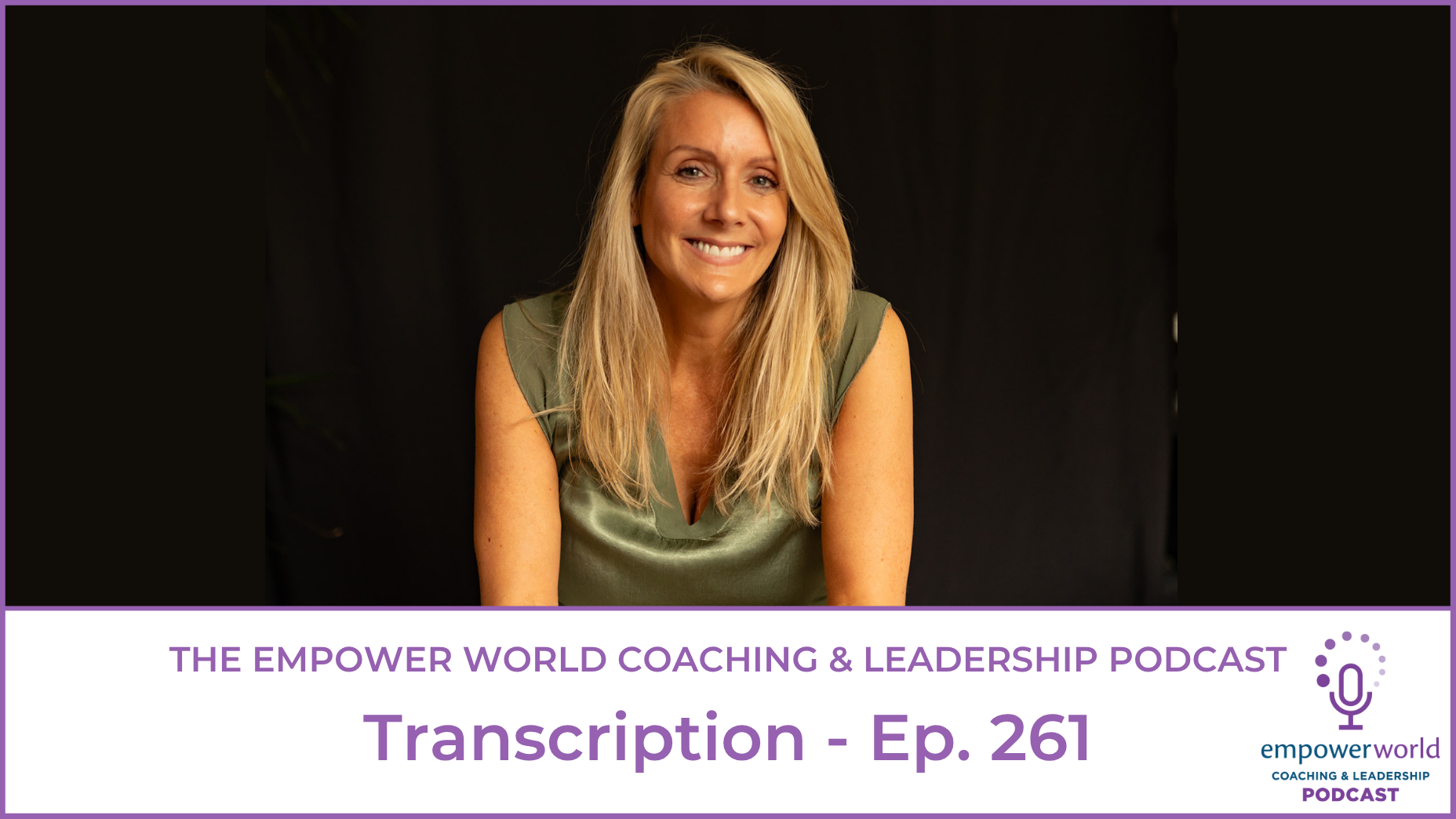
Nicola Spencer-Perera
Executive Coach & Founder, Reset Wellness
Jeanine Bailey: Hello and welcome, listeners, to the next episode of the Empower World Coaching and Leadership Podcast. Today, not with Marie, and I am very delighted to be here with Nicola Spencer-Perera. I hope I said that correctly, and you can change that for me, Nicola, if I've said that wrong. But I'm so delighted that you are here. You are part of one of Marie's and my cohorts back in Doha, Qatar, in 2019, a coach training program, so it's been wonderful to see you in the room, but also to continue following your journey as you've moved out of Qatar, back to the UK, set up a business, and I've really been enjoying the different things that I'm seeing you focusing in on, and the difference that you're making, so I was really keen to bring you on to our podcast to share with our audience what we can do as coaches in various different ways to support people to come back to who they are, reset, look after themselves, and bring out their authentic selves. So welcome, Nicola. I'm going to hand over to you to introduce yourself much more specifically, but thank you for being with us today.
Nicola Spencer-Perera: Well, thanks, Jeanine, thanks for the introduction, and it's great to see you and talk to you again. Yes, I have very fond memories of our time in Qatar. I absolutely knew that I had found my purpose, really, when I attended the life coach training. I enjoyed every second of the training, and then my journey since. I think that's where my passion comes from. I found it so rewarding and helpful for my own journey to go inwards and understand myself better, and why I'd made decisions in the past, and reflect on the past. But now I'm really sharing that with as many people as possible, and set up my company called Reset Wellness.
Having spent 27 years in the corporate field, I was in global communications, marketing, PR, and events-pretty fast-paced, quite demanding, quite high profile. I was often supporting the chairmen and CEOs of companies, so you know, couldn't make mistakes. And it led me, really, to feel overwhelmed and burnt out, and so I'm now bringing my experience-my coaching experience, my experience in the corporate world, and also in employee engagement-together to support organisations and individuals to avoid burnout and to be well. There are a lot of-it's not just me feeling and thinking this; there's lots of research in this space now that suggests that the challenge with corporate burnout is increasing.
I think I've got some stats on the wall here, just in case I didn't remember them, but Deloitte did a study, and they estimated that around £51 billion is the annual cost of poor employee mental health to the UK economy, and presenteeism-which means you're at work but you're not performing at your best-accounts for around £24 billion in lost revenue for companies. So that's not a light figure. And add to that, the global figure is $12 billion for annual days lost to poor mental health, anxiety, depression, and those sorts of feelings of being unwell or disease. So it's a huge challenge, and I'd like to do my small part in the world to support organizations and individuals to be well.
Jeanine Bailey: Yes, thank you for sharing those statistics, because I'm very aware that this is a challenge for many, if not all organizations, that mental wellness and looking after people to ensure that they're in the best shape, for want of a better word, to be able to do their role effectively, if not passionately. So I've heard that trend that you've been speaking about, how it is ramping up in terms of the cost of not looking after our people, and the mental stress and pressure that is on people today. But hearing those numbers really puts everything into context and light as you share that. So thank you for bringing that into the podcast.
One of the things that I read about yourself, Nicola, is really having a passion not just obviously bringing this reset and wellness into the workplace as a one-off thing, but actually really supporting organisations to create a culture, because I think that many companies, organizations can fall into that trap of perhaps doing a thing here and there, believing that they're contributing and supporting people, but it's more than just a one-off thing. It's really creating a culture.
Nicola Spencer-Perera: Yeah, this has been my experience as well in the corporate world, and I love the term, it's not just free fruits and yoga. I mean, I thought I came up with that, but I'm sure someone else did, but free fruit and yoga is fantastic, but it's just like putting a plaster over the challenges. The last organization I worked in was running at such a fast pace, from the leadership down to the employees. And yes, they had a yoga on a Tuesday night, but if your manager's emailing you at midnight and giving you unrealistic deadlines, you don't feel safe enough. Psychological safety is a big challenge. So you don't feel safe enough, really, to tell your manager, for fear of losing your job, that you feel stressed and overworked, so you just quietly continue.
This has been my own experience, and I did work in that way for a long time, and I think it really does need to change from the top. It's great to offer those things, and a lot of companies are introducing apps now, but if they're still running at that high speed, and employees are still expected to over-deliver, then it's not going to work. So I'm really looking at organizations from the inside. I'm working with an organization at the moment, and they did an anonymous survey recently, and they were really surprised with the results and how unhappy staff were feeling. So we will start with those results-okay, how are they feeling, and why are they feeling like this, and what can we do about it? And it's not a quick fix; it's a long-term strategy, a well-being strategy, usually run by HR but in alignment with the leadership. And really supporting managers and leaders to change their behaviour. This is where I find the link with coaching and the skills that I learned through coach training, in terms of being vulnerable, understanding boundaries, understanding how you role model your behaviour, and how that can impact others. So if a leader is dysregulated, shouting at people, or just not behaving in a real connecting human way, it can affect a whole team. I've experienced it, and no matter how hard you try to regulate yourself, look after your own well-being, jog at lunchtime, if you're then going straight back into that environment, then you're not going to feel great.
Jeanine Bailey: I'm appreciating that you have ways of supporting organisations to create that culture, to begin creating that awareness within the organization in terms of what are the challenges, what are the things that people are experiencing that is creating that stress, and what's the impact, what's the cost of all of that? I'm curious about that, and I'm also curious about how do we really support those organizations that perhaps don't even have that awareness, that perhaps are so busy at that fast pace that you're talking about that they just don't see what's going on in the organization. How do you help organizations perhaps recognize there's a challenge here?
Nicola Spencer-Perera: That's the golden question, really. I am offering, just for me, in terms of trying to get into organizations, for them to see the statistics, to have some awareness, to have that aha moment, potentially. I'm offering a lunch and learn with leaders, one-to-one conversations with leaders, but they have to be willing to change, and want to change. I know a lot of leaders are under immense pressure to meet targets-delivery targets, financial targets-and then before you know it, another 6 months has gone by. But I think the focus in this space is growing, awareness is growing. I think as the younger generation come through, they're much more aware of well-being practices, their own health and well-being, coaching, and therapy is becoming more mainstream. So I think it is going to take a long time, but for me personally, just starting with a conversation, just listening, and really trying to change that mindset-the value of having well, engaged employees is immense. Other stats: the average return on investment, so for every £1 an employer invests in its workforce in mental health and wellbeing support, the return is almost £5. So there is evidence that it does offer a great return, but it's the mindset change. I think it happens slowly. There are organizations that are already modelling this, and doing some-KPMG, Google, Apple have programs. But I have worked with another big financial company, and the head of wellbeing was at an event that I went to, yet I know from being in Qatar, the staff on the ground are not feeling that. So that's also tricky within a huge global organization-making sure that those initiatives are filtering down to the masses. Manager training-a lot of us fall into management positions without much training; you go up your career ladder, and by default, you end up managing a team that you might not be set up to manage. You might not have the individual personality or care for a team to be in that role. Not everybody is an actual leader, and that's not a criticism, but I think we need to be tougher about that as well.
Jeanine Bailey: It's amazing how that pattern just continues to keep happening, even though we as a human race have been aware of that being a challenge for many decades, yet it still continues to show up, and again, in really high-profile organizations. That was certainly something that I experienced when I was in Qatar as well-fantastic technical people that did a brilliant job in their technical roles, but when it came to looking after a team, they were potentially not equipped, which makes it challenging for them and the people that they manage.
Nicola Spencer-Perera: It will be a gradual change. Something that I did at the last company I worked in-I think I've chatted to you about this-was I was the wellness support for a team that were managing a really high-profile event, a lot of pressure from the CEO down. I ran Wellness Wednesdays and a drop-in session. I had the support of the leadership, and people could drop in, and we discussed all themes-coaching themes, daily routines, how they could support themselves. But also, I kept an eye on workload, and I could see if people were going under with their workload, and then I had the permission from them and from the leadership to raise it up, to say, okay, we need workload distribution here; this person is feeling stressed. That type of thing-companies could implement, send one person on some training, give them the support to support their teams. I think there are a lot of mental health awareness coaches now in organisations, but there's more really looking out for people that are on the edge, raising it up and having those mechanisms in place to support managers, to support individuals. As I said before, a lot of people still feel unsafe to raise their concerns, and just continue working under that pressure.
Jeanine Bailey: Again, I really appreciate that you brought in the statistic that for every pound invested, the reward is a £5 return on that investment into wellness. I think that's really significant, because I was wondering if part of the challenge for organizations to do that is to recognize, well, if we invest in that, potentially we lose productivity; we can't stay on track with the targets that we've set. But by sharing that, it sounds like actually we can do better, we can do far better.
Nicola Spencer-Perera: Yes.
Jeanine Bailey: That statistic, Nicola, where does that come from?
Nicola Spencer-Perera: This is from Deloitte, 2024, a study that they did. There are several studies in this space from big organizations that are quite recent, and I know there's a lot of people out there that are trying to change mindsets and support leaders. But yeah, it's a huge cultural change for a lot of people.
Jeanine Bailey: And so getting that message across that this is so worth it is paramount. And so, Nicola, how do you support organizations to look after their mental health? What are perhaps some of the things that you recommend introducing into organisations?
Nicola Spencer-Perera: Obviously, I would start with a wellbeing audit-so if they haven't done that already, send out an anonymous questionnaire to employees, a pulse check, sensing where they are, how they're feeling, are they engaged with their work, any challenges they're facing, really honest if they can. Hopefully, people will be honest. So that gives you a baseline of where the company is at, and where the priorities might lie. Start with the leadership, so talk to them about everything we're talking about now-what the statistics are, what it means to have employees that are engaged and well, how it can benefit the organization, how it needs to be a culture change. Then it's almost like I would offer them tools and mechanisms to support their staff, and it'll be a gradual implementation of a strategy.
For instance, when you host a meeting, could you start with 2 minutes of breathwork and breathing? Can you ask people how they are, but actually how are you-like we do in coaching, not just a "oh, good thanks" and onto the meeting. Encouraging people to be vulnerable. So if a leader role models that behaviour-if I come in and say, "Really sorry if I seem a bit off today, but I've got a sick mother I'm looking after, and I'm really tired"-everyone's got something. So role modelling that honesty and vulnerability. Role modelling leaving the office at a good time. I had a great chairman, actually, in Qatar, and he had 3 young children. He always left around 6 to have dinner with his wife and boys, play football with them-may have got back online later-but that gave me the permission to get home to my girls, and so role modelling that behaviour leads to more satisfied employees, and they feel that they can do the same.
Then I offer a whole variety of things, depending on the organization, but teaching or supporting employees to understand what their values are, and how they are with their own boundaries. What I've done before is teaching people to put those stops in, those micro-resets I call, into the diary. Rather than going from one meeting to the next, put that space in. The more people do it, the leaders do it-reset break or well-being break, it could just be 5-10 minutes, as well as a lunch break. That would start to filter through the organization, but it needs to be consistent. It needs to be led by the leadership. And then more of a deep dive, if they have the budget-workshops, away days, really touching on all of these subjects. I shared books and podcasts to people, and how long's a piece of string? There's so much that we can do, but it just depends on the support of the organization. Things like breathwork and sound healing, which I am trained in as well, help to regulate the nervous system, really bring us out of that fight-or-flight response mode into the rest and digest. Because it's the space that I'm in, I feel like everyone knows how to do it and is experienced, but there's a lot of people that aren't. So giving them taster sessions-just try this-and if we just have a few of the leaders pick that up and take that through the organization, you know, you can come to a sound bath once a week, or let's do breathwork before each meeting. I do think it will be mainstream in 10 years' time. I'm hoping it will. I'm positive-my cup's half full-that we will see a change, but it will be slow, and I think it's just that mindset of really supporting leaders to make that change and giving them the confidence to lead in that way.
Jeanine Bailey: Absolutely. Since Marie and I began Empower World in 2012, and we were coaches in our own businesses before that, we can certainly see a significant change, but yes, there's still a long way to go as well to make it mainstream. I remember us bringing in some breathwork into an organization with a team, and most of the people-I would say yes, most of the people-really appreciated that opportunity to slow down, and you could see the responses, you could hear the responses, yet there were one or two who thought this was all oobie-dooby. But there's so much science and research that backs this up, and the neuroscience behind wellness. Again, there's so much scientific evidence that is shared with us that actually these practices have an opportunity to help us to recentre, think more clearly, make decisions more effectively, and really give our body a break, and release those naturally made substances in our body that just helps us to be more effective at what we do, and to connect. We are in a world of people, so that's also very important to be able to work with our fellow colleagues as well.
Nicola, what would you like to share that really-maybe it's a specific example, or a trend, or whatever it may be-with our audience about the work that you do that really demonstrates the power of resetting ourselves, and looking after and taking care of ourselves?
Nicola Spencer-Perera: Well, I think with the company that I worked on-so I was actually within an organization, and I had come back from Qatar, joined the organization, and we were delivering a huge global event. CEOs were flying in for the event from all over the world, from the Microsoft CEO to the head of Shell, so it was very high profile. I joined quite late, so I think it was about 3 months out from the event, but I'd had 20 years of event experience, so I kind of hit the ground running. The first thing somebody said to me about the event was, "Oh, get ready to get scurvy, because you won't see much daylight over the next 3 months." And immediately, I had that feeling-this is not a way of working I value, I don't want to be here. But, you know, financially, I just landed this job, I was still a bit of a people pleaser, and just rolled up my sleeves and got on with it. But the whole team were-the director that was managing the event at the time was just working 24 hours a day, demanding, demanding, demanding from the team. People were off sick, we all cried at one time or another with the pressure. We got through it, we delivered, and from the outside, the event was amazing. But there was an HSE issue-some people raised this up and it went right up to the top.
The event was coming around again in two years' time, and I made it my mission to support the team for that not to happen again. The management had to listen, because it'd been raised up to the highest level, so I had their ear. I worked with the head of wellbeing, we put together a strategy for the team, there was a director of the event, I worked together with him. And so it was just something that happened on a daily basis that we got used to talking about. People got used to feeling vulnerable, checking in with each other, checking in with the leadership. I planned an away day-all the leaders, the head of wellbeing, the doctor from the medical team came along. He gave a talk on burnout. The director of the event shared her daily routine, so what it looked like for her-she had two children, she was traveling back and forth from Paris to London, how she put boundaries in place to manage her energy. And so that role modelling began.
As well as that, I had the Wellness Wednesdays, the drop-in. Confidentially, people could talk to me to raise any concerns that I could then raise up to the medical team or the leadership. And so there was that safety, there was that support. I had such great feedback from the leadership downwards when I left-some things I wasn't really aware of at the time, and some people that I didn't even know were following the content, because I shared a lot of content with the team to support them with their well-being, came out of the woodwork and said how amazing they had found the content, and they wished they'd had access to this-obviously they have access, but not the awareness. And the event was a success, and the team were happy. So it just shows you that the same event can be delivered with a well team, and they didn't end up in the medical centre, or taking weeks off work. Ultimately, the unseen cost of that time-I mean, at the last event, I was off sick for two weeks after it, so that lost time to the company, if you add all of that up, and it didn't cost them much, because I was already in-house. So that's an example of just a small example of how what a difference this type of work can make.
Jeanine Bailey: That's a really powerful example of how when there is that focus and that commitment, what the difference can be for the organization, the teams, the outcomes. Just for the audience's information, you shared there was a HSE-was it HSE?
Nicola Spencer-Perera: Yes, health, safety, and environment. So I was in the energy industry, so lots of acronyms, and they're very hot on physical safety-they work on oil rigs around the world, and so the physical safety is paramount; they aim for zero accidents, of course. So I would love to see mental and personal safety and wellbeing given the same level of support. We used to check in and have a safety moment in meetings-if you're out on a rig, there's more opportunity to perhaps make a mistake that could be potentially harmful to somebody. But we would share our own personal, "Oh, I left my bag and I tripped over it, I left it by my chair." But imagine if that was a wellbeing check-in-"So Jeanine, how are you feeling today? How did you sleep last night?" "Oh, I didn't..." and you tell me why perhaps you didn't sleep that well, or why you're feeling overwhelmed, and okay, so how can you support yourself tomorrow to have a better day, and support your wellbeing, and just really reminding ourselves. I mean, I'm not perfect-I still have days where I don't take enough breaks, or work too long on the computer, don't sleep well, take on too much-but it's that I now know, I can feel it in my body, okay, I need to go for a walk, I need to do some breathing, I need to go to bed early-just checking in with myself. As well as the leadership, employees can check in with each other as well.
Jeanine Bailey: Which is a great tip to share with those that are listening and curious about this, and perhaps haven't instigated that kind of thing before. And so, Nicola, for our audience, which is a combination of coaches, leaders, and potentially people interested in coaching who are not coaches yet, if they're getting curious about this in their organization, what might be the telltale signs that could let them know that actually we need to change and shift something here? Because, of course, a lot of people do just go to work unconsciously-it's a generalization, but very unconscious, it's just part of the routine. But what might be the telltale signs that let people know that actually there's something that needs to change here in support of us all?
Nicola Spencer-Perera: Well, I think, first of all, develop that listening skill. So if they're a coach already, great, because they'll have that, hopefully. The telltale signs, in my opinion-in meetings where people have looked disengaged, physically look disengaged, they're sort of looking down, they're not making eye contact. When you deliver a message, they're not really engaging with the conversation, they're just listening, thinking "oh yeah, nothing will change," and off they go. And that kind of skepticism-people become skeptical. Absenteeism-if people are off sick, running late often, they're not engaged, they don't want to be at work, they're not feeling well. Productivity levels-if people are not as productive as they used to be, there could be a challenge there for them. Check in with them-"I've noticed you're not delivering how you used to be, can I support you?" Yeah, those are the key signs, in my opinion. Obviously, it could escalate right up to something quite severe, and I think all leaders should be trained in looking out for these signs, and get the support of mental health coordinators if it's something that needs to obviously seek medical support as well.
Jeanine Bailey: Making errors, disengagement, financial results-yeah.
Nicola Spencer-Perera: Yeah. Often, when I was guilty of this as well, you had so much work, so many meetings, and you're in a meeting and you're double multitasking all the time-people joining Zoom calls and they're-you know, and we all know now that you don't do any job well if you're doing two things at once all the time; you don't do it at your best. And what it does to our brain-we're already overloaded by receiving messages and content from all angles, and then we're joining Zoom calls or meetings and we're double tasking. That level of overwhelm-and it's not a badge of honour to be stressed and to be busy. It's often still a badge of honour for a lot of people, and then they go on their holiday and just lay on a beach and do nothing, or become sick on holiday because their nervous system finally relaxes. So there are a lot of signs out there, but you have to have your eyes wide open and be listening, and then sort of slow down yourself, I think, as a leader or manager to notice.
Jeanine Bailey: I'm also very aware of-for example, I got a message from a friend of mine and asked how my week has been, and I responded, "Again, another busy week." So I'm very aware that that's often my response, but something that I do do is take many breaks, so I don't sit permanently at the computer-I'll walk outside into the garden and do something mindful in the garden. I know my habits aren't perfect at all, but it is just recognizing that we can do the little things that can help us to reset, take a break.
Nicola Spencer-Perera: The small things, and also in the morning-I'm a morning person, and it's easy to get sucked into "just do this, and get through this, and complete that task." But if you have a routine where you start your day well-getting out in daylight, doing some meditation, some exercise, whatever you like doing-at least you're setting yourself up well. We all know there's lots of stats around looking at your phone first thing, and how it raises your cortisol levels a bit too quickly, and so you're starting the day in that stressed, overwhelmed state, particularly if you're really busy and all these emails and demands are coming in. Don't do that. Just allow your time. When my girls were young, I used to get up extra-especially in Qatar, where everything started so early-I used to get up extra early just to have that window of time, because I knew once the day started, it would be difficult for me to get that time in. So there's lots that we can do ourselves as well.
Jeanine Bailey: Yes, and really setting at the beginning of the day a clear intention of what we want our day to be. I think that for me is very helpful.
Nicola Spencer-Perera: Yes.
Jeanine Bailey: So, Nicola, as we start to wrap up our conversation, thank you so much for sharing your wisdom. I'm checking in just to see if there's anything else that you would like to share with our audience, based on what you've been sharing with us, that is potentially important to know or take away.
Nicola Spencer-Perera: I think it's just really, if you are a leader in an organization and you are concerned about employees, then start to listen-take note, really listen to how they're feeling. If you want a conversation with me, I'm happy to have a conversation to discuss how I might support you. And also take charge of your own well-being. As you say, set an intention for the next day, the next month. How do you want to feel? How are you really feeling? How can you make small changes in your life to support yourself and your wellbeing? Because something I didn't mention actually is that the build-up of this continued stress-there is a rising, I'm not making the direct link because I'm not in that world, but there's rising things like cancer and disease, and there are theories out there that look at stress, and the more stressed we are, and if we're not getting enough sleep and recovery, then our bodies start to disease. So what we're doing now, we might think, well, we're young enough and fit enough now to cope, but it can hit us later in life. So I think having that mindset as well-supporting my body now so I can live a long and healthy life, hopefully.
Jeanine Bailey: Thank you, Nicola, for being with the Empower World Coaching and Leadership podcast. Really appreciate your insights, experience, wisdom, knowledge, and I trust that this will really support some of those listeners out there that perhaps may have not really paid so much attention to this, and that might spark something, which we trust in 10 years' time will be very mainstream.
Nicola Spencer-Perera: Excellent.
Jeanine Bailey: Listeners, you can connect with Nicola Jeanine Bailey: Hello and welcome, listeners, to the next episode of the Empower World Coaching and Leadership Podcast. Today, not with Marie, and I am very delighted to be here with Nicola Spencer-Perera. I hope I said that correctly, and you can change that for me, Nicola, if I've said that wrong. But I'm so delighted that you are here. You are part of one of Marie's and my cohorts back in Doha, Qatar, in 2019, a coach training program, so it's been wonderful to see you in the room, but also to continue following your journey as you've moved out of Qatar, back to the UK, set up a business, and I've really been enjoying the different things that I'm seeing you focusing in on, and the difference that you're making, so I was really keen to bring you on to our podcast to share with our audience what we can do as coaches in various different ways to support people to come back to who they are, reset, look after themselves, and bring out their authentic selves. So welcome, Nicola. I'm going to hand over to you to introduce yourself much more specifically, but thank you for being with us today.
Nicola Spencer-Perera: Well, thanks, Jeanine, thanks for the introduction, and it's great to see you and talk to you again. Yes, I have very fond memories of our time in Qatar. I absolutely knew that I had found my purpose, really, when I attended the life coach training. I enjoyed every second of the training, and then my journey since. I think that's where my passion comes from. I found it so rewarding and helpful for my own journey to go inwards and understand myself better, and why I'd made decisions in the past, and reflect on the past. But now I'm really sharing that with as many people as possible, and set up my company called Reset Wellness.
Having spent 27 years in the corporate field, I was in global communications, marketing, PR, and events-pretty fast-paced, quite demanding, quite high profile. I was often supporting the chairmen and CEOs of companies, so you know, couldn't make mistakes. And it led me, really, to feel overwhelmed and burnt out, and so I'm now bringing my experience-my coaching experience, my experience in the corporate world, and also in employee engagement-together to support organisations and individuals to avoid burnout and to be well. There are a lot of-it's not just me feeling and thinking this; there's lots of research in this space now that suggests that the challenge with corporate burnout is increasing.
I think I've got some stats on the wall here, just in case I didn't remember them, but Deloitte did a study, and they estimated that around £51 billion is the annual cost of poor employee mental health to the UK economy, and presenteeism-which means you're at work but you're not performing at your best-accounts for around £24 billion in lost revenue for companies. So that's not a light figure. And add to that, the global figure is $12 billion for annual days lost to poor mental health, anxiety, depression, and those sorts of feelings of being unwell or disease. So it's a huge challenge, and I'd like to do my small part in the world to support organizations and individuals to be well.
Jeanine Bailey: Yes, thank you for sharing those statistics, because I'm very aware that this is a challenge for many, if not all organizations, that mental wellness and looking after people to ensure that they're in the best shape, for want of a better word, to be able to do their role effectively, if not passionately. So I've heard that trend that you've been speaking about, how it is ramping up in terms of the cost of not looking after our people, and the mental stress and pressure that is on people today. But hearing those numbers really puts everything into context and light as you share that. So thank you for bringing that into the podcast.
One of the things that I read about yourself, Nicola, is really having a passion not just obviously bringing this reset and wellness into the workplace as a one-off thing, but actually really supporting organisations to create a culture, because I think that many companies, organizations can fall into that trap of perhaps doing a thing here and there, believing that they're contributing and supporting people, but it's more than just a one-off thing. It's really creating a culture.
Nicola Spencer-Perera: Yeah, this has been my experience as well in the corporate world, and I love the term, it's not just free fruits and yoga. I mean, I thought I came up with that, but I'm sure someone else did, but free fruit and yoga is fantastic, but it's just like putting a plaster over the challenges. The last organization I worked in was running at such a fast pace, from the leadership down to the employees. And yes, they had a yoga on a Tuesday night, but if your manager's emailing you at midnight and giving you unrealistic deadlines, you don't feel safe enough. Psychological safety is a big challenge. So you don't feel safe enough, really, to tell your manager, for fear of losing your job, that you feel stressed and overworked, so you just quietly continue.
This has been my own experience, and I did work in that way for a long time, and I think it really does need to change from the top. It's great to offer those things, and a lot of companies are introducing apps now, but if they're still running at that high speed, and employees are still expected to over-deliver, then it's not going to work. So I'm really looking at organizations from the inside. I'm working with an organization at the moment, and they did an anonymous survey recently, and they were really surprised with the results and how unhappy staff were feeling. So we will start with those results-okay, how are they feeling, and why are they feeling like this, and what can we do about it? And it's not a quick fix; it's a long-term strategy, a well-being strategy, usually run by HR but in alignment with the leadership. And really supporting managers and leaders to change their behaviour. This is where I find the link with coaching and the skills that I learned through coach training, in terms of being vulnerable, understanding boundaries, understanding how you role model your behaviour, and how that can impact others. So if a leader is dysregulated, shouting at people, or just not behaving in a real connecting human way, it can affect a whole team. I've experienced it, and no matter how hard you try to regulate yourself, look after your own well-being, jog at lunchtime, if you're then going straight back into that environment, then you're not going to feel great.
Jeanine Bailey: I'm appreciating that you have ways of supporting organisations to create that culture, to begin creating that awareness within the organization in terms of what are the challenges, what are the things that people are experiencing that is creating that stress, and what's the impact, what's the cost of all of that? I'm curious about that, and I'm also curious about how do we really support those organizations that perhaps don't even have that awareness, that perhaps are so busy at that fast pace that you're talking about that they just don't see what's going on in the organization. How do you help organizations perhaps recognize there's a challenge here?
Nicola Spencer-Perera: That's the golden question, really. I am offering, just for me, in terms of trying to get into organizations, for them to see the statistics, to have some awareness, to have that aha moment, potentially. I'm offering a lunch and learn with leaders, one-to-one conversations with leaders, but they have to be willing to change, and want to change. I know a lot of leaders are under immense pressure to meet targets-delivery targets, financial targets-and then before you know it, another 6 months has gone by. But I think the focus in this space is growing, awareness is growing. I think as the younger generation come through, they're much more aware of well-being practices, their own health and well-being, coaching, and therapy is becoming more mainstream. So I think it is going to take a long time, but for me personally, just starting with a conversation, just listening, and really trying to change that mindset-the value of having well, engaged employees is immense. Other stats: the average return on investment, so for every £1 an employer invests in its workforce in mental health and wellbeing support, the return is almost £5. So there is evidence that it does offer a great return, but it's the mindset change. I think it happens slowly. There are organizations that are already modelling this, and doing some-KPMG, Google, Apple have programs. But I have worked with another big financial company, and the head of wellbeing was at an event that I went to, yet I know from being in Qatar, the staff on the ground are not feeling that. So that's also tricky within a huge global organization-making sure that those initiatives are filtering down to the masses. Manager training-a lot of us fall into management positions without much training; you go up your career ladder, and by default, you end up managing a team that you might not be set up to manage. You might not have the individual personality or care for a team to be in that role. Not everybody is an actual leader, and that's not a criticism, but I think we need to be tougher about that as well.
Jeanine Bailey: It's amazing how that pattern just continues to keep happening, even though we as a human race have been aware of that being a challenge for many decades, yet it still continues to show up, and again, in really high-profile organizations. That was certainly something that I experienced when I was in Qatar as well-fantastic technical people that did a brilliant job in their technical roles, but when it came to looking after a team, they were potentially not equipped, which makes it challenging for them and the people that they manage.
Nicola Spencer-Perera: It will be a gradual change. Something that I did at the last company I worked in-I think I've chatted to you about this-was I was the wellness support for a team that were managing a really high-profile event, a lot of pressure from the CEO down. I ran Wellness Wednesdays and a drop-in session. I had the support of the leadership, and people could drop in, and we discussed all themes-coaching themes, daily routines, how they could support themselves. But also, I kept an eye on workload, and I could see if people were going under with their workload, and then I had the permission from them and from the leadership to raise it up, to say, okay, we need workload distribution here; this person is feeling stressed. That type of thing-companies could implement, send one person on some training, give them the support to support their teams. I think there are a lot of mental health awareness coaches now in organisations, but there's more really looking out for people that are on the edge, raising it up and having those mechanisms in place to support managers, to support individuals. As I said before, a lot of people still feel unsafe to raise their concerns, and just continue working under that pressure.
Jeanine Bailey: Again, I really appreciate that you brought in the statistic that for every pound invested, the reward is a £5 return on that investment into wellness. I think that's really significant, because I was wondering if part of the challenge for organizations to do that is to recognize, well, if we invest in that, potentially we lose productivity; we can't stay on track with the targets that we've set. But by sharing that, it sounds like actually we can do better, we can do far better.
Nicola Spencer-Perera: Yes.
Jeanine Bailey: That statistic, Nicola, where does that come from?
Nicola Spencer-Perera: This is from Deloitte, 2024, a study that they did. There are several studies in this space from big organizations that are quite recent, and I know there's a lot of people out there that are trying to change mindsets and support leaders. But yeah, it's a huge cultural change for a lot of people.
Jeanine Bailey: And so getting that message across that this is so worth it is paramount. And so, Nicola, how do you support organizations to look after their mental health? What are perhaps some of the things that you recommend introducing into organisations?
Nicola Spencer-Perera: Obviously, I would start with a wellbeing audit-so if they haven't done that already, send out an anonymous questionnaire to employees, a pulse check, sensing where they are, how they're feeling, are they engaged with their work, any challenges they're facing, really honest if they can. Hopefully, people will be honest. So that gives you a baseline of where the company is at, and where the priorities might lie. Start with the leadership, so talk to them about everything we're talking about now-what the statistics are, what it means to have employees that are engaged and well, how it can benefit the organization, how it needs to be a culture change. Then it's almost like I would offer them tools and mechanisms to support their staff, and it'll be a gradual implementation of a strategy.
For instance, when you host a meeting, could you start with 2 minutes of breathwork and breathing? Can you ask people how they are, but actually how are you-like we do in coaching, not just a "oh, good thanks" and onto the meeting. Encouraging people to be vulnerable. So if a leader role models that behaviour-if I come in and say, "Really sorry if I seem a bit off today, but I've got a sick mother I'm looking after, and I'm really tired"-everyone's got something. So role modelling that honesty and vulnerability. Role modelling leaving the office at a good time. I had a great chairman, actually, in Qatar, and he had 3 young children. He always left around 6 to have dinner with his wife and boys, play football with them-may have got back online later-but that gave me the permission to get home to my girls, and so role modelling that behaviour leads to more satisfied employees, and they feel that they can do the same.
Then I offer a whole variety of things, depending on the organization, but teaching or supporting employees to understand what their values are, and how they are with their own boundaries. What I've done before is teaching people to put those stops in, those micro-resets I call, into the diary. Rather than going from one meeting to the next, put that space in. The more people do it, the leaders do it-reset break or well-being break, it could just be 5-10 minutes, as well as a lunch break. That would start to filter through the organization, but it needs to be consistent. It needs to be led by the leadership. And then more of a deep dive, if they have the budget-workshops, away days, really touching on all of these subjects. I shared books and podcasts to people, and how long's a piece of string? There's so much that we can do, but it just depends on the support of the organization. Things like breathwork and sound healing, which I am trained in as well, help to regulate the nervous system, really bring us out of that fight-or-flight response mode into the rest and digest. Because it's the space that I'm in, I feel like everyone knows how to do it and is experienced, but there's a lot of people that aren't. So giving them taster sessions-just try this-and if we just have a few of the leaders pick that up and take that through the organization, you know, you can come to a sound bath once a week, or let's do breathwork before each meeting. I do think it will be mainstream in 10 years' time. I'm hoping it will. I'm positive-my cup's half full-that we will see a change, but it will be slow, and I think it's just that mindset of really supporting leaders to make that change and giving them the confidence to lead in that way.
Jeanine Bailey: Absolutely. Since Marie and I began Empower World in 2012, and we were coaches in our own businesses before that, we can certainly see a significant change, but yes, there's still a long way to go as well to make it mainstream. I remember us bringing in some breathwork into an organization with a team, and most of the people-I would say yes, most of the people-really appreciated that opportunity to slow down, and you could see the responses, you could hear the responses, yet there were one or two who thought this was all oobie-dooby. But there's so much science and research that backs this up, and the neuroscience behind wellness. Again, there's so much scientific evidence that is shared with us that actually these practices have an opportunity to help us to recentre, think more clearly, make decisions more effectively, and really give our body a break, and release those naturally made substances in our body that just helps us to be more effective at what we do, and to connect. We are in a world of people, so that's also very important to be able to work with our fellow colleagues as well.
Nicola, what would you like to share that really-maybe it's a specific example, or a trend, or whatever it may be-with our audience about the work that you do that really demonstrates the power of resetting ourselves, and looking after and taking care of ourselves?
Nicola Spencer-Perera: Well, I think with the company that I worked on-so I was actually within an organization, and I had come back from Qatar, joined the organization, and we were delivering a huge global event. CEOs were flying in for the event from all over the world, from the Microsoft CEO to the head of Shell, so it was very high profile. I joined quite late, so I think it was about 3 months out from the event, but I'd had 20 years of event experience, so I kind of hit the ground running. The first thing somebody said to me about the event was, "Oh, get ready to get scurvy, because you won't see much daylight over the next 3 months." And immediately, I had that feeling-this is not a way of working I value, I don't want to be here. But, you know, financially, I just landed this job, I was still a bit of a people pleaser, and just rolled up my sleeves and got on with it. But the whole team were-the director that was managing the event at the time was just working 24 hours a day, demanding, demanding, demanding from the team. People were off sick, we all cried at one time or another with the pressure. We got through it, we delivered, and from the outside, the event was amazing. But there was an HSE issue-some people raised this up and it went right up to the top.
The event was coming around again in two years' time, and I made it my mission to support the team for that not to happen again. The management had to listen, because it'd been raised up to the highest level, so I had their ear. I worked with the head of wellbeing, we put together a strategy for the team, there was a director of the event, I worked together with him. And so it was just something that happened on a daily basis that we got used to talking about. People got used to feeling vulnerable, checking in with each other, checking in with the leadership. I planned an away day-all the leaders, the head of wellbeing, the doctor from the medical team came along. He gave a talk on burnout. The director of the event shared her daily routine, so what it looked like for her-she had two children, she was traveling back and forth from Paris to London, how she put boundaries in place to manage her energy. And so that role modelling began.
As well as that, I had the Wellness Wednesdays, the drop-in. Confidentially, people could talk to me to raise any concerns that I could then raise up to the medical team or the leadership. And so there was that safety, there was that support. I had such great feedback from the leadership downwards when I left-some things I wasn't really aware of at the time, and some people that I didn't even know were following the content, because I shared a lot of content with the team to support them with their well-being, came out of the woodwork and said how amazing they had found the content, and they wished they'd had access to this-obviously they have access, but not the awareness. And the event was a success, and the team were happy. So it just shows you that the same event can be delivered with a well team, and they didn't end up in the medical centre, or taking weeks off work. Ultimately, the unseen cost of that time-I mean, at the last event, I was off sick for two weeks after it, so that lost time to the company, if you add all of that up, and it didn't cost them much, because I was already in-house. So that's an example of just a small example of how what a difference this type of work can make.
Jeanine Bailey: That's a really powerful example of how when there is that focus and that commitment, what the difference can be for the organization, the teams, the outcomes. Just for the audience's information, you shared there was a HSE-was it HSE?
Nicola Spencer-Perera: Yes, health, safety, and environment. So I was in the energy industry, so lots of acronyms, and they're very hot on physical safety-they work on oil rigs around the world, and so the physical safety is paramount; they aim for zero accidents, of course. So I would love to see mental and personal safety and wellbeing given the same level of support. We used to check in and have a safety moment in meetings-if you're out on a rig, there's more opportunity to perhaps make a mistake that could be potentially harmful to somebody. But we would share our own personal, "Oh, I left my bag and I tripped over it, I left it by my chair." But imagine if that was a wellbeing check-in-"So Jeanine, how are you feeling today? How did you sleep last night?" "Oh, I didn't..." and you tell me why perhaps you didn't sleep that well, or why you're feeling overwhelmed, and okay, so how can you support yourself tomorrow to have a better day, and support your wellbeing, and just really reminding ourselves. I mean, I'm not perfect-I still have days where I don't take enough breaks, or work too long on the computer, don't sleep well, take on too much-but it's that I now know, I can feel it in my body, okay, I need to go for a walk, I need to do some breathing, I need to go to bed early-just checking in with myself. As well as the leadership, employees can check in with each other as well.
Jeanine Bailey: Which is a great tip to share with those that are listening and curious about this, and perhaps haven't instigated that kind of thing before. And so, Nicola, for our audience, which is a combination of coaches, leaders, and potentially people interested in coaching who are not coaches yet, if they're getting curious about this in their organization, what might be the telltale signs that could let them know that actually we need to change and shift something here? Because, of course, a lot of people do just go to work unconsciously-it's a generalization, but very unconscious, it's just part of the routine. But what might be the telltale signs that let people know that actually there's something that needs to change here in support of us all?
Nicola Spencer-Perera: Well, I think, first of all, develop that listening skill. So if they're a coach already, great, because they'll have that, hopefully. The telltale signs, in my opinion-in meetings where people have looked disengaged, physically look disengaged, they're sort of looking down, they're not making eye contact. When you deliver a message, they're not really engaging with the conversation, they're just listening, thinking "oh yeah, nothing will change," and off they go. And that kind of skepticism-people become skeptical. Absenteeism-if people are off sick, running late often, they're not engaged, they don't want to be at work, they're not feeling well. Productivity levels-if people are not as productive as they used to be, there could be a challenge there for them. Check in with them-"I've noticed you're not delivering how you used to be, can I support you?" Yeah, those are the key signs, in my opinion. Obviously, it could escalate right up to something quite severe, and I think all leaders should be trained in looking out for these signs, and get the support of mental health coordinators if it's something that needs to obviously seek medical support as well.
Jeanine Bailey: Making errors, disengagement, financial results-yeah.
Nicola Spencer-Perera: Yeah. Often, when I was guilty of this as well, you had so much work, so many meetings, and you're in a meeting and you're double multitasking all the time-people joining Zoom calls and they're-you know, and we all know now that you don't do any job well if you're doing two things at once all the time; you don't do it at your best. And what it does to our brain-we're already overloaded by receiving messages and content from all angles, and then we're joining Zoom calls or meetings and we're double tasking. That level of overwhelm-and it's not a badge of honour to be stressed and to be busy. It's often still a badge of honour for a lot of people, and then they go on their holiday and just lay on a beach and do nothing, or become sick on holiday because their nervous system finally relaxes. So there are a lot of signs out there, but you have to have your eyes wide open and be listening, and then sort of slow down yourself, I think, as a leader or manager to notice.
Jeanine Bailey: I'm also very aware of-for example, I got a message from a friend of mine and asked how my week has been, and I responded, "Again, another busy week." So I'm very aware that that's often my response, but something that I do do is take many breaks, so I don't sit permanently at the computer-I'll walk outside into the garden and do something mindful in the garden. I know my habits aren't perfect at all, but it is just recognizing that we can do the little things that can help us to reset, take a break.
Nicola Spencer-Perera: The small things, and also in the morning-I'm a morning person, and it's easy to get sucked into "just do this, and get through this, and complete that task." But if you have a routine where you start your day well-getting out in daylight, doing some meditation, some exercise, whatever you like doing-at least you're setting yourself up well. We all know there's lots of stats around looking at your phone first thing, and how it raises your cortisol levels a bit too quickly, and so you're starting the day in that stressed, overwhelmed state, particularly if you're really busy and all these emails and demands are coming in. Don't do that. Just allow your time. When my girls were young, I used to get up extra-especially in Qatar, where everything started so early-I used to get up extra early just to have that window of time, because I knew once the day started, it would be difficult for me to get that time in. So there's lots that we can do ourselves as well.
Jeanine Bailey: Yes, and really setting at the beginning of the day a clear intention of what we want our day to be. I think that for me is very helpful.
Nicola Spencer-Perera: Yes.
Jeanine Bailey: So, Nicola, as we start to wrap up our conversation, thank you so much for sharing your wisdom. I'm checking in just to see if there's anything else that you would like to share with our audience, based on what you've been sharing with us, that is potentially important to know or take away.
Nicola Spencer-Perera: I think it's just really, if you are a leader in an organization and you are concerned about employees, then start to listen-take note, really listen to how they're feeling. If you want a conversation with me, I'm happy to have a conversation to discuss how I might support you. And also take charge of your own well-being. As you say, set an intention for the next day, the next month. How do you want to feel? How are you really feeling? How can you make small changes in your life to support yourself and your wellbeing? Because something I didn't mention actually is that the build-up of this continued stress-there is a rising, I'm not making the direct link because I'm not in that world, but there's rising things like cancer and disease, and there are theories out there that look at stress, and the more stressed we are, and if we're not getting enough sleep and recovery, then our bodies start to disease. So what we're doing now, we might think, well, we're young enough and fit enough now to cope, but it can hit us later in life. So I think having that mindset as well-supporting my body now so I can live a long and healthy life, hopefully.
Jeanine Bailey: Thank you, Nicola, for being with the Empower World Coaching and Leadership podcast. Really appreciate your insights, experience, wisdom, knowledge, and I trust that this will really support some of those listeners out there that perhaps may have not really paid so much attention to this, and that might spark something, which we trust in 10 years' time will be very mainstream.
Nicola Spencer-Perera: Excellent.
Jeanine Bailey: Listeners, you can connect with Nicola-the details are with the podcast. If you enjoyed this podcast, or if you know of people that could benefit from what Nicola has shared today, please do pass it on, and thank you for listening.
Nicola Spencer-Perera: Thanks, Jeanine, thanks for having me.
Jeanine Bailey: An absolute pleasure. Really, really great to reconnect.
the details are with the podcast. If you enjoyed this podcast, or if you know of people that could benefit from what Nicola has shared today, please do pass it on, and thank you for listening.
Nicola Spencer-Perera: Thanks, Jeanine, thanks for having me.
Jeanine Bailey: An absolute pleasure. Really, really great to reconnect.


