
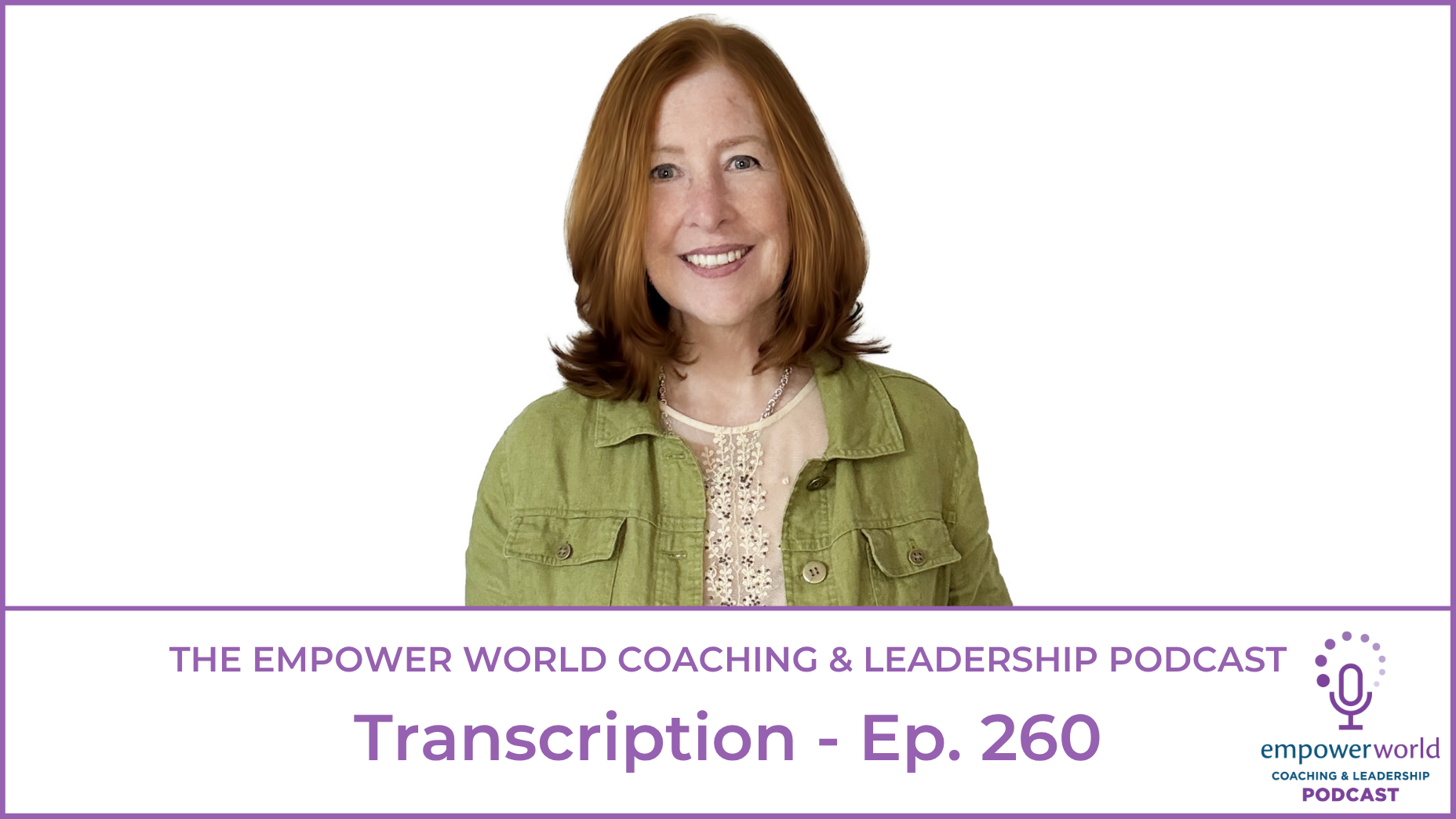
Lyssa deHart
LICSW, MCC, BCC, EMCC, Author, Coaching Educator & Mentor Coach
Jeanine Bailey: Hello and welcome, listeners, to the next episode of the Empower World Coaching and Leadership Podcast. Today, I'm not with Marie Quigley, my wonderful business partner, but I am here with Lyssa deHart, who I am so delighted is here. Lyssa, thank you so much for joining us today.
Lyssa deHart: Thank you so much for having me.
Jeanine Bailey: I really appreciate your yes to come on board the podcast. I was introduced to your work, Lyssa, many years ago, when my colleague at an Australian university college introduced me to your work as she would post resources to the students that we were teaching and mentoring. Quite often, she would refer to your work, your videos that you recorded, to support people to understand the ICF core competencies as expressed through a coaching conversation. That was something that I first learned about you, and really enjoyed watching and learning from those videos as well. Then I was introduced to you again through a mutual coach connection that we have some time ago, about 18 months ago-Tracy Clark, who I met at a training, and she shared with me your book Light Up. She said, "This is a great book, you should read this, Jeanine." So I did, and I loved it so much that I introduced it to the Empower World Book Club, and we read that the other month, so we really enjoyed it. I reached out to you, and you said yes, you would join the book club, but even better, come onto the podcast. I'm really delighted, because I know, Lyssa, you are really creating an impact, you're very widely known through the coaching profession, so I just feel very grateful that you've said yes to joining our podcast today. Thank you for bringing your masterful self here, and I'd love to hand over to you to introduce yourself to the listeners.
Lyssa deHart: Oh, okay, well, thank you. Thank you so much for having me, number one. I'm Lyssa deHart. I've been a coach for-well, I got my original coach training in 2008, so I completed it in 2008. I didn't really become a coach until 2014. I was doing some coaching, but I was much more involved in my therapy practice, where I worked very specifically with complex trauma, dissociative disorders, PTSD, relationship issues-those were sort of my primary focuses in the work that I was doing. I had a move in my life; we moved from one state to another due to my husband's job, and I got an opportunity to sort of reinvent what I was doing, and I was like, well, I think I'll check out this coaching thing, and so that was sort of a transition for me into the world of coaching. I've been in this field since the late 80s, which makes me feel really old as I say that. I do have a lot of experience working with a lot of different types of people, and often under really difficult circumstances. I bring that to the way that I think about and conceptualize the work that I do. So that's a little bit about me, I guess.
Jeanine Bailey: Yes, thank you very much for sharing. I really appreciate the work that you do, and the way that you bring in the neuroscience behind what we do as coaches, and the coaching conversation, particularly with metaphors. The book that I read and the book club read, which was called Light Up, right behind you, really about understanding the science behind metaphors. What drew you into that work, Lyssa?
Lyssa deHart: You know, it's really interesting. I did say I was a therapist for years, and I worked with people, and I know they were using metaphorical language, but I'll be honest with you, I did not hear it at that time. I think it was really focused on an outcome; I was really focused on the movement from non-functional to functional, which is often the case in therapy-moving from things are really not working at all to how am I at least functional. Then I did the transition into coaching in 2014, and I really started that move from functional to thriving, or really doing what it is that you really want to do. It's a different focus, so I think there was a bit of the different focus that was going on in my work.
One of the things that is, I think, extraordinary about people who are professional coaches-I wouldn't say everybody, but people in the professional coaching realm who I think are doing the best work are often doing critical analysis of their own work. You certainly are doing that as you're moving from ACC to PCC, and then again from PCC to MCC. I'm a person who's continued to do it even from MCC on. If you are a credentialed coach, I think it's one of the practices that very few other professions do-other than sports, frankly. That's the only other time I really see people looking at the playback of what just happened, and looking at what their choices were, what they did, thinking of different ways to handle that sort of situation. So we're in sort of a biofeedback loop as coaches if we're practicing our developmental opportunity.
As a result of that, I started really looking at my work as a coach in a way that I had not done it as a therapist, because I was occasionally observed as a therapist, but not as often as I am as a coach. I wasn't recording all of my sessions-these are people coming in with depression, or PTSD, or complex trauma, dissociative disorders. You're not going to record those conversations, which in some ways is unfortunate, because you miss that opportunity to see what you're not hearing. It was only through this reflective practice that really started happening a lot more in my work, especially as a PCC. I was teaching in a coaching school, so of course I was seeing myself coaching people in class, and Zoom was coming online, so we were getting recordings of ourself a lot more. Then moving towards MCC, and then as an MCC, again a lot more recordings. I started really looking at my work in that kind of thoughtful, analytical way, and I started really highlighting the things that the thinker-or the client, as many people would call them, but I really use the language of "thinker"-the thinker was offering me, and starting to tune my ears to what was actually being said, so that I could actually hear them better.
It was in a class that I was teaching that somebody… I did a quick 15-minute coaching demonstration for the class, and it just sort of the perfect storm for me, where I had been really paying a lot of attention to my work, and I was doing a lot of transcript analysis, and then I was in this class, and I was with the right person in that moment, and what they brought was a really full plate. They were talking about, "My plate has just been so full, I've been really mindful of saying yes to things, and for a long time I was waiting for something to be on my plate, and nothing was there, and now all of a sudden I have so much on my plate, I don't know what to do with it all." Just this modeling of this really full plate was like-it sent light bulbs flashing in my head all of a sudden. I got super giddy. It's not my best recording, because I get so excited. I'm like, "Oh my god, I heard the plate!" I wasn't maybe that excited, but I was inside-I was giddy, because I made this connection in that moment.
Our entire 15-minute conversation was around the conceptual idea of the overfull plate being overwhelmed, because she basically said that. So we began this exploration: what would be useful to do with this plate in our 15 minutes together? She's like, "Well, maybe by the end I'd be able to take one thing off my plate." I'm like, excellent. Well, what needs to be explored in order to see what's of service to your plate? She knew exactly what it was-she had a business relationship that was not going as well as she had wished. We ended up having a really thoughtful conversation, and by the end of the conversation, I asked, "Where are you now with this plate?" By the end of this conversation-15 minutes again-she's like, "I'm gonna scrape the whole entire plate clean. I'm gonna start over. I need a divided dish." So she was able to really talk about boundaries, choices, values around how she was making a commitment to a business relationship as though it was a relationship for life because she said yes once, and that there was no re-evaluation of the contracting that she was doing with people. It shifted her life, in her mind, and it was because of how the metaphor allowed her to explore this really sensitive issue around how she was saying yes to things, no to things, the ability to say no to things, her own mental scripts around integrity, and her values around integrity, as well as boundaries, and how do you set healthier boundaries for yourself and others-all in 15 minutes. I was like, okay, not only have I been noticing these things, but now I can really start to see the landscape and the mapping that's happening through the context of this metaphorical language. I think that was sort of the-well, that was the big moment that blew my brain open, basically, speaking of metaphors.
Jeanine Bailey: I'm curious about what that blowing up the brain means for you.
Lyssa deHart: Well, it really means exactly what I said-that experience of your mind just got blown by something magical in that particular case.
Jeanine Bailey: Thank you for sharing that powerful story and the magic of the metaphor for that client in that moment. As you say, as you blew up your mind with that giddiness and that idea of working with metaphors, what came next for you, Lyssa, to really incorporate that practice into the way you coach?
Lyssa deHart: This was at about 2018, and I love to research things. I just love to research things, so I'm like, well, I'm not that special, so if I'm noticing this, I cannot be the first person to ever wonder about this. It really took me down a rabbit hole around metaphors. I started studying where the science was on metaphors, number one, because I love neuroscience-I think that's probably because of my therapeutic background and working with people's minds. I also was just really fascinated and curious about them in and of themselves. Between the two curiosities, I did a pretty deep dive on the science of metaphors, which really brings out the neuroscience. They don't exist in a vacuum. People may not use metaphors consciously. Like, when I say, "My mind got blown," I'm not thinking, "Oh, I need to explain this to you metaphorically," I'm just using language. I know exactly what that means to me when I say something like that, and you probably don't even need to ask me what it means based on the context of how I'm actually saying it. It becomes a shared conceptual language-it's an idea container for an experience.
When you think about this, these experiences, now you've got a whole somatic, emotional, mental, physiological experience that's going on with this idea of "my mind just got blown." My hands are even moving as I do it, because there's the metaphorical hand movements that go along with that. We have emojis for it, because it is a metaphor that you just need a smiley face with its brain blowing off the top of it, and everybody knows what that means. We don't need to have "please explain what that means to me," honestly, because it's a shared experiential moment, because you've had those moments in your life as well as I have. It becomes a way that we're listening and resonating with another human being in a way that we can't if I just say, "I was having this moment, and it was just really exciting, and I felt a lot of this sort of thrill run through me as I was having this clarity that there was a connection here between this idea and these words and this moment." Maybe you get what I'm talking about if I lay it all out like that, but not in the simple, clean way of "it just blew my mind." Metaphors resonate between two people if you allow them to. They become a shared moment, a shared experience in that moment.
How this works in the brain is this: we as early humans on this planet were in small hunter-gatherer societies, moving around-whether it was in plains, or in mountains, or in tundras, it really didn't matter. We were just climbing all over the planet and exploring different places. Along the way with this exploring, we were also being attacked by wolves, bears, tigers, lions-we tasted like chicken to a lot of things, so we had to be constantly on guard as we moved through our environment, checking for the tiger in the tall grass, so to speak. We were also seeking food all the time, whether through hunting or gathering of roots and berries and leaves, and we were forming relationships, and we were starting to tell stories about meaning-making in our world. We were moving through these environments-we're looking at things, finding food, moving through environments. I think we could agree that we are the most proficient tool users on this planet. We were developing tools, and so we were manipulating objects, whether it's rocks, flint, arrows, whatever-we're starting to create the use of tools to make jobs easier.
When you look at the structures in the brain and how the brain developed and evolved through time, we have structures that are designed for vision, structures designed for texture, structures designed to pick up on things like noticing food, how we move through the world-our whole motor skills are all in our brain. Also, just the way that we manipulate objects and puzzle things out is part of how our brain is structured. It makes perfect sense, then, that when you look at the four primary conceptual metaphors that Lakoff and Johnson really started exploring, it was thinking is moving, thinking is seeing, thinking is eating, and thinking is object manipulation. These structures in our brains light up when we have conversation. Even the idea of "that blew my mind" is a movement in time and space of an experience that I'm having in that moment. They relate very well. What this does is it tells somebody-when somebody's using metaphorical language-you can sort of track what's turning on in their brain. This is lighting their brain up in some way. It isn't important for a coach or for a therapist to listen to that language and be like, "I know exactly where it's lighting the brain up, and I know now where they need to go," because we don't. It's going to be different for each person, but we know that something's lighting their brain up. They've done a lot of research, looking at EEGs and fMRIs, and for instance, one of the studies that I write about in my book is if you say to somebody, "I'm having a hard day," or "I'm having a rough day"-"hard day," they know what that means, but "rough day" really lights up the textural receptors in the brain. Those light up in a very different way versus "bad day," which is sort of a more theoretical word versus "rough," which is a texture. "Hard" is sort of a texture also, so those words are going to light up those structures in the brain that have to do with how we feel things. So we know then that it's lit up their brain.
When we have in coaching or in therapy a starting point, "I feel stuck"-that is a very powerful metaphor people use all the time, and most people ignore it because they're like, okay, that's just whatever. "What are you stuck about?" And we get into the details of it versus just noticing the stuck. "What would you want to have be different?" And the person says, "I'd like to be able to dance." Excellent. So is that what we're doing-is this movement from stuck to dancing? That's what I want to do-I want to move from stuck to dancing. Excellent. We then start to construct these two metaphors that both have to do with movement. Now, somebody may use a different metaphor. They may say, "I'm feeling stuck," and what we explore may be a little bit more like, "What are some indicators of where you'd like to be?" Instead, they may say something like "peace." Now, it's not a movement piece; it's a state of being. It becomes a metaphor of a way of being, and what we're doing then is looking at this movement from stuck towards peace. That may be acceptance of the stuckness-maybe there's nothing I can do about this thing over here, so I want to have a different experience with it. These become really important metaphorical containers for the movement that a person wants to make. They're both metaphors, which I think most people miss, because we're thinking they're just words. They are words, but they are words that have an embodied experience attached to them in that moment for that conversation.
Jeanine Bailey: Fantastic explanation. Thank you for sharing that. What I'm hearing is that, as coaches, we need to be listening out for those words that potentially are metaphors in relation to their embodiment of a feeling, of a place they're in. I also heard potentially it could be around a way of being-peace. What would you say to coaches in terms of listening out for those metaphors that perhaps they might often miss?
Lyssa deHart: Transcript analysis. Start recording your work, getting transcripts, and start highlighting everything that the thinker offered you, because they're in there. I have occasionally-very occasionally, maybe 1-2% of transcripts-seen no metaphorical language, or very little, or it's so abstract that you don't notice it. But most conversations have metaphorical language, because it's just how people speak.
Jeanine Bailey: Highly recommend your book Light Up, because there are so many examples you provide of the sort of words, the phrases to listen out for that potentially get missed because perhaps they're just a couple of words, or so common. Like, how many times do people say, "I feel stuck," and people go, okay, and then they're like, "So what do you still-what do you want to do today? What would be important for today?" And we ignore that stuck state, that recognition of the stuckness as the metaphor of a state of being. Instead, we're like, "So what would you like to be different?" which is not a bad question, it's a great question. I think the bigger problem is "What makes you feel stuck?"-that's probably way more problematic. But we might say, more consciously, "I'm really hearing the stuckness-what would you prefer instead?" which then, we don't get such a big open answer of what the person actually wants, because they're not hearing "stuck" as a metaphor-only the listener is hearing it as a metaphor.
Jeanine Bailey: Getting curious about the current feeling can potentially lead into a whole lot of negative detail-like, "Stuck, it feels like I'm just in mud." They'll give you more metaphors often, but we're now directing them completely towards that negative state experience that they're having, and they already know what that feels like, so that's not the direction of coaching, or therapy, really.
Lyssa deHart: We are here to support our reflective partners in terms of what they want to experience and how to bridge that gap between stuck, for example, and what?
Jeanine Bailey: Yes. I really appreciated how you shared about how the brain lights up when it's starting to reflect on those textural words, or the visual words. There's way more than just four conceptual metaphors. I talk about Kvox's work in my book, and I've come up with my own sort of conceptual metaphors that I've seen also. Don't feel limited to the four conceptual metaphors-there are many more than that. But those are the four that have been most studied.
Jeanine Bailey: For coaches listening to this, a tip for them to explore those words, because you talked about the lighting up-what would we notice, perhaps, when speaking to a client that something is being lit up in the brain?
Lyssa deHart: Well, the brain lights up and we don't see it happen. It isn't always a magical moment, but I think it's really listening for those powerful words, those unique terms of phrase. I just had somebody say that, you know, one of the things that as they're thinking about decision making, they're like, "I do a lot of rowing, and I feel grounded in the water sometimes, which is weird to say because I'm in the water." And I'm like, "What does grounded in the water mean in terms of this decision making?" because they've brought it up in relationship to decision making. "Grounded in water" is abstract-I don't know what that means exactly to this person, and I don't need to ask specifically, "Tell me about grounded in water, what does that mean?" but "What does it mean in relationship to your decision making?" When the person has used language like that in context to a larger topic they're talking about, there is some connection in their brain, or those words would not have come out together. We want to be really deeply listening to these things so that we can hear. This really speaks into our presence, our capacity to be really listening deeply to the thinker when they're speaking, to not be jumping ahead to what is the next right question I'm supposed to ask, and really what is emerging in this moment in this conversation that might be useful to support more inquiry, and possibly give them a framework of looking into their own way of thinking about something that is different than they would do all by themselves. When I asked, "What does it mean being grounded in water-how does that connect for you between that and decision making?" she's like, "That's a really interesting question," and she had to sit with it for a bit and think that through. And then, magically, people make meaning-she makes meaning, and that's just the brain working at that point.
Jeanine Bailey: When I'm working with clients, I am also tuning into my own reactions. If I'm noticing a response within me when my client is speaking, then I'm trusting being present with my client. I'm trusting that I'm getting perhaps some unconscious or perhaps conscious signals from the client that something's happening here. Paying attention to physiology, paying attention to perhaps the energy that might be between us, that might give me a clue that there's something here, there is a metaphor here to be explored, or not. As you say, being really present with the partner that we're working with can help us really identify those moments when the brain is being, perhaps, lit up.
Lyssa deHart: It's not that metaphors are the only ways our brain gets lit up-something's happening. So it doesn't have to just be some sort of flowery metaphorical language that does it. Like, "I need to lean into feedback, but I find myself leaning back"-that's a beautiful metaphor of this experience of moving towards or away from something. A lot of people might not even hear that as the metaphorical powerhouse that it actually probably is. But people are also doing all kinds of stuff while they're talking, right? So you might be like, "I'm noticing a lot of this as you're talking-I'm curious, what does that tell you?" We trust ourselves to notice things, and then be curious, without assuming that we're right about the meaning.
Jeanine Bailey: There are many roads that lead to Rome, so we might not pick up those key physical cues, or maybe even the emotions, but there are so many ways that our client, our reflective partner, will send their communication across to us as coaches. Presence is the key.
Lyssa deHart: Yes, presence is the key.
Jeanine Bailey: As we start to wrap up, I wanted to check in with you. What else might be important to share with the listeners about this work, working with metaphors, and how it can have this incredible impact that's going on within ourselves when we use our language?
Lyssa deHart: You know, I think that to be heard is so important to our human experience. Most people go through life not feeling heard, I would think-at least that's been my experience with people, with myself. I think all of us have these places in our lives where we do feel heard, but then we have a vast majority where conversations are either superficial, people are bouncing from thing to thing, so you start to share something and you get kind of rolled over and the conversation moves on. I think we just spend a lot of time not feeling really connected or heard by other people. It becomes really important as a coach or anybody working in the helping professions to truly hear this person who's come to us, who may not be feeling heard. If we can truly hear them-and that takes our presence, it takes listening on the multiple different levels that you're talking about-energy, words, body language, nonverbal, all the nonverbals, and also the verbals: powerful beliefs that get communicated, stories people tell themselves, values that they're communicating, but these powerful beliefs that they feel about themselves and about the world. We need to be listening to those things, and we need to be honoring that. I find metaphors and listening deeply for metaphors-even if I don't hear a metaphor, I'm listening in a different way as a result of it. I'm going to hear something. One of the things I consistently hear from people who I've coached is that they felt really heard.
Jeanine Bailey: It's such an important message, isn't it, Lyssa? I just noticed through my day-to-day interactions in my non-coaching work how, as you say, people aren't really listened to deeply, which means missing a lot of the unconscious, important language, stories, beliefs. To really honour the person or the people that we're with, that deep listening is something that we can all do that can make a difference in somebody's life. I really appreciate you sharing that invitation to continue listening deeply to another.
Thank you, Lyssa. Thank you so much for sharing your wisdom. I really appreciate it. Again, thank you for the four books that you've written-I will include them in your bio so that people can continue to learn from the wisdom and the experience that you've had. Particularly for me, really enjoying the neuroscience behind everything that you've been sharing. Thank you, Lyssa.
Lyssa deHart: Thank you so much for having me on your podcast.
Jeanine Bailey: A great pleasure. Listeners, you can find out more about Lyssa through the bio, and we trust that you'll connect with her. We know that she's making a wonderful impact in the world. Thank you, Lyssa.


