
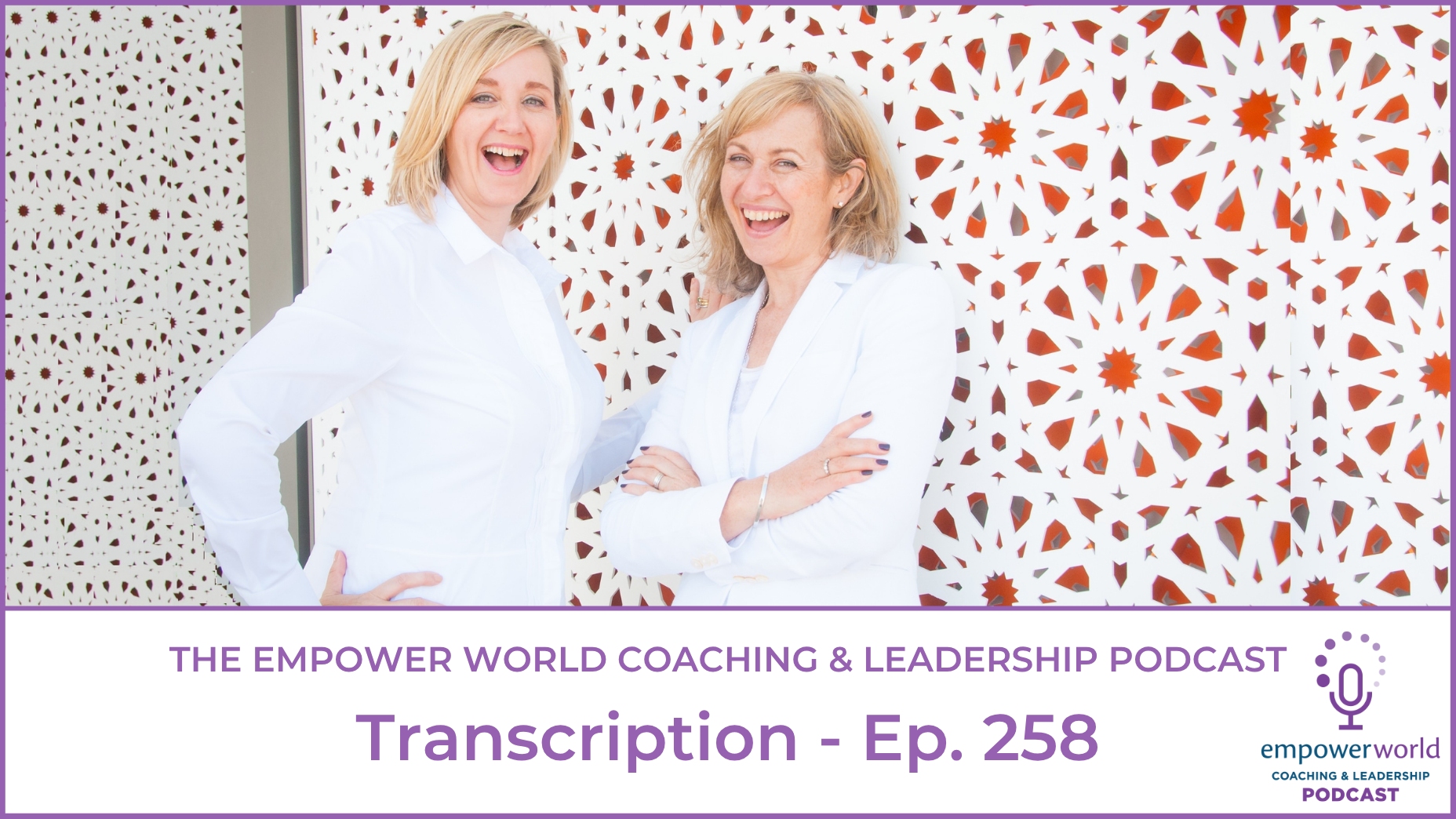
Jeanine Bailey & Marie Quigley
Co-Founders of Empower World
Jeanine Bailey: Hello, and welcome, listeners, to the next episode of the Empower World Coaching and Leadership Podcast. Again, I'm here with the wonderful, amazing Marie Quigley. Again, we are in the same time zone, same country, so I'm delighted that we are here and able to record together. I'm going to hand over to you, Marie, to introduce what we're going to focus on today, but welcome. Thank you for being here.
Marie Quigley: Thank you, Jeanine. Great to be with you, and our listeners, as always. We got together as we normally do for a little pre-conversation, and we have been thinking about the term "naturally creative, resourceful, and whole." Sometimes you'll see it in books as NCRW. So, we're going to explore what that means, what the impact this has for our coaching, for the people that we're working with, for our beliefs as a coach. It's a really fascinating way of entering a conversation, entering a partnership with a belief that somebody has all of their answers within themselves-anything they're asking that is of a self-nature, not how to do something. We all need to learn how to do things. We're not saying that everybody has the answer to every question in the world, but we are saying that the deep questions we're asking ourselves, we have the answers within. And that has a really great philosophy for coming into a coaching partnership.
Jeanine Bailey: It certainly has, Marie. It's one that I believe perhaps all coaches hear about at the beginning of their journey, and it probably sounds great, but perhaps don't embody it. I can say that I was one of those coaches who absolutely heard that guiding principle for coaching, and as a new-ish coach, I really didn't take it on board fully, completely, 100%. So what it meant was that, potentially for me, I was believing that I needed to be able to support the coaches, yes, to find their own way, but if they couldn't find their own way, there would be this desire to come in and potentially rescue.
One of the things that I experienced quite a number of years ago was in front of the room, training, and doing a coaching demonstration. The person that had volunteered was experiencing quite a bit of trauma, and so what came up was something that was deep, was difficult, and this particular person was struggling with what was coming up for her. And not that it was a question that led to the "go find that," but through her processing, it was bringing up some things for her. In that moment, I felt, "What am I to do?" But it was in that moment that I heard essentially: our clients are naturally creative, resourceful, and whole. So hold the space. Believe that your clients are naturally creative, resourceful, and whole. And let them do the work.
It was an amazing experience, because the space that was in the room was incredible. It felt like it was a very long, spacious moment, but she was able to really tap in deeply into her own resourcefulness and find her way. It was such a liberating moment for her, but also for me. It really just shone the light on that principle. As we unpacked that experience, I recall that particular student saying, "I just felt held, and I felt safe. And even though it was hard, I could feel your support just through your presence. And so I felt I could find what I needed." That really reinforced that principle for me. It stops me from thinking I've got to somehow intervene. It really allows the people that we're working with to find their truth.
Marie Quigley: That's a beautiful example that you've just given, Jeanine, and look what it gave you as a coach, and look what it gave the person you were working with-the power to work it out themselves and stay with something, perhaps, that they hadn't looked at before. I think this is what stops some coaches from staying in the role of a coach when they believe that this person can't handle it, this person-I'm not sure about this, they might cry, or it might be too revealing, they might say something they don't want to say. You might not have contracted for staying in brave places, so you don't stay there.
As you were talking, it brings to mind somebody I was mentoring and listening into the mentoring recording. The client was desperate to explore their emotions about their home country, and what their home country was experiencing, and their home country was in war. The coach said, "Oh no, no, we can't talk about that, we can't talk about that." And because of their own fear of talking about it, they stopped believing that the client could handle it. As we unpacked the session, the coach said, "I didn't want the client to get upset. I didn't want them to be crying about it. I didn't think they could handle it, and I thought it was better if we didn't talk about it." That is absolutely the antithesis of what you've just shared. This is believing that the client is not capable of handling whatever they're given, is not capable of handling their emotions, is not capable of naming their emotions, and the coach is terrified that tears mean that the client is in distress, not just processing the emotions that are coming up.
Jeanine Bailey: Yes, that's a powerful way to share the power of that principle. What I was hearing, Marie, as well through what you were sharing, was that the emotions-the client in this particular case recognized that their emotions were their guide, their guiding posts. We always say that emotions are our compass. They let us know whether we're on track or off track. There's no such thing as a good or bad emotion. There's just emotions that let us know if we're living according to our values, or if we're dismissing our values. It sounds like the client was wise to that, and wanted to do that exploration in service of themselves. That's a beautiful demonstration of how coaches can potentially collude, get caught up in stories, perhaps not do their own work in terms of their own emotional landscape, again in service of themselves and the people that they serve.
Marie Quigley: Indeed. That's not to say that coaching is the right methodology for some people. Some people are experiencing trauma in a way that cannot allow them to process, or move forward, or be with whatever is happening for them, with a coach. That is our job, ethically, to pay attention to that, and if needed, to refer to a therapist, or a psychotherapist, or some other helping professional that will support them. But that happens through dialogue and working out with the client what is right for them. So you may think, "Oh, this is too-this isn't right for coaching." And the client may think, "This is perfect for coaching, because I'm able to be with it, and I'm really ready to explore it in a way that is empowering for me and allows me to move on to the next stage." So, there's also a question when we're assessing whether coaching is right for somebody, or therapy, or some other helping professional is right. The client may also know that as well.
I remember meeting somebody in Qatar in a hotel for just a chat and potential coaching opportunity, and when I shared that actually I think therapy would be better for them, they said, "Oh, thank goodness for that. I knew that. I knew that that was the best way for me." So, it's interesting how the client, even in that state, still knows the best answer for them. Sometimes they just need somebody to be able to mirror it back to them.
Jeanine Bailey: It's a really good point that you've made, Marie. It is in discussion, so it's part of the contracting at the beginning to work with the partner to identify when emotions come up, is getting that permission to explore the emotions, sharing why you might explore emotions for the reasons that we shared earlier, and your client is able to say yes, no, or maybe, depending on the situation. So, you contract for that at the beginning. When emotions come up in the session, again, you can seek permission to explore, and the client is at choice as to whether they will go there or not. It's a constant dialogue to work out whether those emotions can be explored or not. The client is in charge of where they go. It's something that happens from moment to moment. I really appreciate you bringing that in, Marie, because otherwise we could step into territory that the client doesn't want to go into if we haven't got permission. But if we're upfront, if we contract, if we share the reasons that we do this, and if we feel that we're not the right coach for them, that we don't have the capability to work with what's coming up, we will refer them. It's an ethical thing to do.
Marie Quigley: I'm also thinking, you know, coaching has evolved from therapy and counselling, and I'm thinking about Carl Rogers, who had the philosophy of unconditional positive regard for his therapeutic clients. That's coming from that naturally creative, resourceful, and whole perspective. Neuro-linguistic programming, that philosophy also has a belief that we have the answers within, and that if we have the right questions and the right reflections, that we can work it out ourselves. There are so many philosophies that this has evolved from to be part of the coaching philosophy. So, go and research it. Have a look at where this evolved from. Have a look at the different approaches to coaching that believe in that philosophy, because there are quite a lot that think about it from that perspective.
Jeanine Bailey: Yes, good advice, Marie. So, as we start to wrap up, checking in, what would you like to share with our audience as we start to wrap up our podcast today?
Marie Quigley: Well, I think it always begins with us, so have a look at yourself, coaches. What is your philosophy about your clients? Bring different clients to mind. You may think one client can handle a situation and another client can't. What's the reasons for that? What are your assessments for that? How are you judging that? How's that impacting your coaching? How's that impacting how you turn up? I think, what's your contracting process around the philosophy of naturally creative, resourceful, and whole? How are you explaining to the client that that is something that you believe in if you do? And how does that show up in the type of questions you ask, or the type of interventions you may use with your clients? Let's have a conversation, a dialogue, to support the client's understanding of it. Because, of course, "naturally creative, resourceful, and whole" means nothing to the client. It just means something to the coach.
Jeanine Bailey: Yes, I don't think I can add much more to that, Marie. That was beautifully summarized. I think really having a dialogue around what that means-that principle that coaching is based on, and how you work as a coach-and sharing that with the person that you're working with, and exploring what does that actually mean? That can lead to further contracting in terms of when this shows up, this is what we'll do, or if this happens, then we'll explore that. So it's setting the expectations, it's creating that safe container to work within, so that the client knows that when perhaps those strong emotions come in, or thoughts, or whatever may come into the session, they know that they're in a safe container that will feel uncomfortable, because that's what stretching coaching conversations are about. It will feel uncomfortable, but it's also a place to explore, and the client is in charge. They are in charge. So tapping into that creativeness, that resourcefulness, and that wholeness, they can make a choice as to where to go with what's coming up in the session.
Marie Quigley: Absolutely. So, thank you for listening, coaches, leaders. We'd love to hear your thoughts about what we're talking about. We'd love to hear your experiences of working with clients in this naturally creative, resourceful, and whole way. If you like what you've heard, we'd love you to share it with people in your community that may benefit from it, and if you want to hear us talk about different aspects of the coaching conversations and partnerships, please let us know, because we're open to the different topics that you want to hear. Thank you for listening.


