
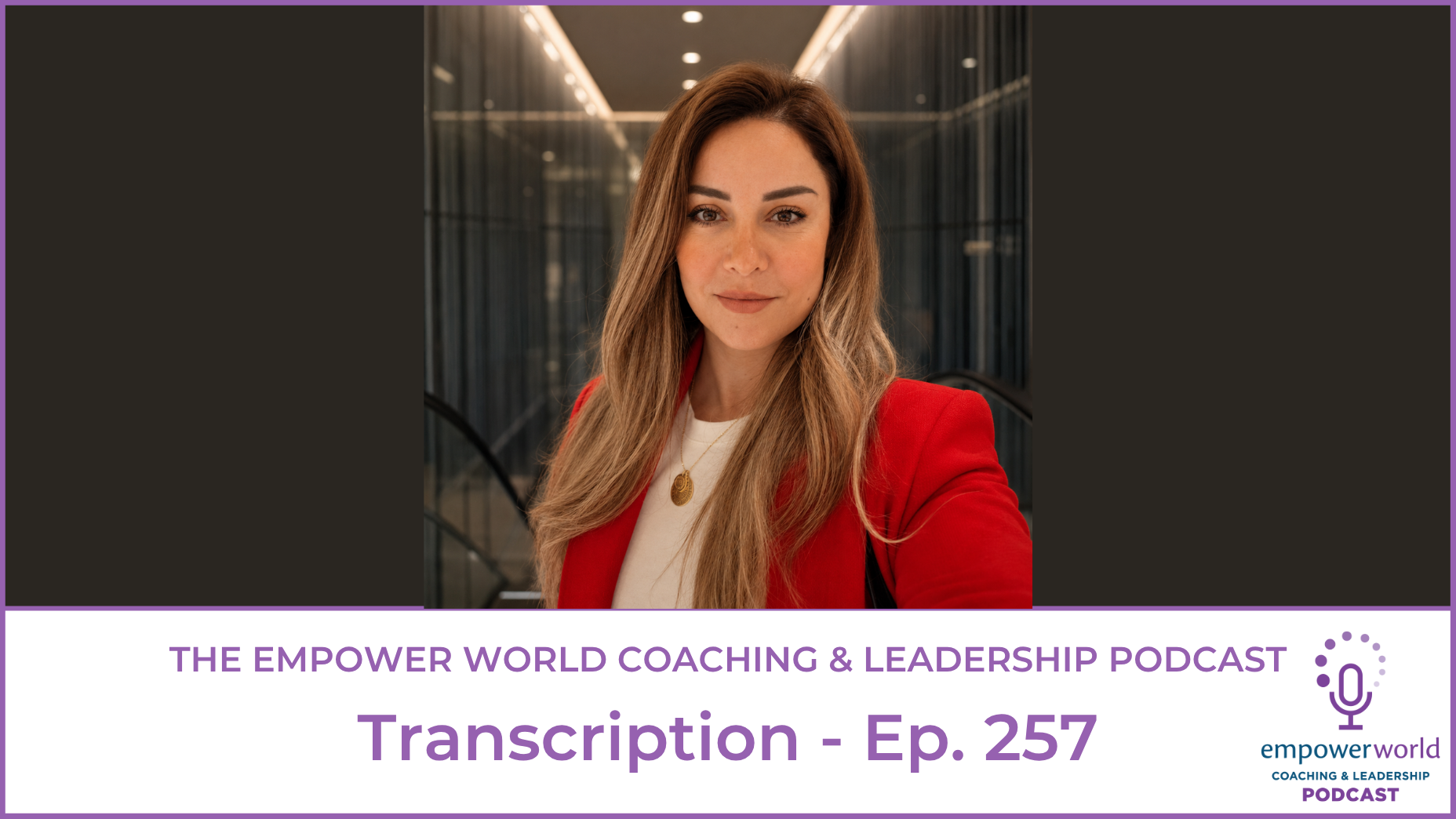
Hind Taychouri
Trauma-trained Somatic Coach, Nervous System Educator, Empowering Leaders to Rewire and Regulate
Marie Quigley: Hello, good morning, good afternoon, good evening, wherever you are in the world. As you know, my name's Marie Quigley, and today's coaching podcast episode is with the amazing Hind Taychouri. Hind, I hope I'm saying your name correctly.
Hind Taychouri: Yeah, it's Taychouri.
Marie Quigley: Taychouri, beautifully. Much more beautifully said than my first version. You're based in Perth, Australia, so thank you for coming to the podcast in your evening time. I appreciate that.
Hind Taychouri: Thank you for having me.
Marie Quigley: You're a trauma-trained somatic coach and a nervous system educator, and you support high performers, leaders, and mission-driven humans to come home to themselves. I love that phrasing around that, to heal from chronic stress, prevent burnout, and thrive from a place that enhances their health and wholeness. You're rooted in somatic experience, polyvagal theory, IFS parts work, yoga, and applied neuroscience. I know you from a number of years now, Hind, and I know how wise you are, and how calm you are to my nervous system when I'm around you. So thank you for being with us today.
Hind Taychouri: Thank you for having me, Marie, and likewise, I also feel calm, and I feel that my heart opens when I'm in your presence. So thank you for having me.
Marie Quigley: Oh, you're welcome. So, we had a little bit of a conversation before we joined together, and we had an idea that might help both of us as we're having a conversation, but also as our listeners before we start this conversation, Hind. So, I'm going to hand it over to you.
Hind Taychouri: Thank you, Marie. So, yeah, I mean, it's always, I get nervous when I want to speak up and speak on podcasts and on camera, so for this reason, I invite us all, you and me, Marie, and the listeners, to just tune inwards, find our center, take a couple of breaths. Maybe if you are seated, just feel your feet on the ground and feel your sitting bones on the chair. If you're driving, please keep your eyes open. Yeah, and just connect to the here and now, to the present moment. Maybe allow your eyes to roam around your space, just looking at objects, colors and shapes, and maybe finding something pleasant, a glimmer. Hmm. Yeah. I already feel more settled, less nervous, and ready for this conversation.
Marie Quigley: Me too. Thank you for that. I think we forget, as professionals, to take care of ourselves some of the time. And we're human, right? When we're sharing thoughts with the world, it can be a little bit nerve-wracking inside our bodies. We respond maybe from a younger version of ourselves. I appreciate because I fluffed up the podcast a couple of times before joining, because of my nerves, and I fluffed up my words, and I notice when I'm in a state of breathing and calm, and noticing, as you helped us go through there, how different it feels to be present with myself and you.
Hind Taychouri: Yeah, absolutely. It's really, really important to check in every once in a while, to get a sense of the ground that is holding us, and the chair that is supporting us, and look around us, away from the screens, away from the thoughts in our heads, and just to take in the beauty around us.
Marie Quigley: Yeah, thank you for that. So, Hind, we've known each other for a few years, and we met in a place that we both called home in Qatar, and now you're in Australia, and it's been wonderful to see your journey evolve. So, take the listeners through how you came into the work you're doing now. Where did it all start?
Hind Taychouri: Well, you'll be surprised, Marie, it all started in my training with Empower World, coach training, and it was a training that was very inspirational for me, and it allowed me to tap into my power. I remember in one of our sessions, we had you get us to draw a drawing, and in the drawing, it was everything related to the body, to movement, to inner peace, inner calm. Also, in one of our mentoring sessions together, maybe in 2021 or 2022, I remember telling you, Marie, I want to be skillful in what I do. I want to be masterful in what I do. And soon after that, I realized, yes, we know the way of how to become masterful. We can practice, we can do more sessions, we can get supervision, mentoring, but I also realized there was a piece that was very important for me, which was the inner mastery. The mastery of my inner world, inner parts, those younger parts that you just talked about, and energy. How do I work with my internal energy to take meaningful and purposeful action in the world? So yeah, this took me to somatic experiencing, which is a trauma healing modality. It's a bottom-up approach, body-based approach, based on the nervous system, and releasing stored survival stress that is stored in our nervous system. And then other modalities, like IFS, polyvagal theory-I'm trained by Deb Dana, Stephen Porges. My work involves educating people about their nervous system, because some of us, just like myself, years ago, I never knew about it. What is my nervous system? What is fight and flight, freeze, fawn? So, after learning all of that, it really made sense to me why I do the things I do, or why I don't do the things I want to do. I educate individuals about that, and from there, they can lead and design their life in a way that respects their unique capacity and nervous system. Also, which is the part that I really, really love about coaching, which is empowering people to expand this capacity, to feel the discomfort, not the distress, but the discomfort. For example, like now, I'm really nervous when I go out there and speak, but I'm doing it. I'm doing the hard thing to expand my nervous system capacity to do more of that. So basically, my work all evolves about bringing people back to the wisdom of their body, and helping them uncover their potential, and how to move forward without overwhelm and burnout, from a place of survival.
Marie Quigley: Thank you for sharing that, Hind. You said a couple of things, and some of our listeners will know what they mean, and some won't. So, you mentioned IFS, so you and I know what that means, but what does that mean?
Hind Taychouri: So, IFS stands for Internal Family Systems, and if I'm going to explain it briefly and simply, it's like we have inner parts of ourselves that are still stuck in places and time of woundings, hurt, and trauma, and did not get the memo, the update, that now we are adults, we are empowered, and they still act from that place. And they do things to protect us from the overwhelm that we once felt in the past, and to manage. Sometimes we sense that they are in the driver's seat, they're leading the way in our lives, they are the ones taking decisions. But when we connect within to these parts and we know them, and we feel what they feel, and we ask them what are they afraid would happen if they stopped doing that and that, then we realize that they only need a corrective experience. They need to be heard, seen, and empowered as well.
Marie Quigley: Yeah, and I'd add loved as well.
Hind Taychouri: Absolutely.
Marie Quigley: Yeah, for those who want to know a little bit more about IFS, have a look at Richard Schwartz's work. He's the developer of IFS, and he's got a wonderful book called No Bad Parts. So we often think and judge ourselves from a place of criticism, but those parts also want something good for us, and if we can love them instead of trying to get rid of them, they tend to calm down, right, Hind?
Hind Taychouri: Absolutely. I mean, I had the wildest journeys with my inner critic. She's wild. But I learned to love, understand, and know where she comes from.
Marie Quigley: Yeah, me too. We've had some big conversations, me and my definitely many more than one critic within me. And then you talked about Stephen Porges' work, and I'd love to hear how you came across that, and what was it that drove you to train with his philosophy?
Hind Taychouri: Well, I reached a stage in my life where I was completely burnt out. And I got a diagnosis from the psychiatrist that I have anxiety. He specifically said-because I was crying when I heard that, I thought, oh my god, it's a diagnosis, I have anxiety, then my life is ruined, I'm done, that's it. So I was crying, and he told me, well, it's alright. You're not the only woman. You can take pills for the rest of your life, just like any other woman. I can sense, Marie, what you're sensing in your body right now. I can see…
Marie Quigley: I'm managing myself here, Hind.
Hind Taychouri: Right? I felt that, and I was like, no, I'm not gonna accept that. That's not okay, that's not right. I'm a young person, I'm overwhelmed, I'm burned out. I passed through a very difficult phase in my life, and I'm not gonna accept this as my solution. And you know, Marie, I believe I was divinely guided on the internet, because I'm a seeker, I'm always asking questions, I look for things, and from one person to another, one video to another, I arrived to polyvagal theory, nervous system regulation, and somebody on the internet was talking that anxiety is not what you think it is, but it is trapped emotions and trapped energy in the body, and I'm like, okay, this is what I need to do. I need to learn that. And after that, I decided to learn somatic experiencing, which is the work of Dr. Peter Levine. And basically, they complement each other. One of them gives you the understanding of the nervous system, all the different states that our autonomic nervous system gets into, and what's the way out if we get stuck into them, and to love them and unshame them, because they are part of our human experience. And somatic experiencing really taught me how to feel, and be in the body, and skillfully track the sensations and the uncomfortable sensations that we all try to avoid and move away from.
Marie Quigley: That's such a lovely journey, and knowing both of their work, not in the capacity that you do, Hind, I really appreciate the science that they bring behind what's happening to us, because there's many people that can kind of wipe that off the table, thinking it's not important, but actually there's a real science behind what's happening in our body. And so I'm a practitioner, and I'm really fascinated by how people manage things like the part of them that is anxious. You know, I've got clients who will come to me and say, I have anxiety, and I'll say, well, which part of you is anxious? And then they'll realize, oh my goodness, it's not all of me, it's just a part of me. So, when you got that diagnosis, when you saw Porges' work, and you experienced looking at your anxiety, what happened? What happened in the process for you?
Hind Taychouri: Well, at the beginning, it was very difficult for me to understand it, so I really immersed myself in lots of courses, trainings, somatic therapy sessions for me to understand that. But then something beautiful started to happen: when we feel the discomfort in the body, we tend to contain it. We tend to have more capacity to be with it, and then we realize that it doesn't stay the same. It shifts, it changes. And as you said, Marie, it's not all of us, it's a part of us. So, by doing so, by connecting, by feeling the uncomfortable sensations, but slowly-in somatic experiencing, we always say we do that in titration, little by little, drop by drop. So, the key here, the trick in somatic experiencing is not to avoid the discomfort, but also not to be overwhelmed by it. You know, not to jump right ahead into it. So, little by little, I was starting to have more capacity. I would start to feel these anxious waves in my body, but they don't take over me anymore. Ever since I came to Australia and I see surfers on the beach, I always say that to my clients or explorers, as I learned from you a couple of days ago. It's like when you come on the surfing board, you first, it's messy, but then you start to learn how to stabilize your feet on it, and then you're able to ride the wave instead of crashing into it. So this is what started to happen for me-to ride the wave of discomfort until it moved out of my body. And it took a couple of years, but it finally moved out of my body.
Marie Quigley: Amazing experience. Thank you for sharing that process. I know that, in my experience, many people are afraid of looking at the challenging thing that they're experiencing, because they don't want it to get worse. They have a belief, like in the old days, don't talk about it, because if you don't talk about it, it'll go away, it won't get bigger. So don't feel, because if you feel it, then it's going to get worse. But the opposite is true, from what you're saying, and what the researchers are saying. And I think back to Brene Brown's work on shame, and she talks about, if we hide shame, it just gets bigger. But if we shine the light on it, it just has to shrink, because-
Hind Taychouri: Same thing.
Marie Quigley: Yeah, same thing. And so, if you've got a client who is coming and is nervous, a part of them is nervous to look at the nervous part of them, the anxious part of them, how do you support them to get into a state where they can be with that part, and look at it, perhaps as Richard Schwartz would say, with love, or compassion, or connection?
Hind Taychouri: Beautiful. So the first thing is resourcing. Before we jump into the trauma or the uncomfortable part, we resource ourselves, we equip ourselves with capacity to be with. And this resourcing could be something as little as how we just started looking for something pleasant in our environment, a glimmer, and as powerful as sensing the feet on the ground, the sitting bones on the chair, that we are held right here, right now. And the most powerful thing is the presence of the practitioner, and the facial expressions. If you, Marie, are accepting me right now the way I am, and not making a big deal out of my nervousness, but creating space for my nervousness to just be, it will shift. So, these three components, these three elements are very, very important. And then we do that, we tune inwards to the discomfort, but with titration, we don't have to stay there all the time. We just dip our toe, just a little bit, and then we go back to resourcing. So we pendulate. There's also the concept of pendulation. So we move into the unpleasant for a little, and then we go to somewhere pleasant, then we do that again. And this dance between pleasant and unpleasant really creates space in our nervous system for this discharge to happen, to release, and to regain more capacity and balance.
Marie Quigley: Wow, I'm really feeling it as you're talking. I notice my body's moving, notice your body's. And the word titration is new to me, so thank you for sharing that. And I love that kind of going in and out. It reminds me of when animals are in fear, they have the capacity to shake it out of their stuff, out of their body, and we've forgotten how to do that, so it gets trapped within us, but moving in that way is almost like us shaking a little bit, shaking the system so that it can move. I mean, I'm not the expert here, you are, but that's what came to mind.
Hind Taychouri: Absolutely, yeah, Marie, spot on with the example of the mammals in the wild. They don't get traumatized, they don't get PTSD, and this is what Peter Levine observed when he developed somatic experiencing. Because they just allow, after the traumatic experience-the predator coming-they just allow their body to shake off all this excess stress energy from the body and the hormones. But for us, we've learned in our educational system, in our society, culture, that, you know, stay strong, don't show emotion, don't cry, this too shall pass. Yes, this too shall pass, but it's okay to sit with it. It's okay to put a hand on the heart and just say, it's a moment of suffering, and I'm not the only one suffering, and that's okay, and this too shall pass, but if I'm with it, rather than running away from it. And when we do this pendulation, this dance between pleasant and unpleasant, what we see in animals and mammals is a bit exaggerated, but we actually feel that in the body, but in small twitches. A little bit of a shake here. Energy's finally moving from a stuck joint, for example, or heat in the body, or many sensations, tingling, vibrations. All these internal sensations, these are signs that energy is moving now inside the body, and there is a shift. Something is changing.
Marie Quigley: Wow, I love that. And now, where my mind's going, and it might not be the right direction, Hind, but I'm thinking about if we have pain in the body, if we're suffering pain, how does that relate to what you're talking about here?
Hind Taychouri: Yeah, this reminds me of what Peter Levine says, that pain is stuck sensation. Which means that if we just track it, stay with it, like, what does this pain feel like? Is it sharp? Is it radiating? Does it have a color, a shape? What's the temperature of it? And we track it. Is it moving? Is it staying? And then you'll realize that it can move, it can change, it can shift, and sometimes emotions come out-not sometimes, yeah, most of the times, emotions come out because this pain is from a time where we had to brace. And this bracing stayed stuck in us. So when we tune into that, we could find relief and release of that energy inside the body.
Marie Quigley: Yeah, that's so fascinating. I'm thinking, you know, one of my body's indicators when I'm under stress is I get a numbness down my left-hand side, and when I can spend time with it, and sit with it, and kind of get curious with it, it manages itself. But can we ever completely get rid of that, Hind? Is that what you're saying, through the work that you're doing?
Hind Taychouri: Personally, on a personal level, I did get rid of a lot of physical symptoms that I was struggling with because of my stress and anxiety. And one of them is my gut issues, my IBS. And that's on a personal level, but what I know from clients and from colleagues in trainings and from studies and case studies, is that a lot of symptoms can go away, yes, and a lot of problems can be healed. And the key is to really-it's a change, you know, it's not a one-time thing. That's the key. It's to always come back, always listen. And when we come back, when we listen, our body tells us that maybe there's something in our life we are doing that is not okay for us, and then we can take steps and actions to also remove that, which also helps.
Marie Quigley: Yeah, I 100% agree with that. And how challenging it is when we get an indicator, I'm getting an indicator, that something needs to change, but I don't want it to change, because I like the discomfort of this, but my body's saying, come on, Marie, you need to do something differently. And if I don't, then it will stay until it starts screaming at me to do something differently. And for me, when I get it starts around here, and just a tingling helps me realize, oh, something's going on that I need to change, and that helps me catch it a little bit quicker than I would in the past.
Hind Taychouri: 100%. It's like a sign inside of you that tells you, alright, you're over your capacity now. Then you need to slow down a little bit, or back off a little bit, or change, do something different, step away from the screen, go outside, look outside, tune into the present moment, or whatever it is.
Marie Quigley: And so, if a client wanted to work with you, Hind, what's the process look like from meeting you and working with you?
Hind Taychouri: So, the process is first to understand whether they're reaching out to me for coaching or for somatic experiencing. And they can reach out to me on LinkedIn, on Hind Taychouri, my name, or on Instagram, The Embodiment Coach, and also my website, which I plan to change and renew, because I feel like I'm not the same person anymore who's on that website, but yeah, I'm working on that. So also, the website is The Embodiment Coach.
Marie Quigley: Oh, lovely. And as we're wrapping up, thank you for sharing where people can find you, and find out more about working with you. And you do this online as well, right? Because this doesn't have to be in person.
Hind Taychouri: I do this online, and what I love about somatic experiencing, it's just like coaching, it's a conversation. But instead, we spend most of the time of this conversation tracking what's happening inside the body. And sometimes memories can come up, emotions can come up, and all of that, but everything can be worked with online and in a conversation. So it's not like a hands-on modality where the practitioner needs to touch, not like rolfing or trigger point approach or other modalities. And I love sharing with my clients some neurosensory audio exercises for them, recorded with my voice, to help them during the time in between sessions to find their ground, connect to their body, and to harness this skill.
Marie Quigley: Wow. So just a bit similar to coaching-there is work to be done after you have these experiences. It's not just a one-off, it's a process of learning, developing, experiencing. That's what it sounds like to me.
Hind Taychouri: Yeah, it is. Because, you know, this is work on neuroplasticity, and neuroplasticity is not a one-time thing. You need practice, you need repetition, and you need connection, and this is when things start to shift by always not outsourcing your recovery or trauma resolution, but really tuning inwards. And this requires us to learn this language again from scratch, especially if we're not used to and we're very disconnected from our bodies.
Marie Quigley: Absolutely, and if I recall correctly, Hind, you don't just work with coaches, you also work with organizations-real human beings who might not get the language that we're talking here. What's that like?
Hind Taychouri: Well, it was interesting at the beginning, because I was really nervous to mention the word trauma in a workplace. But, I'm loving it, and people are receiving it very well, even management. I've done many workshops here for Bechtel, for Rio Tinto in Australia, and it's all about educating them on their nervous system, and how does each state show up for them in their daily life, on their desks, with their colleagues, in their projects, on sites. And this brings a lot of awareness to them, and what are the daily habits that is worsening what they're passing through rather than making it better. I love the interaction, and I get to do so many somatic practices with them. They recently put it in the journal, in the magazine of Bechtel, where I was with one of the employees pushing hands together, expressing healthy aggression, fight response. And I was like, wow, that's interesting, to be able to do that in an organization, and I'm grateful that they're receiving it very, very well, because after all, human beings are working, and human being means autonomic nervous system means we have states and means we need to express and learn about these states.
Marie Quigley: I love it. You're speaking my language. You're working in industries that absolutely need it, and thank you for bringing the word trauma into everyday life, everyday working situations. I think there are words that used to be taboo in the workplace, like trauma, and like something I talk about, which is love. And I think we've got to be brave in this world and the work we do, to keep naming what other people are craving, what they need, what they desire to look at, and so thank you for naming it, and being brave in your work.
Hind Taychouri: Yeah, thank you, Marie. We shouldn't be afraid of the word trauma, because it's over-coupled with lots of meaning, with lots of shame. But what trauma truly is, is that energy that is trapped in the body. And when we connect to it, there's a way for it to release. Trauma is a fact of life. I don't think I've met any person who hasn't experienced trauma in their life. But it doesn't have to be a life sentence. It doesn't have to lead the way.
Marie Quigley: Yeah, I love that, and thank you for naming that, because some people think trauma is a big, big, big thing that has to happen, but it could be just a tiny moment that has caused a response that your body holds onto. That is also a traumatic experience.
Hind Taychouri: 100%. And also the accumulation of stressors over time can get us into a place where the nervous system can be traumatized. So it's not just one event, it could be an accumulation of many different events throughout our lives.
Marie Quigley: Yeah, and that brings me back to the animals, Hind, because you said animals in the wild can manage that. But there are domestic animals that have been abused again and again and again, and you can see how that is also trapped in their little bodies. It makes me so upset to think about that. We've got a rescue cat, and when we first got him, he-I don't know what kind of a life he had before-but he held trauma, and he's a different animal now. So you've said something important there, I think, this reiteration of the trauma, of something that's happening again and again, that gets even bigger and makes us smaller. My body wants to go smaller when I'm talking about it. And once we're able to kind of be with it, it creates an expansion with others, and if I look at my cat, he's so much more expanded than when we-he's older, he's smaller, but actually he's more expanded in his nature because of loving connection that he's received from my lovely family, particularly my kids.
Hind Taychouri: Yeah, absolutely. You mentioned love and connection, and those are our greatest healers. Whether connecting to others and loving presence of others, or connecting to ourselves and becoming the loving witness to our experience. So, having grace and compassion and love to whatever we're passing through is a powerful healer.
Marie Quigley: Wow. I just want our listeners to maybe play that again, play that back again, listen to what Hind said, put your hand on your chest like we're doing, and receive what Hind's just shared, because for me, that's a real remembering. We must bring love to ourselves, as well as to others. Hind, that sounds like a lovely way to wrap up our conversation. I honestly don't want to let you go, but the time is ticking. If you could leave our listeners with something to think about or reflect on, what would you offer them?
Hind Taychouri: I wrote down this question before we start, Marie, and it's, if I really allow my feeling and sensing self to come online, what does that open for me? So what possibilities do we have if we truly allow ourselves to witness our internal experience instead of moving away from it? And I'd like the listeners to just reflect on that.
Marie Quigley: Thank you. Some beautiful questions there, Hind, and listeners, I really do suggest you listen back to this a couple of times, because I know I will, because I'm sure there is even more learning than we initially realized from Hind's beautiful presence, her wisdom, her knowledge, but also the way she's turned up to this conversation with courage and vulnerability. And I notice how calm I'm feeling at the end of this conversation, and also how curious I am, because I want to know more about this. There's lots I don't know. So I'll be finding more about what you're doing, Hind, so thank you so much for joining us today.
Hind Taychouri: Marie, thank you so much for having me. I really enjoyed this conversation, and it was beautiful how I really started nervous, but I really felt so present and open-hearted, as always, in your presence, so thank you so much.
Marie Quigley: Oh, you're most welcome. Listeners, if you like what you hear, please share this widely with others, not just coaches, that may find this useful. I know I've got people in my life I'll be sharing this with. If you've got any ideas for podcasts that you want us to talk about, or guests that you'd like us to explore, please let us know. And of course, to find out more about what the lovely Hind is doing, please reach out to her in the capacities that she shared earlier. Thank you, Hind. Have a wonderful day.
Hind Taychouri: Thank you, Marie.


