
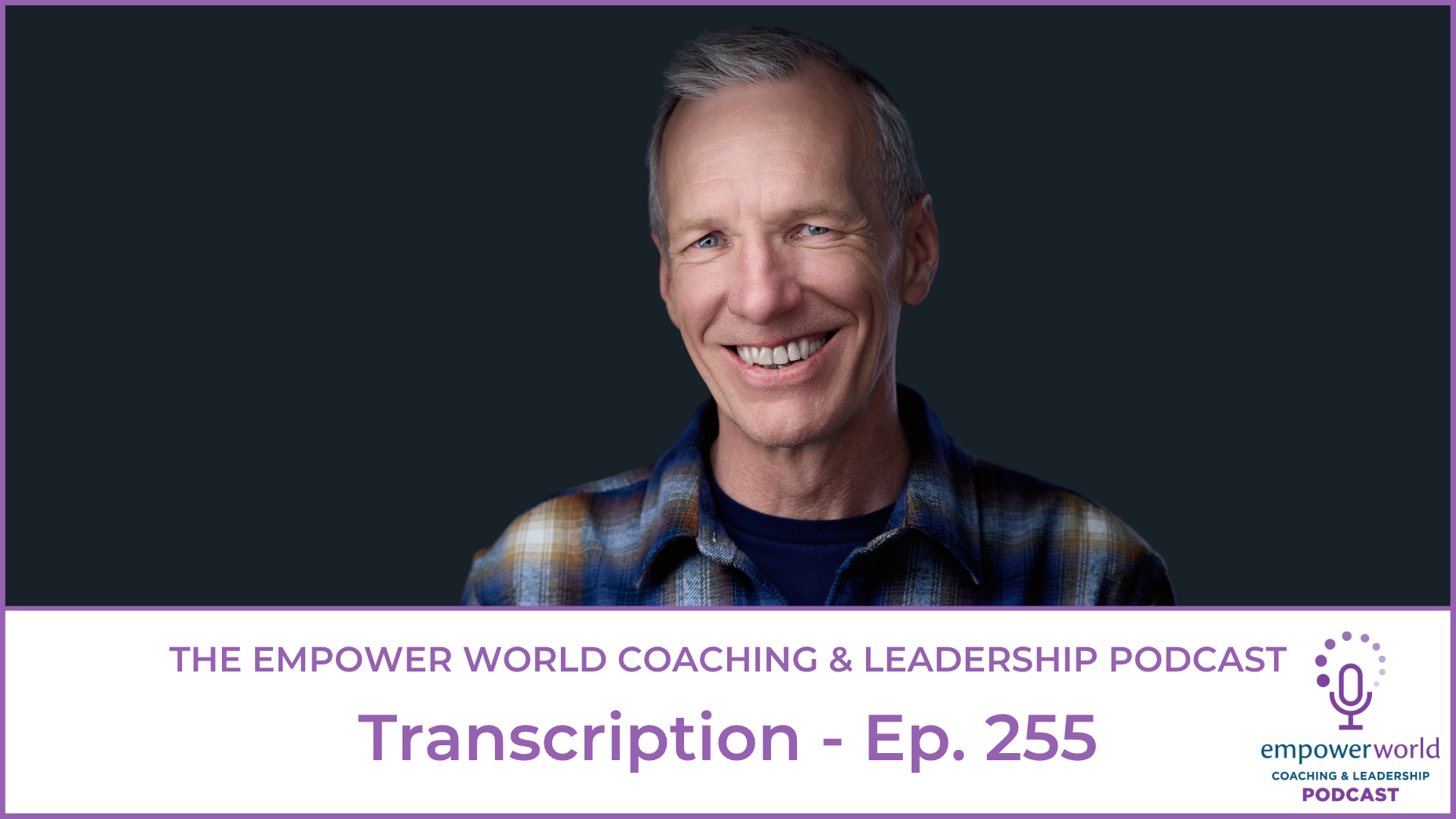
Andy Robbins
Founder of Oyster, Executive Coach, Author, Climber, and Photographer
Marie Quigley: Hello and welcome! My name's Marie Quigley, and today I am with a fascinating man who I'm very lucky to call my friend and colleague. We've done some wonderful things together, and his name is Andy Robbins. Andy is the founder of Oyster, a Portland-based leadership development company. He's an executive coach, an author, a climber, and a photographer based in Portland, Oregon. We're in the same time zone, Andy, which has never happened before, and we recently met up, as I'm based in Seattle. Welcome to the show, Andy.
Andy Robbins: Thank you, Marie, and yes, you're right, it's so nice to be in the same time zone, and you're just a few miles up the road.
Marie Quigley: Yeah, and you very kindly came up to Seattle, and we did some lovely sightseeing and explorations of the surroundings, as well as the city, so thank you for that, Andy.
Andy Robbins: You're welcome. It was a lot of fun.
Marie Quigley: It was indeed. You can hear in the introduction, Andy, that you're many things in the world, and probably many more things than that. I know you're a dad, a husband, a friend-you've got lots going on in your life. We decided that it would be perhaps interesting to come together to talk about something that's really close to your heart at the moment, and that's photography, and maybe linking it to the process of coaching. I'm going to stop talking, Andy, and hand it over to you, and let you kick off. What would you like to say about that?
Andy Robbins: Yeah, thank you. To coaches listening, it may be curious or odd why there's a photographer on Marie's podcast. In some respects, I could say maybe not a photographer, maybe coaching blended with photography has really become presence design and presence creation. As a coach when I'm working with leaders, what I'm looking to do is to help them show up in the way that they want to be seen that's going to allow them to fulfill the things that are important to them and the people around them. As a leader, if it's a difficult situation, showing up with calm and poise and confidence. And as a photographer, you can look at that as the role of creating an image, a picture. I think a lot of photographers are looking to create a nice image, something that looks nice, but there's such a greater opportunity here to create an image which really reinforces how a leader comes over and how they want others to see them.
Oftentimes, our images are the first thing that people see about us, whether that's on LinkedIn, or on a resume, or going to a conference. Whether we believe it or not, that creates an image of how we believe that person's going to be. What I've realized here, blending my coaching background around creating presence with my headshot photography passion, really allows me to get a little bit more intentional and perhaps granular here in terms of what sort of people am I working with, how do they want to show up, what's important to them, how would they want others to see them? It might be an executive who is in transition; maybe they've been let go from a senior role, and they're looking to show up with gravitas, calm, authority. Maybe there's a technical expert, and they don't necessarily need to show up with gravitas; they may want to show up with technical excellence, precision, reliability. If you're a speaker, both of those descriptions are maybe not so relevant; maybe it's more about charm and curiosity: who is this person, and how are they going to show up in the next half an hour with me? So it's been fascinating.
One of the really interesting things here is when I work with a new client and I ask them how they want to show up, oftentimes at first I get a little quizzical look, like, "I'm not sure, what do you mean?" Once we get talking about it, they say, "Oh yeah, I'd like to be like this and like that." Then when people see their images at the end, something really profound happens-and this was a real surprise to me-they walk out maybe an inch or two taller. What I mean by that is they walk out with a new sense of confidence, a new sense of "this is who I am, this is the presence that I'm bringing." I've worked with a lot of people who are in between jobs; they've walked in having been looking for a job or interviewing for 6 to 12 months, they're a little bit down, and they're walking out with a different sense of energy, possibility: "Alright, I can now go show up, be my best self, and go get something." That has been really, really rewarding and beautifully surprising.
Marie Quigley: It sounds like a profound experience, not just for the person having the headshot taken, but also the deeper connection that you're able to make with people to support them to unlock their presence. It is an interesting question: how do you want to be, or who do you want to be? How do you want to show up in this world? I've been writing a lot about presence recently, Andy, and I'm struck by the process of creating a person's presence in an image. Often we can feel it in ourselves, can't we? We can feel when we're fully present, our body is responding. But how do you capture that in a single moment, through eyes, through face, through energy? What's your process of supporting people to determine their presence?
Andy Robbins: Yeah, well, it's interesting. As you were alluding to, we know it when we see it, but we can't describe it. If you look at a lot of people's headshots, you get a pretty good idea when it's a fake smile versus an expression which is genuine. As I've been going deeper on the photography, posing, expression side of this work, there has been a lot of research which talks about the characteristics of a smile. There's something called the Duchenne reaction: there are certain muscles in our face that we tense up when we try to smile-our head tends to go backwards, and we get little creases in our cheeks, and things happen around the eyes. One of the things that has been amazing for me with coaching is recognizing that unconscious side of us that is deep and sees these things, but we aren't aware. We already know what a genuine expression looks like.
One of the things I came across as a coach, which was fascinating, is the "reading the mind in the eyes" test. I don't know if you've heard of this-there's a test where you see lots and lots of people's just their eyes, and they are representing different emotions. It's a really great little test, and I was amazed: "Oh yeah, that's anxiety. Oh, that's joy. That's curiosity." All you're seeing is their eyes. Once you start to understand this, then you go, "Well, why on earth would I want a headshot out there that I'm just trusting to luck? I don't want to be intentional about it. What do I want it to portray?" It's such an opportunity that we lose.
So to your question, how do I do it? I've created five profiles for now, which may change. Each of these profiles, I've really thought about what we look for in a particular role or a person in that role, then translating that into what the image should display. For example, if I look at a technical expert, image signals should be intelligence, precision, competence, reliability, composure, approachability. What we're looking for here is not a nice wide smile that says "I'm a lovely person to be around and I'm fun." We're looking for composure, reliability, competence-a controlled expression, not overtly showing one emotion or another, not stern, but just composed, confident, comfortable with who I am. It needs to have direct eye contact. When we see someone's eyes on a photograph and they're looking right at you, that signals so much. In real life, when someone's in front of us, I don't think, "I'm going to look right in their eyes," but that's exactly what a great image does. For a technical expert who's all about precision, knowledge, and being right, no flinching on the eyes-give me those eyes right at me, and maybe with just a little squinch, so that it gives that air of authority.
What I'm describing here is the coaching process when someone is in front of me. We start off getting warmed up, taking some images, but then we start to narrow in and really focus: "Give me that tiny, tiny smile. Too much. Let me look at those eyes, just give me a tiny little squinch." We'll work from there, then work on angles and posture and how the head needs to be. It's remarkable when we take a little break-I take several breaks through the process, and I shoot straight into my laptop-I say, "Come on over, let's have a look at these pictures," and people are amazed at the micro, micro differences which portray very, very different perceptions and expressions. We're talking absolute micro differences: a head up or a head down, a slight tilt, the mouth whether it's a little bit too smiley or about right. That's really what we're aiming for. I recognize that folks can't just get in front of me and go, "Okay, I'm going to be just like that." It's a little bit of a moving target. It's a bit like coaching: I trust the process that at the right moments, the expressions I'm looking for will come out, and I'll be there capturing them.
Marie Quigley: Love that, Andy. I am noticing that masterful coaching is noticing those tiny moments of shift as well, and if we are paying attention, there's so much that can be uncovered, unfolded, from noticing a movement, or a nod, or a change of skin color. The body's speaking constantly, isn't it?
Andy Robbins: It is. Absolutely. And tiny, tiny adjustments have dramatic impacts on us.
Marie Quigley: So then I'm thinking, I've recently had some headshots done, as you know, Andy, and the process of standing to have your photograph taken is a bit daunting, because somebody's looking fully at you and trying to capture you. I noticed how initially I felt a little bit uncomfortable having the spotlight on me, because it's usually the other way around in my work-I'm giving full attention to somebody else. What are the ways that you get people to come into their body so that they're able to express themselves in the way that when they see themselves in the photo, because I have said, "Oh, that's me,"-but the wildly laughing one that was snapped because of a joke isn't actually how I feel inside; that was probably more nerves than anything. But there was a picture that I thought, "Oh yeah, that's who I am." So how do you get somebody to that stage where they're able to be in a place to recognize that?
Andy Robbins: Yeah, it's fascinating. Some people walk in, and from the moment the shutter opens and closes, they are on. It's remarkable. They're not professionals at all-I'm not shooting actors or models who know how to do this-but some people just have this natural ability of just being themselves. I guess that's in real life: some people show up with just confidence, things just bounce off them, and they go through life like that. Lucky them. I have other people who show up who are terrified, and I can tell they're doing their best. I had a wonderful lady who showed up, who I think really froze. I was giving her directions, and she just didn't move, didn't respond; she was very statuesque. That's when the coach in me kicks in. It gives me a choice: what could I try? I could be very reassuring, or I might be totally disruptive, maybe coming at it from a completely unexpected direction.
I'm being mentored by an incredible photographer called Peter Hurley in New York, and I had the privilege to be in his studio in a workshop a few weeks ago. He has people come in, and he's probably about ten blocks from the Empire State Building. One of his things to disarm people is he says, "All right, Marie, turn your head towards the Empire State Building. No, I said the Empire State Building. Which direction are you going in? Which way is it?" All of a sudden, he's starting to break the ice a little bit. You have to pay attention to how somebody responds. It might be that they respond very stone-faced and stern, like "What the hell's going on?" Then you know your next move. It's about what you have to do to create that trust and that sense of security-very, very similar to a coach. I also find that when people just walk in the door, I get a sense, like when you first meet somebody, you're just feeling your way.
What I'm learning now is that one of the things I have to get better at is expanding my toolkit. As a coach, I have my regular go-to questions that I feel very comfortable with, and if that one doesn't work, it's okay, I've got three or four others. I think it's building my repertoire now behind the camera of which things I feel really comfortable about pursuing, because I have to show up believing in them, that they're going to create the sort of reaction I'm looking for. In that respect, it's very, very similar to coaching.
Marie Quigley: I hear that, and I love that disruptive pattern that Peter Hurley creates to support a shift in somebody, because that's what we do as coaches as well. We challenge, we are provocative, with permission, to support new awareness or new information to come out, rather than stay in our little comfort zone. Having experienced it recently myself in the shoot, it just breaks down a few barriers. The fun, the provocation, the challenge allowed me to just settle into myself a little bit more. I appreciate you noticing that, and how some people may not respond well to it, and how you've got to perhaps recover that. As coaches, we're constantly recalibrating our relationship and our partnership to think, how can I get the best out of somebody to support them to see their own greatness, to see their own beauty within?
Andy Robbins: You know, it reminds me of a story that Peter Hurley shared at the workshop I was at. He had a session the day before with a very senior female leader. She was Asian, all business. She was like, "I don't have time for this, I've been told to be here. My boss says I need to be here, so let's get it over with." It never lightened up. She hated her images. She wanted to look twenty years younger but also not have people say it's fake. What Peter did, I thought, was a very mature, composed move. Peter said, "I am one of the best headshot photographers in the world. I am doing my best here with you, and I think these images have a lot more to offer than you do. I'm going to ask you just to trust the process." Him being willing to stand his ground, to be grounded, to challenge her where she was-because she's a pretty senior leader who's probably not used to people standing up to her-that was a spark in that session which changed the dynamic. Now they were equals. It wasn't "I'm coming here, I haven't got time for this, this is an annoyance, you're just a photographer, get it over with." It was a partnership. I saw the images that Peter took, and it's like, wow. She still wasn't happy, but hey, you can't please everyone.
Marie Quigley: I'm thinking again of that lovely link. I always say to coaches that I'm training: you are equal in this partnership. Of course, the client's world is their world, and they are the most important thing, but you are trained as a coach. You are an expert as a coach in who you are. When you come not apologizing for your craft, for your work, then it gets much more respect, and you can meet people where they are with the same energy. If they are confrontational, with the same confrontation, that often helps somebody to say, "Okay, you know, you are equal to me," and that helps build trust and connection again.
Andy Robbins: Beautifully said. Exactly right. Peter's not going to give her any business advice, and she's not coming in to get business advice. But what he can say is, you do what you do, this is what I do.
Marie Quigley: Love that. I think that is relevant to any coach at any stage. I always say, you are one step ahead of your clients because you've learned all these magnificent processes. The more you can step into your own presence, the better your coaching's going to be, and the more connection you're going to have with your client. You're describing that in the partnership that Peter created-it creates a beautiful image.
Andy Robbins: Exactly, yeah.
Marie Quigley: I'm also thinking about, you know, perhaps we all would like to look twenty years younger. I remember having a headshot done-it must have been about twenty years ago, and I was younger then-and the photographer wiped my face. He edited it so much-hopefully it wasn't because my image was so bad-but he edited it so much that I didn't see myself in the picture. It was a beautiful picture, but it wasn't me. He'd missed out my lines, my dimples, my movements, my uneven lips. I just didn't recognize myself. I think we've got to recognize ourselves; that's what you're talking about in this work. We have to see ourselves to feel that, "Yeah, that's the one, you've caught me, you've got me."
Andy Robbins: Yeah, and you're touching on something that I think is also relevant in a different way right now, and that is generative AI, artificial intelligence. I know in the coaching world there's a lot of anxiety, concern about what the future holds: "Am I going to have a job?" Same in the photography world. I'm a member of Peter's community, and there's a lot of dialogue about AI. For what you're describing there: yeah, I can spend, in the US, $35. I did a little test. I sent in six terrible passport photographs and said, "Alright, give me your headshot, give me your best one." Amazing. They looked pretty good. But you know what? They were all generic, all over-processed, they had that same kind of background, they were all wearing the same kind of suit or whatever. They weren't me. They were okay, but they really miss the human aspect. I think the same is true with coaching. We can have some generic tool which is helpful, but is it able to pick up those micro differences in expression which give us that-something you taught me, Marie: pay attention, look for those little moments where you can say, "I noticed something there, what's going on for you?" It opens up a whole other world that otherwise you'd miss. So it's fascinating that there are just so many similarities across the two crafts.
Marie Quigley: And how beautifully you've described it as a craft, because it is. It's a practice. The more we do it, the more we do it with a sense of deep connection to the other human being, wanting to understand with a deep curiosity. The models are useful-you need to know your craft from the perspective of theory and models, that's always useful-but actually, it's in the relational capacity that you get the most out of another human being.
Andy Robbins: Exactly. It is being able to notice just those tiny little things that open up different possibilities. As a photographer, what I'm learning is to see with a different pair of glasses. I'm learning different distinctions. Things that when I first started, I looked at an image and said, "Oh, that's great," and now I look at it, and I go, "Yeah, but there's this, and this, and this." It's the same thing with becoming a coach. You start to notice, and I think you're so right that that's a skill we develop, and it's so important.
Marie Quigley: I've seen some of your work, Andy, and it is beautiful and inspiring. I love how you describe somebody out of work having this headshot with you and walking two inches taller-gosh, that makes a difference in somebody's life. We're coming to the end of our conversation, but what would you like our listeners, our coaches, our leaders to think about if they're thinking about wanting to maybe get an image for themselves that represents them and the work that they do? What advice do you have for them?
Andy Robbins: One thing that comes to mind is, as we're working with a client, we're working with the whole person. Take a look at their headshot. Go on LinkedIn or whatever site it is, or if they've given you one. What does that tell you? Is it twenty years out of date? In which case, "I don't really care about how people see me." Is it not representative? Is it really polished up? What does that say about them? Is there a lack of confidence, perhaps? There's a wealth, visually, that we can pick up. So I really encourage folks to extend their craft into that area, not from a "I want to really promote photography"-that's not where I'm coming from-it's recognizing the world that we're in, how so much of it is online, how we show up online. How are they showing up on video? I have a partner who is an incredible communications expert. He has a different lens to me, and he's always looking at their background, what's in there, and what does it say about them? I would really encourage coaches to, in addition to the analogies we've shared about coaching practice, be willing to extend themselves and perhaps take a look at some photography books or images. What do you see? Who is that person? What questions come up for you? What makes you curious about how they are? Because we're basically going to the gym and exercising new muscles. There'll be a time when you have someone in front of you, and you notice something, and that opens the door that has never been opened before.
Marie Quigley: Beautiful. Even, listeners, pause our video if you're watching this, and look at Andy and myself, and notice what do you see in these two human beings having a conversation together. That could be a lovely activity. And the way my mind works, Andy, is that as you're talking, I'm also thinking how interesting it would be for our clients to bring in different headshots from different periods of their life, and explore them, see what they mean to them, and get curious with them about what this new headshot is offering them now. There's so much creativity we can do in this beautiful work of coaching.
Andy Robbins: That's brilliant, because what is important at each stage of our life can certainly show up in a picture that we value. What a wonderful way of really expanding the relationship and going deeper, and doing so in a way which is fun.
Marie Quigley: Exactly. Also, when we get creative in our work, the research shows us that the playful aspect of it takes the seriousness of whatever's happening away, so we can think in a different way. If we can connect to ourselves, if we can laugh at ourselves, if we can get curious in a different way about those images, it can provide some profound insights.
Andy Robbins: It can. You know, there's one other thing that just comes to mind here, Marie, that you're role modeling here. A lot of people would say, "Why on earth did you suggest to me to come on your podcast as a photographer? What has that got to do with coaching?" Hats off to you. When I was a corporate leader, I didn't have time to meet with anybody that really wasn't on my agenda; it was really clear why I was meeting with them. Then when I became a coach and started my leadership company, I had to expand my network. I might meet with you-I have no idea who you are, why we're meeting, other than it's nice to get to know you-and something amazing always came out of those conversations. You're just showing it here: "Wow, that's a great idea, we could have those images from different parts of our life, and that would open up some amazing insights." So I encourage listeners to get out of the box, go connect with things which have absolutely no rational relationship, because I bet there will be-something will come up.
Marie Quigley: I want to high-five you there, Andy. I absolutely agree with you. I think we should be looking outside of the world of coaching and its models to support us to deepen our craft: poetry, dance, outdoors, photography, painting, singing, laughter, whatever it is that really inspires you. Go experience that, and in some ways allow it to come into your work. It creates magical thinking.
Andy Robbins: It does. Exactly. Kudos. Since we started talking today, I've really taken away so many more connections that I really wasn't aware of.
Marie Quigley: Oh, that's fantastic, and me too. This is what the beautiful process of generative thinking happens when two people who have no idea where the conversation is going to go use themselves to support the development of the conversation. Andy, thank you for giving your time. I know you're incredibly busy, and I know many people would be interested in the work you do in leadership, but also in the work you do as a photographer. So how can people find you?
Andy Robbins: I'm an unusual photographer in that I have a fairly active LinkedIn account, and I do talk about my work from the leadership, coaching perspective on LinkedIn; I have a few posts there about it. There's my photography website, which, yeah, everybody has, and I'm sure you'll be able to get that link from the show notes. The big thing for me that I'm not comfortable with right now, I'll be honest, is building an Instagram presence. My story here is, "Whoa, there's all these photographers who've been doing this for years and years, and who am I?" So please go out and follow me on Instagram, give me a helping hand. I'm posting stuff, and it's my way of showing up, and it's perhaps a little different than what other people do with the angle I'm bringing, but it's fun. I'm stepping into a new world.
Marie Quigley: Fantastic. What's the Instagram account?
Andy Robbins: It's andyrpdx-Andy, R for Robbins, PDX for Portland. If you look me up, you'll find me. It's not your traditional photography account, but it's growing.
Marie Quigley: Lovely. I just wanted to highlight that this is how a lot of new coaches feel when they come into the world of coaching and think, "Oh my god, there's so many coaches that have come before me. Is there room for me? Is there space?" So I appreciate your vulnerability in this new space that you're in, Andy. I just think we've got to step into that space and do it in our unique way, because if we're not in the space, how on earth can people find us when they need us?
Andy Robbins: True. It's like when I started writing a blog. I just put it out there, and it's like, okay, I like it. If nobody else does, it's okay, it's not for them. You get surprised that many more people like it than you think.
Marie Quigley: You do indeed. Thank you so much. I feel like we've captured an image for me for the rest of a beautiful day, because this conversation has been really inspiring, as always with you, Andy, and empowering. Thank you for giving your time, thank you for sharing your wisdom. I wish you all the best as you develop your Instagram, and maybe your TikToks and whatever else.
Andy Robbins: That's even scarier.
Marie Quigley: I'm sure that it will have been an interesting conversation for so many of our listeners. Any words you want to say before we close off, Andy?
Andy Robbins: I guess just thank you again for being willing to step outside of the box, inviting this conversation. I really appreciate it, and I hope people listening take that on board and take it on their journey, and step outside their box and see what's out there.
Marie Quigley: Fantastic. Thanks, Andy. And thank you, listeners. We always appreciate you listening in, sharing the podcasts if you like them, commenting on the podcast what you appreciate, maybe what you don't like, what you want more of, or what you want less of. Feedback is always useful for us. Please share with some people that you might think find this interesting, and of course, keep listening, and most importantly, keep coaching and being creative in your coaching. See you next time.


