
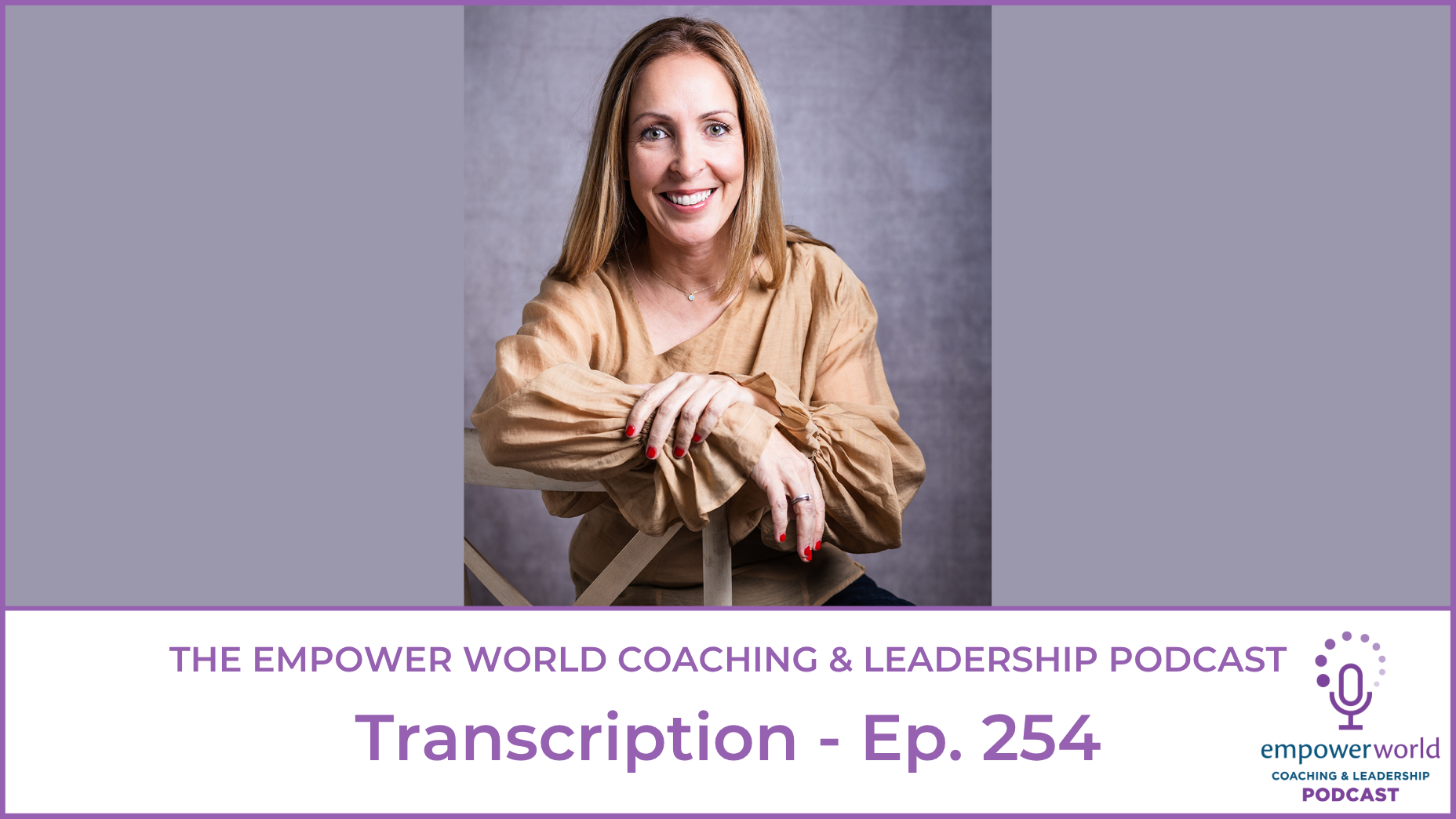
Monia Pyraki
Personal Growth Advocate, Life & Business Coach
Jeanine Bailey: Hello, and welcome, listeners, to the next episode of the Empower World Coaching and Leadership Podcast. This time, not with Marie, but I am with the wonderful Monia Pyraki. Monia, I'm so grateful that you are here with me today, because I've been watching your journey since you did the training with us, and it's been magnificent just to see the work that you've been doing. I know it's all sorts of combinations of different things, but I've seen you doing some fabulous work with Google, Estée Lauder, Lululemon, and I feel really inspired. I wanted to catch up with you, so thank you for being here. I really appreciate it.
Monia Pyraki: Thanks for having me.
Jeanine Bailey: So, Monia, would you like to introduce yourself to our audience and share a little bit about yourself?
Monia Pyraki: Yes, definitely. First of all, I'm always very grateful and inspired by the work you do with Empower World, and it's been a very important milestone in my journey today. I'm a life coach and a business mentor, but also an events professional. At the moment, I'm focusing on organizing and creating wellness and personal development experiences and workshops for companies, brands, and people. I have kind of blended all my experience from events, from business, and from the life coach training I did with Empower World, and I have established a company called Monia Pyraki Coaching and Wellness, which has different parts to it: the coaching part, workshops, and retreats and experiences that blend what I mentioned before.
Jeanine Bailey: Yes, thank you. Again, I can see, following you on LinkedIn, that you've really made an impact in these organizations through those different components that you've shared. I really appreciate how you've been incredibly creative and resourceful with those skills, strengths, and passions to create the business that you've created. So thank you again for being here.
Monia, I wanted to start by just checking in with you. What brought you to coaching? What was the inspiration?
Monia Pyraki: Great question. So, I was living in Doha back then, and I was in a very good and high-paid corporate job. I was happy with my job, but something was missing, and I didn't know what was missing. I always liked personal development and growth. I was always reading self-help books. Many years ago, in 2006, I went to a workshop Tony Robbins did in the US, so I was always into this kind of world, but I needed to go deeper, not to have a superficial workshop. I discovered that you were doing these trainings in Doha, and I was super interested. What got me in was, first, I wanted to know more about myself, and I know that that can happen with coaching. I also wanted to help others, my team back then, to be able to ask more questions, to listen-which are the basic foundations of coaching. I never actually knew that I would become a coach and develop this skill later on, but that happened naturally, and I think it's very inspiring to see other coaches do the same. The main thing that brought me was kind of-I was feeling stuck. I knew there was more, but I didn't know what that "more" was, and I had a bit of self-doubt: "Can I change careers?" "Can I become a coach?" I had all these question marks. So the main thing that brought me was I needed to go deeper into myself, to start with.
Jeanine Bailey: Yes, I really resonate with what you've shared. You're taking me back to my own journey of going into coach training, recognizing something's missing and I don't know what it is exactly, but following a hunch, following a calling, a whisper, to go on that kind of training to explore about self first and foremost. I think the beautiful bonus is learning those skills of coaching and leadership that can be utilized in so many different ways.
Monia Pyraki: Yes, exactly.
Jeanine Bailey: So you joined the training. It sounds like you maybe found what was that missing link?
Monia Pyraki: Yes, I did. Actually, one of the other things I really enjoyed was the connection with like-minded people. I think that I had everything, but I was missing this real, true connection and to be allowed to be myself, to be allowed to be vulnerable, to be in a safe space where I could tap into everything I needed to tap into. I think after the coach training, some doors opened, and not because the doors were not there, but probably I could not see these doors. I got to know myself better through getting clarity on my values, what was important, and all the limiting beliefs that I had. I managed to create a vision that I was excited about and not scared. But the community and the support that I had through Empower World-I still talk about it. It was just the start of my journey. Sometimes, you know, back then I wished for what I have now, and sometimes we forget. It's like you are somewhere today, and you think, "Oh, I need this," or "I could do that as well," but for me, this call reminds me of all the importance of actually going back to where you were and checking in, and the gratitude I feel today because that was the start of my journey as an entrepreneur, as a coach. I took the leap after the training, and I actually managed to leave that corporate job-not because of the training only; the answer was there already, but it helped me trust more my abilities to create what I have today.
Jeanine Bailey: Yes, absolutely. I can hear that, and I can also hear that it takes a leap of faith to potentially invest in something like this, because it is an investment. It's potentially reflecting on what is it that I'm going to get out of this training? If I decide to become a coach-because as you share, it's a personal development journey-but if I decide to be a coach, what's open? What's available when I finish? How do I get myself started? How do I create what it is that I want to create? I heard you share that you became clear on your values, what you wanted to create, and you connected to a community that supported you. I'm curious, what else perhaps supported you to be able to see those doors that you mentioned and open them to create what you wanted to create?
Monia Pyraki: I gave myself space and time. I connected really with my long-term vision and what was important to me. We do have only one life, so I thought that it's always easy to postpone decisions, right? To say, "Okay, I'm good," or to stay in a comfort zone because it feels safe. But actually, magic happens when we get out of the comfort zone, and when we trust our intuition, and when we connect with what matters to us. From every challenge or setback, I've learned in this journey that there is no such thing as a mistake; it's just a learning curve and an involvement. That's how growth came. Of course, there's always the doubt: "Is this the right decision?" "Will this work?" But at some point, you need to trust yourself, you need to trust the environment you are in, and then just go for it. As you said very well, it's an investment, and I do believe the best investment we can do-at least for me-is an investment in personal development and growth and to our health. At the moment, these are the main two things that I keep saying: if there is one thing I will do until I die, it's that I will keep learning, I will keep doing things for my health to grow and to feel strong and healthy.
Jeanine Bailey: Yes, wonderful, Monia. I'm also appreciating that when you completed the training, you took that leap of faith, you gave up the corporate job to do something that you're passionate about, which you created in Doha. But then you moved.
Monia Pyraki: Yes, that was a big problem. I started in Doha, working and collaborating with a yoga place called Nia Yoga, and we created wellness events. I started my coaching journey in Doha; all my clients were there, and then suddenly, as you said, I moved to Zurich, Switzerland, and suddenly everything changed. Because I felt like I lost my community. They were always there, but physically the in-person meetings, the events, the experiences, the coffees-anything. I had to start from scratch. Also, very different cultures, and apart from starting from scratch, I was also a mom of twin boys-when we moved to Switzerland, my kids who are now 8 years old were 6 months old. So it was a very lonely journey; it was hard, but again, all the tools I learned through the training really helped me ask myself questions as well. I started with simple practices, not only learning at that point-because at that point I needed to just use what I had learned-with a gratitude practice, with maybe having a chat with one of the people from the peer group. That helped me, one step at a time, find my way again, restart, but at the same time, I think it wasn't a restart; it was just continuing what I started, but in a different way.
Jeanine Bailey: Yes. So what I'm hearing again is that comfort zone was shifted. Utilizing everything that you've learned about yourself and learning these skills, you've been able to take that into that new world, reshape what you do, create, take your power back, and create the life that you want.
Monia Pyraki: Yes. And if I can do it, anyone can do it. I think those skills are a foundation for life. So I always say, when people ask me about coaching and if they're thinking to transition from a corporate job and get certified as a coach, I always say start with the basic coach training, because that's a gift for yourself to learn yourself better. You don't need sometimes to make huge decisions; you just need to start. That's what I did. And then the decisions came in a very natural way, and not in a quick and reactive way to something that was not working. That's the other thing I've learned: to take a moment to really tune in with myself and my intuition, and be able to support whatever I want to do with the skills I learned. Connecting to my values-and values change, they can be different-but again, all these tools we learn are tools for a lifetime.
Jeanine Bailey: Yes, they are. They really are. Throughout our conversation before the podcast and in this podcast, I really hear that wisdom that you've been sharing, and that it's all down to us. We are 100% responsible for our experiences. Yes, life can throw those curveballs, but if we reframe them to see them as an opportunity, as an expansion, as an evolution, then we have the power to be able to create the experiences that we truly want, even through what we're experiencing right now, which is incredibly challenging times.
So, for anyone listening to the podcast right now, Monia, what would you say to them if they are perhaps feeling like they are being swept up by the challenges of the world and feeling perhaps powerless?
Monia Pyraki: The best time to start something, or to learn something, or to do that thing that scares you, is when the times are challenging and when you don't feel well. Because that's when we need it most-the support, the connection to ourselves, the mentors, the people, the community we will create by doing the training or talking to a coach. Sometimes we don't even know it. That's really the secret. Take the leap. You never know where a journey will take you, but there are things you can control and things you can't. Unfortunately, no one can control the situation that is happening worldwide; we are all very sad, and it has affected everyone. But what we can control is what we do for ourselves and what we do for the people around us that we can impact and support.
I'll give you an example here. The other day, a teacher came to my kids' place to do an English lesson, and something happened-a conflict at school. I know she's really good, so I started discussing this conflict with my sons and her, and then I started asking questions to my sons, the 8-year-olds. She said, "I'm impressed. You didn't tell them that was wrong or right; you just started asking questions." I'm saying this because these skills have helped me even with my kids. Instead of telling them, "Oh, what your friend did was so bad," I more tap into how did this make you feel? With all the questions and tools I've learned, it even helps me in my everyday life. So if someone feels that it's a hard moment-and it is a hard moment, and it has impacted their life-ask yourself: how can I help myself and the people that are close to me? It can be a team, it can be your kids, it can be your friends. I think that's a great point to start.
Jeanine Bailey: Fantastic. Thank you for bringing in the example with your kids. It is incredible how resourceful and wise children are when given the chance, when given the opportunity to be heard, and to be stretched and challenged to reflect deeply on their choices and thoughts and beliefs. So it's amazing that your kids are very blessed to have a coach working with them.
Monia Pyraki: I'm trying my best. It's not always easy, but I'm trying my best.
Jeanine Bailey: Well, you are human too.
Monia Pyraki: Exactly.
Jeanine Bailey: I know that wellness is a big thing for you as well. What's the inspiration behind the focus on wellness for you?
Monia Pyraki: I think that I always took my health for granted, but when I came here, and the kids were growing up, and I was feeling lonely-I think I went through a postnatal depression, which I didn't know. The moment I started working on my doing some meditation, some breathwork, which is really healing for me, and started doing things that I love, like yoga, or now I started swimming in the cold lake, or doing walks in nature, I realized how my mood was changing. I realized I was a better person, a better mom, a better partner, a better friend, a better coach as well. Sometimes we help everyone else, or we take care of everyone else, and we forget ourselves. After this time of my life, I had an incident where I went to the hospital with severe pain in my body, but I didn't know what it was. At the end, it was probably a reaction to stress and tiredness. So I decided that after that, I would do everything to schedule wellness and well-being in my life. That doesn't mean only physical wellness, like a workout-which is great, I'm the first one to say that after a nice workout I feel great-but also the mental wellness, the connection to self, to your breath, to maybe even talking to a coach. That, for me, is wellness and well-being as well. Then I saw such a huge change, one step at a time, and I stopped saying "I don't have time." I was creating time to integrate wellness and well-being in my life, because health is one of my top values, and I had to honor it. That's how I moved into creating and integrating the well-being part into my workshops and experiences, because if we don't have that, we will not be able to do anything else. That's the foundation.
Jeanine Bailey: Yes, it's really about putting on your oxygen mask, isn't it? It's so easy to not do that, and I know I've certainly been caught up in that trap. I'm so pleased to share that I have walked every day for the last 7 months-at least 7,000 steps a day. It's so life-giving to be able to have that time for self, instead of putting that aside because there are more important deadlines. But health, I agree with you, is so important. We need to ensure that we look after ourselves so that we're in the best place to serve and support others.
Monia Pyraki: Exactly.
Jeanine Bailey: Monia, as we wrap up our conversation today, I really appreciate everything that you've shared. What parting words of wisdom would you like to share with the audience? Maybe it's somebody considering becoming a coach, maybe it's a coach already, or a leader who coaches. What would you share with them?
Monia Pyraki: One thing I would share is that there is never the right time. Just take the first step-the first step to a new training, the first step to your first client. Create the right time. We can only be responsible for what we do, and once we acknowledge that and make peace with that, everything kind of flows around us. Trust your instinct and intuition for whatever you do. The wellness world, the well-being, tapping in, and walks in nature have helped me really connect with myself. Take care of yourself. Put your oxygen mask on. You don't need to do one hour of meditation; you can do 5 minutes of breathing. Just start, whatever that is.
Jeanine Bailey: Beautiful. Thank you for your wisdom, Monia, and thank you for sharing your journey of becoming a coach, being a highly successful coach, and really living your dream.
Monia Pyraki: Thank you. I honestly, highly, highly recommend Empower World Training. It's been life-changing for me. It helped me tap so much into myself and create all the skills that I have today. I'm forever grateful, and I'm happy to be here. I always talk about Empower World everywhere to everyone.
Jeanine Bailey: Thank you, thank you, thank you so much, Monia. Again, I'm really grateful that we've crossed paths in the coach training and beyond, and I've been fortunate to see you since then and here online. I look forward to seeing you somewhere, somehow, in the world in the future.
Monia Pyraki: I'm sure we will meet soon.
Jeanine Bailey: I hope so. Thank you, Monia.
Monia Pyraki: Thank you very much. Thank you.


