
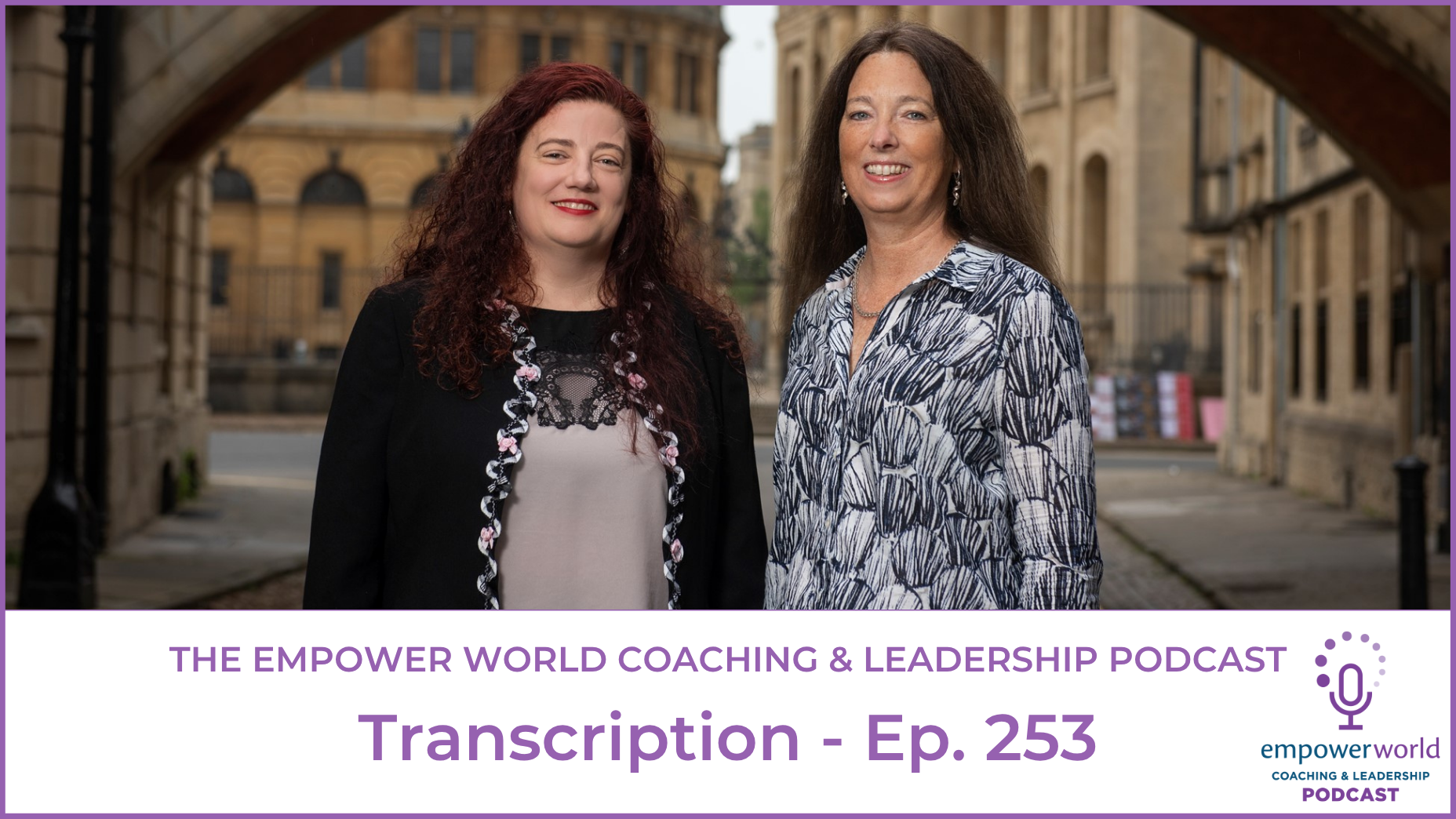
Larissa Thurlow and Traci Manalani
PCC Credentialed Executive Coaches and Coach Supervisors
Jeanine Bailey: Hello, and welcome, listeners, to the next episode of the Empower World Coaching and Leadership Podcast. Today, I'm not with Marie Quigley, but I am with two amazing women, coaches, leaders, supervisors, and so much more. I'm here today with Larissa Thurlow and Traci Manalani. Welcome to you both. Thank you for joining me today. I really appreciate your time and generosity of sharing your wisdom.
I just want to quickly share that Larissa, you, and I met many, many, many years ago in Doha, Qatar. Something like 2007, 2008, we were both coaches in Qatar, and there were not very many coaches at that time. We met as we were aiming, as a very small group of around half a dozen of us, trying to build a network of coaches in Qatar. I do have this vivid memory of meeting you in a cafe with that amazing mane of hair that you have. Of course, we went on to reconnect in many different ways in person in Qatar, and since then, online in different ways, in forums, including coach supervision group coaching supervision training, and that is where I met the wonderful Traci as well. Traci, of course, we've been connected in various ways since then as well. I really appreciate you both being here. I've spoken a lot. I'm going to hand over to you both to introduce yourselves more formally.
Larissa Thurlow: Thanks, Jeanine. Yeah, it's a pleasure to be with you, so thanks for the invitation. I love that, looking back at how we've connected. I do remember being in Qatar together, and at that point, it seemed I hadn't long finished my coach training, but I was very interested in teams. As you say, there weren't very many practitioners there, so I was fumbling about trying to figure this all out on my own. Team coaching wasn't what it is now; it wasn't as well-known a podcast. I remember having the Hawkins book and just being frustrated because I felt very isolated with figuring out what this was. Fast forward many, many years, and lots of training and stuff in between, landing in the supervision group, I met Traci, and knew that she was one of the conditions of joining the group-I wanted to work on teams. The facilitators, the leaders, Lily Seto and Damien Goldvarg, said, "Oh, yeah, Traci will be in the group, and she works with teams." I was like, "Okay, sign me up!" So I was very happy to connect with Traci, and we've been doing lots around teams. You mentioned the word "wisdom" that comes into our space as well, but I'll hand it over to Traci to say a little bit more about herself and how we've connected.
Traci Manalani: Yes, and so our paths did not cross until at least this decade, I guess you could say, post, well, during the pandemic, really. But before that, a similar path as a coach, having worked as a coach for many decades, actually, and then specializing in working with teams, because it's really about the systems. In fact, the ripples behind us-both Larissa and I share this in common about wanting the impact at a systems level. When you start working with a system, whether it be a team or a group of people, that's what is my passion, and it lights me up. I loved the fact that we met in all three of us, really, in the supervision of groups. There's something magical about that, working with people in groups. I am definitely loving the power of connection.
Jeanine Bailey: Thank you both, and again, really appreciate you being here. For those who are listening to this versus seeing the visual of this, both Larissa and Traci have got these lovely circles of what looks like a water drop ripple effect going out. I resonate with what you share about teams. I recall, Larissa, working with your organization in an appreciative inquiry exercise with your team, and it's such a wonderful way to be able to connect all of these different perspectives, ideas, and wisdom together through team coaching. Of course, being able to work with a partner as well in that environment is so useful, so helpful. That's something that Marie and I did a lot of in our time in Qatar, and it was hugely beneficial to bring, again, the wisdom that's in the group.
We spoke together before we started this podcast recording in terms of what to focus on, because I know that you both bring so much experience and knowledge that can support teams and individuals, of course, who exist in those teams. So we landed on looking at how we can support leaders, teams, individuals, and groups in terms of reconnecting, pausing, reflecting, renewing, tapping into-this is, I believe, where we landed. You might want to push back on some of the things I've said. I really appreciate how important it is to be able to create that container or place to be able to do that work, to really come out of the tunnel vision that we can potentially get down into, either as an individual or a group, and not pause to smell the roses, so to speak. So, handing over to you both, because I know that that's something that you both are very passionate about creating and supporting with the leaders and teams you work with. Handing over to you to really support our audience to understand the importance of that.
Larissa Thurlow: Traci, do you want to start us off, and I can weave in?
Traci Manalani: Sure. Specifically, what Larissa and I have been doing together, because we are in a relationship with each other, is to help others come into relationships around tough topics, tough concepts, which leadership is one. What we have found through our work as coaches, whether it be individual or team coaches, or even leadership development experts, is that leadership is lonely. People are very isolated when they are in their workplaces, and so we were finding that it's really beneficial when we've experienced people go through cohort-based programs-that's the part they love. Yes, there are some best practices that they pick up along the way, but the magic happens when they're together. And so we've been starting to pull people together and offer them experiences that we've named Wisdom Circles. Instead of a mastermind group where people are just giving advice to each other, we're creating a space for leaders to come together to share their challenges, and it's just a place for them to reflect in community with each other, in connection with each other, to really tap into the power of pause through appreciative inquiry with each other. Actually, we don't need to use much of our expertise other than the holding of the space, because the wisdom is there in the group. Larissa, I'll let you add on to that.
Larissa Thurlow: Yeah, I think there's something-just going back to how you said that we worked together previously, Jeanine-that was always very much internal, sort of coach and OD professional. There was lots of support for leaders, but they were all from the same organization. I really notice, with the work that Traci and I are doing, we tend to collect-and actually, I'm gonna change that and say, curate-our groups. We think about fit, but there's generally a diversity of where these leaders are coming from. They might be from the same sector. For example, the last group that we had, they're mostly from the nonprofit or NGO sector, but I think leaders really appreciate that opportunity to work with people facing similar problems, but in a different organization or a different sector, and just sort of normalizing that-no, I'm not going crazy, I'm not the only one going through this; this is something that's happening elsewhere. Just that in and of itself, I think, is helpful for people, just to sort of normalize it and have a chance to talk to colleagues. Because, as Traci said-or maybe it was Jeanine, I can't remember who said it-leadership is quite lonely. Just having that time and space to talk things through, to build relationships, to build connection-it's quite interesting, the difference between that internal work and now more of that external work.
Jeanine Bailey: Thank you so much for sharing about the work that you're doing. I feel incredibly drawn to it, as you share, because I really believe in that ability to be able to create that safe space, that spaciousness, to be able to have those challenging conversations, but not to direct or lead or bring in your own perspectives, but allow and facilitate that conversation with leaders who, I trust, as you said, Traci, that place can be lonely. To be able to bring that ability for people to connect based on similar but different situations and circumstances can be very, very connecting and resourceful. I'm trying to think of the words that you brought in, Traci, before we came onto the podcast, in terms of what this is about. Those three words-what were they?
Traci Manalani: Well, I was thinking reflection in connection, and Larissa had-would you like to add what you added to that?
Larissa Thurlow: Yeah, I think there's something about restoration as well. People come into the call-different time zones, they might be in the middle of the day and sort of in the swirl, they might be beginning the day or ending the day, but by the time we've had our time together, everyone seems to leave and feel rejuvenated, restored, able to just focus and not be reacting to things, to be a bit more purposeful and mindful.
Jeanine Bailey: Again, really appreciate that you are creating that place that enables those conversations, those tougher conversations. I'm curious, because we talked about potentially at the beginning, before we came online, that people can be in that zone and not come out of it to breathe, to look at another perspective. I'm curious as to how you're finding the uptake for this. Are you finding that leaders are going, "Yes, this is exactly what I need," or is there pushback? What are you noticing?
Larissa Thurlow: Yeah, I can start us off. I think it's a bit counterintuitive, because people do feel like, "Oh, I don't have time for this," so sometimes it's, "This sounds really good, but I've got this on, so maybe in the next cohort." But then, within the first session, they're like, "Oh no, I'm clearing the decks, I'm making time for this." So there is, I think, a little bit of an edge to get over to actually make that time. It's not unlike when we go to the-I'm just back from the gym, that's why I'm looking a bit wet; the mane isn't quite as out of control as it usually is-but everybody knows that they feel better generally after having a workout, or after getting out for a walk, but it's that, "I just want to grind out one more thing." So I think that's something that we're really working with that mindset. Traci, what would you add to that?
Traci Manalani: Yes. I think people don't necessarily understand, or leaders certainly don't understand at first, what is the value of coming to be in a conversation that doesn't have content, that's not structured. "What am I going to learn?" In this fast-paced world, it's more about do, do, do, how can I do it faster? So it's needing to have the ability to experience it first. Then, as Larissa said, once they recognize that actually there is so much learning, because it's spacious learning, and that it creates more space for them to get things done by slowing down, it's that concept of slow down to speed up. But you can hear phrases like that, but you can't believe it until you experience it. For us, it's been really about having people experience the Wisdom Circles and this type of group process, and then they are on board with it. It's similar to other communities. Even we have a community of practice, I think, that you may have come to with the supervision of team coaches, community of practice, but once people find the value of even that unstructured time to be together, there's so much appreciation that comes from it.
Jeanine Bailey: Yeah.
Larissa Thurlow: It just-I think I knew this already or thought this at some level, but just as I was listening to Traci, we think we have this-doing more is better, but it's not necessarily. Just because you're pushing through and doing more, it's the quality versus the quantity. Those that experience it-it's something that you just viscerally feel. Being able to just be more clear-minded and make better decisions.
Jeanine Bailey: Yes, it's sort of the saying, "You can't see the wood for the trees," that comes up when you share that, Larissa. What you're describing is also something that is very obviously similar, aligned to what we know as coaching supervision. I'm thinking of that question that I asked earlier also comes from recognizing that in our own profession, we do have many coaches who go to supervision, but there are still many who don't, for some of the reasons that you've shared-they perhaps don't recognize the power of it, they perhaps don't know about supervision yet as it's still in earlier stages of awareness, although I hope that it's a lot more along those lines now. But I think there are still coaches who don't really fully understand the power of supervision, and putting on our own oxygen mask to be in service of the people that we serve. Hence, my curiosity about that question about leaders. We as a coaching profession potentially should understand that this is the space we need, but I know that it's still not fully embraced, so I was curious about leaders and their willingness to participate. I'm really so happy and delighted for you both that you are making this happen, that space for leadership to do that deeper inner work. So what else are you finding from doing what you're doing? What else are you appreciating that can support other leaders and coaches to do their own work?
Traci Manalani: There was just something from our earlier conversation, and I don't know that it's answering the question, but what was coming up for me is the importance of even slowing down individually. So it's not a-certainly coaches should be reflecting on their own coaching work, but leaders as well. I mean, any human being, to just slow down and to have time to reflect. But what I've been finding interesting, working in reflection in connection with the groups, is that you create that accountability. Because sometimes we will book that time on our calendar for ourselves, and then we end up doing something-I think it was when Larissa was talking about doing something-and so it's easy to overwrite that when it's just ourselves. But when we make a commitment to go and be a part of the group, we gain something, and we're giving something as well. Actually, that's what many of the participants have said: they appreciate listening to each other and offering that gift to another, and that itself is restorative. They're practicing skills of being in a relationship with each other, but they're also protecting that time, because they feel committed to helping others as well as themselves. So there's something about this accountability that is inherent in the group process that is happening.
Larissa Thurlow: And you brought up something for me which is pinging me a bit over here. I love that you brought that, because there's a quote that stands out-I might get it a bit wrong, but one of our participants said in a couple of the sessions, "This is the only place that I can come where people aren't expecting something from me." I'm getting something, and people aren't breathing down my neck, expecting something from me. That just gives me goosebumps. That is really important from the leader's perspective.
But maybe taking us back a bit, when you said about coaching, I don't think it really matters what the practitioner is, whether it's leadership or coaching or supervision. But how we reflect, or if we reflect, really impacts how we see ourselves as practitioners. Going back to coaches, this might be a bit provocative, but I think coaches can be-they don't walk their walk sometimes. They're out saying, "Take care of yourself," but they're grinding harder than anybody I know, and I'll put my hand up; I can sometimes fall in that trap. It's really about you, mentioned accountability-I would say it's also about authenticity. It feels a bit disingenuous to be sort of on autopilot as a coach and trying to help others. So I think we need to do the work that we're trying to support others to do, otherwise it just doesn't feel aligned to me, or in integrity. I think it brings a sense of aliveness to your practice. It's not that autopilot grinding; we notice the energy, don't we? People sort of start the call, and they're just "Ugh." And then it's just, we're all recommitted and re-energized to go and do the work, because there's actually that connection to it. Whereas sometimes I think you can get a bit disconnected.
Jeanine Bailey: Thank you both for sharing. What I heard when you were initially expressing what was coming up for you, Traci, the thing that came back to me was that when you give to someone, when you are offering someone else support, you're also giving yourself a gift in that. It's just that beautiful win-win-win, ripple, ripple, ripple effect. I really appreciated you sharing that.
Larissa, now that Batman's got up, my thought that came up in relation to what you were sharing has just perhaps slipped my mind now, but it will come back.
Larissa Thurlow: I was talking about autopilot and how, as coaches, we need to do our own work. I don't know if that jogs something.
Jeanine Bailey: Yes, thank you for jogging my-thank you, Batman. So there is, I believe, that as you shared, potentially you get on that track as well, of doing, doing, doing. I know that I get on to that track now that things have changed in the business-it's about pivoting-and I truly believe in still putting on my oxygen mask and coaching supervision. I really believe that that is something that supports me through all of those challenges. It's essential that I continue that practice, and support myself, look after myself, through certainly understanding my own blind spots, thinking, and normalizing situations, and supporting me to become, I hope, even better at what I do as a coach. So I believe it's so important that we do put on our oxygen mask, so to speak.
I'm wondering, in terms of you creating this, what evidence you might have explored to support this that might also assist our listeners to recognize, whether they're coaches or leaders, that this is the work that we really need to do to be able to create that firm foundation of who we are and what we bring.
Traci Manalani: Right. There was the evidence that predated us doing this effort, and then now there's new evidence from having done it. I can speak to some of the things that prompted us moving there, which was the cohort-based learning experiences. I've probably spent 40% of my time facilitating learning experiences alongside the coaching work that I've done. I think I mentioned earlier that when people would complete some of these programs, these journeys, their appreciation really was from the group experiences, not just going through a training program together, but actually through group coaching experiences. When there were groups of 5 to 8 people coming together to reflect on the learning together, it was a formalized program; there was magic that would happen that wasn't scripted or planned, it would just happen in the space that was created. Watching that unfold in these programs was really eye-opening for me and exciting. As Larissa and I had been doing group supervision with team coaches primarily, and also some team coaching together, we've been working with systems together, we were thinking, why not? This makes good sense. We wanted the ripple effect, so let's invite this directly and just create these more emergent spaces for leaders. But since then, we're finding more evidence as people actually are going through these Wisdom Circles and, hopefully, soon-to-be in-person retreats. Larissa, what would you like to share as far as what we have noticed through the impact?
Larissa Thurlow: I'm not going to start quoting a bunch of studies, because you said "evidence," and I can, as a little researcher, being all excited. But what's really standing out for me is that the real shift with-everyone's dysregulated when they get on the call. We're not doing a lot of work in person at the moment; Traci's in France, I'm in the UK, but I can feel it. People are just buzzing when they get on the call. They're kind of putting their phones down and looking at this screen. We tend to do some kind of a grounding; we do a lot with breathing and just checking in on your body, not much time at all, it's usually quite brief, but you can just feel, it's not six different individuals. They're not a team; they're not a team because they're all from different organizations, and they're not working really on anything together. They come together to reflect, and just that difference in the energy, in the way they're holding each other, holding themselves, and the thinking, it's just clearer and calmer.
Jeanine Bailey: It's wonderful to hear how you're noticing the difference in the people that show up. I really appreciated, Traci, what you shared about previous, prior to creating what you're creating together, the experiences from the training. I could so relate to that, so relate to what you were sharing in terms of seeing the groups that Marie and I have trained over many years. It's the connection, it's the bond. I still hear that years later, through the work that we do when we bring people together; I still hear those connections with each other, and how much everyone appreciated that, and how they're so pleased that they're still connected. So I think what you're creating works on so many different levels, and the soul.
Traci Manalani: I have one thing. There was a word you said earlier, Jeanine, that really popped for me, which was "blind spot." Because that's the beauty of these group experiences: it's not just blind spots, but it's also the revealing of hidden strengths. Because sometimes a person will come in with a topic that they want to explore, but then it transforms because of what the group is able to see in that person and reveal to that person. The reflection isn't just the internal reflection; it's actually holding up mirrors, or showing how others see that person. That's another thing that we've observed, and it's magical to just see the confidence change for that person, or new possibilities. It unlocks new possibilities because of what is offered as gifts from the group. So it's really magical.
Jeanine Bailey: Yes, absolutely. Blind spots could be anything-the things that hold us back, or the opportunities for enhancing that, or the gaps of opportunities that she was identified.
Larissa and Traci, as we draw near to the end of our conversation today, sadly for me, what is it that you might like to as a final thought, or question, or reflection for our audience listening today?
Larissa Thurlow: I think it might be, for me, just a challenge of when you think you don't have time for it. I don't know-can you afford not to? Basically. In our crazy, busy, people are holding so much-just in the world, everything that's going on, and then in their organizations, and their families, can you afford not to?
Traci Manalani: And I guess for me, it's: what are the connections that nourish you?
Jeanine Bailey: Great, great questions. Yes, I think particularly in this place and space we are in the world at the moment right now, those are such important questions to ask of ourselves, each and every one of us. There is so much that is potentially disconnecting us from each other, so this is the opportunity to really come back.
Larissa Thurlow: I just got goosebumps from that. Thanks, Jeanine.
Jeanine Bailey: I really appreciate the time that we've had together to reconnect, and thank you for bringing your insights, experiences, and reflective questions to our audience. People listening who want to get in touch with Larissa and Traci, please find all of their connections, the way you can connect with them, on the website where you found this podcast. I'm so sure they'll be delighted to connect with you. Thank you for listening. Thank you both. Appreciate you both and everything that you're doing, and I look forward to reconnecting with more exciting outcomes and evidence.
Larissa Thurlow: Maybe in person.
Jeanine Bailey: In person would be amazing. I'm hoping that happens; I'm putting it out there. Thank you.
Larissa Thurlow: Thank you, Jeanine.
Traci Manalani: Thank you.


