
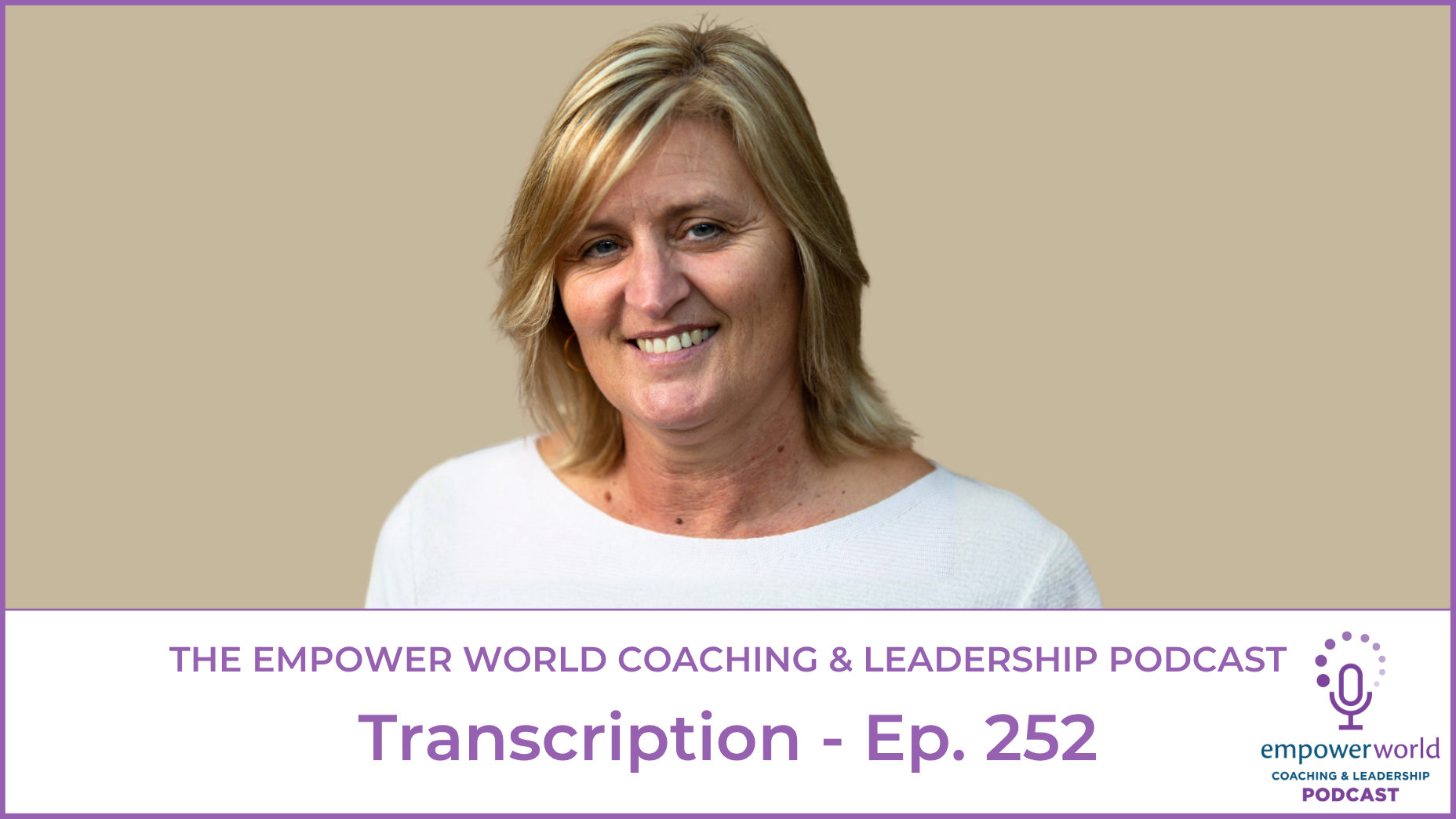
Wendy-Ann Smith
Coaching Psychologist and Founder of Ethics Forum International
Jeanine Bailey: Hello, and welcome, listeners, to the next episode of the Empower World Coaching and Leadership Podcast. Once again, I'm not with Marie Quigley, who is currently traveling, but I am very, very fortunate to be here with Wendy Ann Smith from the Coaching Ethics Forum. Welcome, Wendy, and thank you for joining me today.
Wendy-Ann Smith: Thanks for having me, and I like your start of welcoming the listeners. I don't tend to do that on my own podcast; I just dive right in. So, I hope that lots of people do get to listen to us chat, and they find something useful in it. Thanks for having me.
Jeanine Bailey: Yeah, I trust they will. Knowing you, Wendy Ann, as little as I do, but as much as I also do, I trust there will be some great value that you impart. I was fortunate to connect somehow with Wendy Ann in your Coaching Ethics Forum, which was December last year, and it was the first time that I had attended the forum. I was really thoroughly taken by it. It was a wonderful couple of days listening to amazing presenters, as well as yourself, over a couple of days, and it just-well, as I shared with you, Wendy Ann, it really did inspire me. I did say to you that I wrote a post that I fell in love with ethics again. That was one of the reasons I really wanted to bring you on board, because there was just so much gold, diamonds, wisdom from that conference, and I know that there's been so much more that has been released since then. I know you offer ongoing opportunities for people to really develop ethical maturity. So I want to hand over to you, Wendy Ann, just to introduce yourself, and that might lead then into what it is that you also do in relation to the Coaching Ethics Forum.
Wendy-Ann Smith: So, well, like you, I'm also Australian native, although I am Maltese as well, but I'm born and bred, I guess, in Australia with Maltese culture and heritage mixed in. But I, like you also, don't live there anymore. I haven't lived in Australia for a number of years, and I'm currently in Paris, or just on the outskirts of Paris, and have been here for just on 15 years. I'm a psychologist, registered in Australia, also in France, and a chartered psychologist in the UK. I'm a mother to one and a grandmother to two. They're important little parts of me that need a place to be sent, and also a mother to a cat who's entering her 14th year. So that's me in a nutshell, I guess. We'll discover more about what I do across time, I think, in this chat.
Jeanine Bailey: Yes, thank you for introducing yourself. We might hear Batman, my 15-year-old cat, in the background; I know he's lurking around somewhere. And again, Wendy Ann, I really appreciate what you do, what you bring in certainly to support the coaching profession, so appreciate that you are a psychologist, and what you bring in with the Coaching Ethics Forum and so much more. It really does support us as coaches to develop our ethical maturity. So I'm curious as to-I'm trusting, guessing this is a passion of yours, ethics? I'm wondering what's brought this about for you, and how does it drive what you do for the profession of coaching, and I'm guessing psychology as well?
Wendy-Ann Smith: Yeah, I don't know that I have much of an impact on psychology. I know that we do have an Australian counsellor who's on at every conference, the whole 2 days, 14 hours each day, and he's from Queensland, and he's been to every conference so far, so there's something there for people who are not coaches, most definitely. And there also have been some people who've attended the conference at the forum, like you said, because we've had 5 conferences now. We've had engineers join the conference as well, and found the conversations intriguing and of great interest. So that's kind of impacted how I've seen this work along the way.
But where I began-I'm a coaching psychologist with a great interest in the science of well-being, and have lectured on that way back at the beginning of my career, back at the University of Wollongong. So that's really where I lay my roots in my professional space. But over the last few years, I've been working more in the ethics space, because I just saw the huge gap between the way at least psychologists in Australia, or at least my own training and understanding of ethics in my psychology profession, and then, because I'm a coaching psychologist, I mix into the coaching world as well, and I just saw a huge gap in the way people understood and worked with ethics. And I just thought, you know, if coaches want to be doing the work that they want to do, and want to be seen to be who they are, and really credible in the professional space, then they really needed to up their game in the way that they understand ethics. And as great a job as the coaching bodies do to support the coaching profession, they don't have a very mature navigation of what ethics are. And the language that is used by them, and consequently by coaches often, is very rule-bound and compliance-laden, without a lot of ethical inquiry. And I dare say even the coaching bodies themselves don't like being under the microscope, which I understand, but still, I think if you put the ethical lens microscope on the whole profession, then I think we are moving towards maturing the actual coaching profession in a deeper way.
So that's kind of where I began 5 years ago with this work, and it's grown exponentially, and I've gone a bit crazy, and created a whole bunch of initiatives from that. So now there's a whole-what you might call an ethical spine to the whole profession that everyone can tap into in a pluralistic, dynamic, evolving, non-compliance way. You're invited to engage, and you must do so kindly.
Jeanine Bailey: Yes, yes. I really appreciate what, again, you are doing for the profession, to really support it to certainly behave in an ethical way, and be able to provide that foundation for that trust between the coaches and the people that we work with. And of course, the coaching profession is becoming more complex with the-I don't know if it's an explosion of team coaching, but I'll use that word for now-with that coming up, and that, of course, is impacting a whole lot of different systems beyond just the coach and the partner themselves. It really does have this ripple effect, so I really appreciate that the ethical maturity and practice must be developed and can't be just put aside. It has to be something that is always appreciated, reflected upon, expanded, and grown. So, Wendy Ann, what do you believe might be one of the biggest challenges or opportunities for the coaching profession right now in relation to ethics?
Wendy-Ann Smith: One of the biggest challenges, I think, is the idea that AI suddenly is changing things so dramatically from an ethics perspective. I'm personally really concerned that everyone's getting so caught up in the AI world, particularly around ethics, that they're trying to stamp their feet in the ground of being an expert on ethics just in relation to AI, and that's going to cover them. I'm concerned that coaching bodies might decide to move too far into that space, and not give enough importance and enough work to the human in the space, even with the strong presence of AI and technologies.
I was listening to someone the other day talking about decision-making in relation to AI and technologies, and they were talking as if the platform itself is accountable. And that very language concerns me, because it's the people who own it, design it, and put it out there that are accountable, not the platform. So therein is where you see that the human is lost. And I think there's just still so much work to do in relation to ethics, or ethicality, as I like to use the word, because that's more comprehensive. It's not just ethics in dialogue, it's actually then taking it out and actioning it and working with it. And so generally, society, but especially professionally and coaching, still has so much more work to do to improve and increase their ability to be engaging with ethics and to be in ethicality, that I'm really concerned that this so-called competitive advantage of having an AI focus will mean we don't have as much presence and focus on the human, which is where it needs to stand. It has to be on the human, and whatever ways the human is engaging professionally, the ethics has to stay there. So that's my biggest concern around what's happening at the moment.
The opportunity is that if navigated well, we can maintain the focus on the human, maybe take advantage of the interest in AI to maintain the focus on the human. And by doing that, by being really careful on the language that we're using, so it's still recognised that the ethics lays with the human, and as a consequence, the platform. So, there's an opportunity there, I think, maybe, to use AI to ethics advantage, to not have AI taken over. I'm having a conference next year in February at the Coaching Ethics Forum, and it is going to be focusing on "What is human?" Like, what remains human? And this is an AI conference-no one would pick that up-and it's going to be AI, but also challenging and keeping the humanity as a part of it. So we'll see how we go.
Jeanine Bailey: Yeah, that sounds really interesting and intriguing in terms of certainly the challenge, also the opportunity in the conference. What was coming to mind when you were sharing that was the couple of times recently where I've had to seek out support from a bank, and something else; I think it might have been the UK government site, and it's trying to support my query with its robotic responses, and none of them fitted my particular inquiries. Then trying to convey that to the bot-no, it's not that, it's this-was incredibly frustrating. So I had to speak to the human to get that support. So I trust, I hope that we can continue to keep the human very much in those interactions where we are looking for support, whether it be coaching or something else.
Wendy-Ann Smith: Can I say about those chatbots? I tend to say to the chatbot, "I just need to know how to speak to a human. How can I be in contact with a human?" I go straight for the human connection. I know I have to engage in them, because a lot of these places now have them there as a first point, but I try to navigate myself around them by letting them know I have to speak to a human, and can you just give me a human, any human?
Jeanine Bailey: Yes, I know I did that with my bank bot, and it did take several attempts of rewording, or continuing to badger the bot for a human being.
The other aspect that I really appreciated-going off the AI topic here-in the Coaching Ethics Forum of last year that I attended, which we both talked about before we came on here, I found it a highly engaging but also an emotional experience, particularly when what you did was you brought in a variety of Indigenous voices into the room to also speak to what ethics means to them. And that was incredibly enlightening and empowering, and coming back to the human, that's what I found was the message that kept coming through: it's the relational piece that's really important. So I'm wondering, Wendy Ann, what was your takeaway from that element of what you brought into the Coaching Ethics Forum, because I felt it was really powerful.
Wendy-Ann Smith: It was. I feel like I need to watch the recordings again. When you're hosting and alive and awake for the whole two 14-hour days, it's hard to take it all in. So my memory really sits in my experience of the conference, as opposed to the content of the conference, and that's just because of the role I play. My experience of it was that it was more emotive than I had expected. I'd spoken to all these speakers and panels and helped them set up their sessions, and I had no idea it was gonna land as powerfully as it did.
For me as an Australian, a white Australian, of course, the Australian Indigenous Torres Strait Islander panel was particularly evocative and emotional, and just extraordinarily powerful. There's much there that I think the Australian population as a whole would love to hear. So maybe I need to help make some of that become a little bit more public. But it was just a reminder about history, but sometimes it was set in the challenges of history, but also how they've maintained dignity even through those challenges, how we then move into the current day and can still be one, and can still hold our individual identities, our individual culture, the layers of culture from where we come. I mean, I don't know about you, but actually I do know a tiny bit about you-that you have Indigenous ancestry there. And so then, also looking at me, where I was born in Australia, to an Australian dad, four generations, and to a Maltese mum who was Maltese at the time of me being born, but has long been an Australian citizen. So there's a mixture of cultures that arises in that, and it's about being okay with all that, and they showed us that through a long-range history.
But that's where we're talking about the Indigenous voices, which was really unique to have in the one space. That was a global conference with global voices. So we started on the first day in East Asia, and we had the Japanese, and we had the Chinese, and we had lots of different voices. We had a whole Indian panel where I challenged them to talk about caste, and they weren't so comfortable, but boy, oh boy, when you sat in on their session-I knew how many meetings I'd had with them, and how much thinking I had given, as well as what they had done to get that to where it was, because there's so many sensitivities in current day in India. And just to have that play out, I remember sitting there for the Indian one, and I may have even shared it in the chat, and I said, "We are given a gift here." Because I knew how much they had worked after the last call I ever had with them to then produce what they produced and gave to us, and that was just unbelievable.
So, to go from current-day languages, which have strong historical roots, from east of the world, compared to where I am in Central Europe, to having my native in Australia, to then having the Americas-some Central America, North America, Native voices-it was just like, I don't know if it can be replicated. It was just so unique, and so powerful, and so informing, and reminding of humanity, that I'm at a loss right now of how I can build on that in a way that's really fruitful for everyone, for both them and for the attendees. But there's got to be a way to do that, because it was just so powerful, more powerful than I ever could have dreamed. Very unique space, that one.
Jeanine Bailey: Yes. Incredibly unique and very, very, as you say, emotional and touching, but also just incredibly wise. There was just so much to take away from what the participants shared. I wasn't able to hear all of them, but I was able to be there for some of them, and I was very thankful to be there for the Australian Indigenous contributions. I have two Aboriginal aunts through marriage-my two uncles married two sisters-so I have an Indigenous cousin. So it's something that I'm very invested in, I guess, in terms of being able to support and empower equality, diversity of backgrounds, and again, wisdom that we all bring. So it really spoke to my heart, listening to a whole range of incredible voices.
Wendy-Ann Smith: I could say there, also, what's come to mind is the Middle East, that I didn't mention. We had a panel where one was Persian, two were from Egypt, and I just think, for that panel to be a play back in December, and to where we are in the current day's activities, it was just great to see that those people could come together. And then we also had a spiritual panel, which we've had in a previous conference, but I invited them back to go longer this time. So there we had Judaism, Islam, Christianity, Buddhism. And I think that's unusual. And I was really grateful for all those collectives to come together. That was not an easy panel to bring together. When I first did it, it took me almost 12 months, because of sensitivities around things happening around the world. People either didn't want to be representative of a particular religion, they didn't want to be seen as a representative, even though they are of that particular domain. And they were displaced persons, and they just felt that they were too vulnerable to speak, even though they're going about their daily life. Then you've got others who have family in regions who are going through-they've lost family, or they have family in different areas-and it's really tough for them to come across and be in the same space as some people.
I didn't understand that challenge at first, because I'm going, "Yeah, governments are choosing what they do, and humanity's still at the core of it, so can't we find our common humanity and come together?" But humans are more complex than that, and we have many more sensitivities that we need to just appreciate and give compassion for. So, in terms of the conference, I'm glad that somewhere along the line we were able to push through all those different barriers and find people that were able to come together from these different belief structures, and speak to that, and show us how they show up in some of the scriptures, and how they understand that in daily life and professional life. I think there's a lot for us to learn across all of that as well.
Jeanine Bailey: Yes, I thank you for sharing this, Wendy Ann-that desire, but also that difficulty to bring people from those different areas to come together. And I truly believe that's part of the work that we all must do, as a human race, to be able to come together, because I appreciate that many of us realize we are all connected much more than we realize. So it's about bringing people together to have that dialogue, to be able to create those connections, create that awareness, that understanding, build that mutual respect and trust and so much more. So I thank you for sharing the challenge in that, and having lived in the Middle East for many, many years, I totally understand that dynamic is not easy. So well done for making that happen. I again believe this is part of our ethical maturity or ethicality practice, because we are in the profession of bringing out the best in people, creating ecological outcomes that are good for us, good for others, good for the greater good. So again, thank you for all that work that you've been doing. I know it wouldn't have been easy, so well done.
As we start to perhaps come towards the end of our conversation today, Wendy Ann, what might be striking you now in terms of ethics, or what you've shared in terms of the Coaching Ethics Forum, in terms of what you've been able to achieve? I'm curious as to what might be hitting for you, so to speak.
Wendy-Ann Smith: Well, there are several things. The Coaching Ethics Forum has had 5 conferences now, and there have been two 14-hour days-except for one, which was 3 14-hour days, and that was as well attended as every other conference. I think that's astounded anyone and everyone, because before that, ethics was the one-hour session that might be included in some conference; you might get a couple of people who would turn up for it. It was the add-on. Now it's the center of gravity, exactly where it should be.
I would like to see the coaching bodies support the forum's work more. Not that they haven't entirely for the 5 years, but I think they could a lot more than what they have done. This work has supported them; it's not been in competition with them. It's actually supported their work, and helped influence how ethics is showing up in their codes, in the way they're asking coaches to work with ethics. So I would like to see the coaching bodies recognise that more, and actually encourage their communities to attend the conference. They don't. But they have attended, so it's complicated. But that's what I would like to see.
The forum has now created many ways of people being able to engage: through webinars, through Ethics Circles, through the conference, through the course "Ethics Beyond the Code," which I created and hosted on Coaching Ethics Forum, through the magazine Ethical Edge Insights, through the Journal of Coaching Ethics, which is an academic open access journal, through the Champions of Courage Awards (nominations are open now-just go to championsofcourage.com). We had a great first year launched last year, so I hope we have a great year again this year. And now we've got the umbrella, Ethics Forum International, and that's where it's cross-domain. It's not just coaching, mentoring, leadership; it's across all professional domains. It's already in existence, but launching off much more strongly from now, where it's got memberships, an ethics and ethicality recognition pathway. I see that as the icing on the cake, if people are looking at a coach, or anyone in any profession, and they say, "Okay, I need to engage this profession. Who are the people in this bundle who actually have that baseline accreditation from ICF or some law accreditation? And then who's got the ethics and ethicality recognition layered over the top of that? That's who we're going to choose from." So that's what I hope happens with this umbrella entity, which is connecting everything, all those different initiatives together.
That's all sitting at the top of my mind right now, as well as the course and its uniqueness in that it's not training; it's actually a development course, "Developing Ethical Capability." Even the most experienced practitioners who are going through it are taking-I was a bit concerned, because I built it for it to be a short course of 3 to 4 hours, and some of these very experienced practitioners are taking 3 or 4 hours per module, because the material is rich. They engage not just in what I ask them to engage in, which is quite a lot in and of itself, but they sit for much longer using all that richness across their whole professional life, and it's taking them a long time to mull over that, but they're enjoying that. So in one hand, I was quite horrified, because I didn't build it to do that, but yes, I did build it to do that, but I didn't build it for people to take that amount of time. I'm hoping to have a paper published next year which will give the evidence base for what this course is doing, because I can see it playing out already. It's based on many things, but in the Journal of Coaching Ethics there's a paper there that I published called "Courageous Becoming," and it's those developmental movements-not a model, but developmental movements-that this course is plugging into.
Jeanine Bailey: Wow. Fantastic, Wendy Ann. It sounds like you are really onto something that, again, can really support the profession of coaching, and really support people to reflect upon their practice, which is what we believe in doing: really developing, reflecting upon our ethical practice, ensuring it stays alive. It's not something just done and parked away; it's actually living with us. So thank you, again, for all of your work that you do to really highlight the importance of ethics, but actually really embody it, get curious about it, embrace it, have fun with it, be creative, and so much more. Thank you for being here on our podcast today. Of course, anyone who wants to find Wendy Ann Smith, your details will be on the website to be able to link with you. Wendy Ann, is there anything that you would recommend that coaches do, or leaders who coach, or any other non-coaching person listening to this, if they would like to find out more?
Wendy-Ann Smith: Visit Ethics Forum International as the umbrella, and from there, you can find all the other initiatives and find what's going to fit you. Where do you want to engage? And from there, you can find your way to engage where you want to engage. Some people engage in many different things because they find that fuels them; others have a leaning to one kind of way of engaging than the other. There's a whole plethora of stuff there. Go and engage in whatever way is suitable for you, your structure of your life, your interests, and the way you engage in topics. It's there for you to do that, so I encourage people to go to Ethics Forum International as the first port of call, and find your way to the others.
Jeanine Bailey: Yeah, and they'll find you, no doubt.
Wendy-Ann Smith: You'll find me somewhere there. If they send an email, I get it at the moment.
Jeanine Bailey: Great. Thank you so much, Wendy Ann, for your time and generosity. Again, wishing you all the very best, and I look forward to seeing you on potentially another webinar, the Coaching Ethics Forum next year, or somewhere else. But again, thank you.
Wendy-Ann Smith: Thank you so much. It's been a fun chat!


