
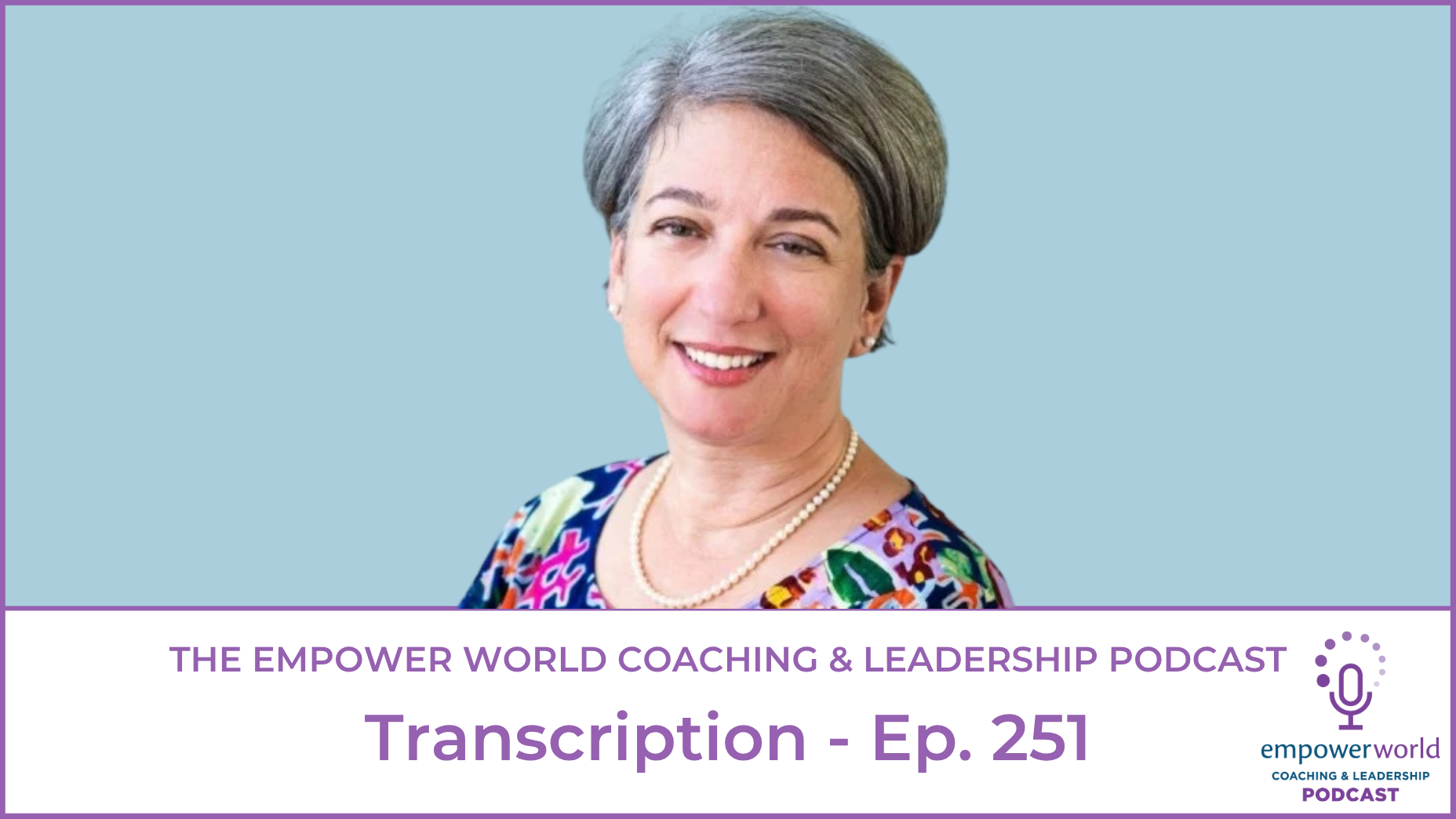
Zsofia Juhasz
ICF Master Certified Coach (MCC), Mentor, and Supervisor
Jeanine Bailey: Hello and welcome, listeners, to the next Empower World Coaching and Leadership podcast. I am not here today with Marie, but I am with the wonderful Zsofia Juhasz. Did I say that correctly, Zsofia?
Zsofia Juhasz: Thank you, yeah. It's not an easy name to pronounce.
Jeanine Bailey: Welcome, thank you for being here.
Zsofia Juhasz: Thanks for the invitation, Janine. Thanks so much.
Jeanine Bailey: An absolute pleasure, and I am delighted that Zsofia is here with us today, because we met many years ago through the ICF; we were both volunteers of the ICF Australasia branch. My role was in relation to coaching excellence, and I'm not sure if you were the president then of the Queensland branch? You were, yes. I just remember, because it was I'd recently moved to Australia from Qatar. And, of course, COVID happened not long after that, and so I was looking for a community to be a part of, and of course, the ICF was calling, because my business partner, Marie, she had just joined the Doha branch of the ICF, which was newly established. I really felt inspired to do something the same. I really appreciate the community that I was welcomed into in the ICF Australasia branch, and I always recall you, Zsofia, always checking in when you had ideas, connecting and having really great discussions to support our members, the ICF coaching members. So that has stayed with me, that desire to support me, and of course, support the members in relation to coaching excellence.
Zsofia, over to you to introduce yourself, as you know yourself much better than I. What would you like to share with our listeners today?
Zsofia Juhasz: Well, thank you for that, and I really appreciated that you said that you felt welcome, because I could relate to what you said about moving back-although you are Australian, moving back to Australia-because I'm Hungarian, and when I moved to Australia nearly 14 years ago, ICF was my community to go to. I remember moving here, and one month after, I went for my first meeting, and then it just evolved from there.
So, who I am. I'm the eldest of three sisters. I also have three kids myself. I used to work in corporate HR, and I'm a professional coach, a mentor, a supervisor, and most recently, an educator.
Jeanine Bailey: Mmm, fantastic, fantastic, Zsofia. And I know you've been on an incredible journey, which I believe your coaching journey began in Hungary as well, is that right?
Zsofia Juhasz: You did, yeah, you're right. I came across coaching when I was working for AstraZeneca in an HR business partner role. Astra hired coaches for the sales leaders, and then that company also offered a training in Leader as Coach training. I was pregnant, and it was, I guess, a fear of missing out if I don't sign up and don't take up that opportunity. I guess that initial intention was interest, curiosity.
After I had three children altogether, and when the youngest was six months old, I was sort of at the crossroads, like, what shall I be doing with my career, with myself, who I am? Navigating life challenges. And then I, again, looked around and sort of had the opportunity to reflect, do some assessments, and I realized that I'm a people person, but I also love developing people, leaders. Actually, I'm a teacher originally, although I never taught. So the overarching theme is people development.
This second course was a one-year course, and I really benefited and really loved. I always say this, Janine, that we were peer practicing and coaching each other, and one of the activities was, like, "What's your ideal day?" And I did write down what my ideal day was, which was part-time working in an HR leadership role, part-time coaching, being able to be there for my children. Do you know what? After I finished the coach training, six months later, I found that job in the shape or in the form of an HR manager role in the Walt Disney office in Budapest. I always share this story with my clients as well, that I guess if you set your intention, and if you set yourself that focus, it will happen. It was really an interesting journey and an experience, because it allowed me to practice the coaching skills that I've learned, both as a leader, as a coach, to hire coaches for the leaders, also be part of initiating a team coaching. If you think of this, this was 2010, like, very many years ago, and quite early, I guess, in my journey, but also team coaching and being part of a team coaching engagement. And now, just seeing the benefits, the ripple effect of that.
Jeanine Bailey: Yeah, fantastic, and I love that story about setting your intention as well, being real purposeful in terms of what you wanted to experience. I resonate with that, because I remember as well, when I went on my journey of becoming a professional coach, I was working for a consultancy at the time in Qatar, and I knew that when I started the journey of coaching-I didn't really sort of did it based on understanding it's about supporting people, which I understood was similar to you, wanting to support people, to develop people-but I didn't really understand what coaching truly was until I did the training and mentoring and so forth. But when I started to get excited about really what coaching was about through my training, I was working for this consultancy, and I thought, what I really want to do is actually transition into a coach for the consulting firm, and offer coaching services. I shared that with my manager at the time, and he said, "Yes, that's possible." And I thought, "Great! That'll probably take a year, or two, or three," but literally within months it happened. So, yeah, setting your intention is so powerful.
Zsofia Juhasz: But I also believe that if you ask what you want, you give yourself a 50% chance of making this. Because if you don't ask, the answer is always no, whereas if you ask, it can be a yes or a no. In that case as well, it shows that asking, being courageous, you never know what will happen, and in your case, it led to something who you are now. So that's very powerful.
Jeanine Bailey: Yes, I think it's a combination of setting the intention, and then taking action to make that happen.
We met briefly before we started to record this to look at what we might focus on, Zsofia. We had some ideas, and we really landed on this idea about-as we met through volunteering-this idea about volunteering in service of ourselves, the coaching community, the profession of coaching, and of course, the people that take up coaching services. Of course, we met back at the ICF Australasia branch, but I know that we've met on a number of occasions through volunteering-type activities. I remember a supervision-just came to me-there was some supervision volunteering that occurred as well, I think, during COVID. And more recently, we've been collaborating. You've been part of the organising committee, and I've said, "Yes, I will support with coaching supervision for ICF Australasia." So we really landed on this space, being able to create awareness to support the industry about how valuable volunteering is in service of, again, of ourselves and others.
Zsofia, what-and you shared with me earlier some key things that brought you into this space. Maybe if you share a little bit more about that with the audience, what perhaps kicked off that journey, and what have you been noticing as a consequence of that incredible-what I see is incredible desire, energy, and generosity that you bring.
Zsofia Juhasz: Thanks, Janine. I think, as I said before, having moved here from Hungary, I guess my first desire was community. I didn't know anybody. I wasn't intended to, you know, sign up into university course or anything. My children were young, they didn't speak English, so it was a lot around-I wasn't doing sort of what I would call it anything, but as you would say, I didn't have the professional identity, I wasn't doing any professional work like what I did in Hungary. I remember saying to my friend in Hungary who was volunteering for ICF that, "That's crazy, why are you volunteering there? We have such a limited time with our time." But here we are two years later, when I told this to her.
Initially, I became-because of my HR background-and then, I guess, also the G20 in Brisbane, and through that, I became involved in, first, the G20, and then through that to Dress for Success, because they were looking for an HR volunteer, or a volunteer with HR background, so I supported the applicants with resume writing, interview preparation, policy review, whatever was needed. I think that sort of built up my confidence.
Then when the ICF leadership team was always very inviting, like, "Zsofia, come and join the leadership team," I said no a couple of times, maybe three times, and then the fourth time I said, "Yes, okay, how can I help?" Initially, it was membership, looking after members, and that was very similar to HR, looking after the employees of the organization. Then I got involved into organizing professional development activities, as you would do in a chapter and a branch. And then because looking after the members as well, we did a lot of outreach to renew, and then we did some data analysis, and we found out that a lot of the members don't renew after two or three years. In conversations with these members, it turned out that, "Well, I can't sustain my business, I don't have the money to renew my credentialing." This sparked an initiative 10, 11 years ago to create a program called Core Competency Coaching Circle, which is a really long name, but in reality, it is a group mentoring. We created it in a way to host two mentors, to have the capacity for 20 participants. We planned it to have it towards the second part of the year, once a month, two hours, one or two competencies, bit of practice, because we always miss the opportunity for demo coaching. This really allowed and supported the members to renew their credentialing at a quite affordable rate. Although initially it was very successful, there was a time when I thought, "Oh, this is not going to be possible." We were in year four or five, and there were hardly anybody turning up, although it's very experienced MCC mentors who offer their time. But then again, COVID happened, and it just gave a new revival of this initiative, which I'm really proud to say it's in the 11th year. There were one or two years when we had to actually offer this twice. I'm really proud because there's that community. Every year, there are coaches who say that it's been really beneficial, or maybe sometimes there are coaches who come back after three years when they have to renew, or when they want to learn, and it's a good opportunity to check in with, you know, where we are, how are we role modeling, how are they, what are the things they do well in their coaching, and what are the things that they could do better.
I've done this, and then I also put my hand up to be the president for the Queensland branch, which I did for three years. But as you know, volunteering can be very time-consuming. Just before the pandemic, I said, "Well, if I'm spending all this time on volunteering, I see if I could be spending it on my business." I ended up working quite a lot, and that allowed me to become an MCC, but also learning from those mentors in these group sessions. In the meantime, I think one thing that I guess was my last act with my HR hat on-that I was also volunteering for the global nominating committee for the Professional Coaches Board, so I was part of the selecting committee who selected the board members. It was also very fun, very late in the evenings, like 10 or 11 o'clock at night, once a month, reviewing the resumes, but I really enjoyed it.
I guess why I'm doing volunteering still is for the community, to give back, to learn. I didn't do really well at uni, I guess, or in school, and I think that's a learning for me, that becoming a coach or being a coach, that I'm actually quite interested in learning and continuous learning. If I look at my log of studies every year, I guess every year I do at least 40 hours, so it's not like 40 hours over three years, but quite a lot. I like to overdo things, obviously, sometimes.
Even now, as we discussed, I volunteered to review the applications for speakers for both the Paris conference and the upcoming Washington conference. I'm still, in a way, volunteering for the New York chapter, and we co-created a group supervision initiative as a pilot, and also with the Israeli chapter, offering a group mentoring training for the chapter members there.
Jeanine Bailey: Mmm, gosh, it's a lot, and that you are committing to, and again, I hear that generosity. And I think you're doing something with Australasia as well, I see a hospital leader in terms of the supervision that I've been involved in.
Zsofia Juhasz: Yeah, you are right. Actually, it's not just an ICF Australasia initiative, it's a regional initiative where 14, 16 chapters participate, and it's called Coach a Coach Program, and it's hosted every year, and it's a different chapter. Whoever signs up can participate in a triad to receive, to give, and be an observer for coaching triads. Then the midpoint check-in event-as part of this initiative, I, as a supervisor, suggested, and of course, looking at the core competencies that Competency 2 says that coaches participate in mentoring and supervision as needed, I sort of floated this idea that how about we offer group supervision? It's a good experiment, good experience. Not every coach knows about the benefits. I reached out to-I think we reached out to 50 supervisors in the region, and then ended up, I think, 20 of them attended. The timing was a Friday afternoon, so that might have had a bit of an impact on who turned up, but 20 supervisors did, and over 100 participants as well. The feedback was that actually the supervision was the most beneficial and useful and valuable part of this whole not just this coach-a-coach, but apparently their whole member ICF journey so far. I was so happy with that, that we could offer something new and different and exciting, innovative, for benefiting the coaches.
Jeanine Bailey: Yes, yes, fantastic initiative, Zsofia, to really create greater awareness and, again, support the profession of the coaching industry. So I'm hearing so many wonderful initiatives that you've created, Zsofia, that have really created an impact, that ripple effect. You've been receiving feedback that lets you know that this has been really helpful for the coaches in the industry, particularly those that might be struggling, being able to put them back on track.
I'm just curious, as you have been sharing this, what are you perhaps being struck by, or noticing as you reflect back on so many wonderful initiatives that you have been a part of?
Zsofia Juhasz: That to give and be generous is very rewarding. But potentially, it's also aligned with my values, especially being in community, learning. So I think if one finds their values, or what is important for them, then I think all these things sort of become very easy to do, it's not a chore. I remember when I was president for the Queensland branch, and I was looking for volunteers that I always ask, like, "What are you passionate about? What is your strength? What are you really wanting? Can you commit to?" Because if we are busy raising kids, starting the business, working, life, and you are wanting to volunteer and give, I don't know, one or two or three hours a week, a month, whatever that is, if it's always going to be the very bottom of the list, it will not work, and it's not going to be sustainable, not for you, but also for the-in this case, ICF, but in any case, any volunteering activity. I try to give the coaches opportunities around their strengths, and sometimes it works, sometimes it doesn't, but I think that's the learning, that it's leveraging what we are good at, the strength. What we are passionate about, finding that, and then it will work. It's easier.
Jeanine Bailey: Yes, yes. And knowing that you are doing this great work for many years now, it feels to me that it also supports your brand, your reputation, who you really are-again, an instigator, someone who gives back, someone who's creative, resourceful, who really does support people. I'm curious, what else have you noticed as a consequence of giving so much of yourself? Because I know, being a volunteer myself, that it does take up a lot of time and effort, as you've shared, particularly when you're branch president. What is this giving back to you?
Zsofia Juhasz: To inspire others, and I really love to inspire others to see-I guess, that maybe they don't see what's possible, but then again, if we are to be creative together, then, yeah, there's this saying in Australia, the busy bee: many hands do magic. It's easier to do things together rather than by oneself. Using one's-in this case, being creative, but I think also what you said, that having maybe been doing this for a long time, if I reach out, having that network, I get a lot of yeses. Not all the time, of course, but it's easier to get a yes, or it's easier to do a next initiative because of the network, and maybe the track record helps.
Jeanine Bailey: Yes, yes. And I trust also that it comes back to you in ways of paid work, too. And of course, that's potentially not why we get into volunteering, but it can be a bonus. I'm trusting, I'm hoping for you, Zsofia.
Zsofia Juhasz: Yeah, I mean, it wouldn't be true if I would say no, it doesn't help. We did speak about the mentoring, and I mean, this is how I got into mentoring, because somebody who got to know me through my volunteering said that she wants me to mentor her, and then although it was a bit of a fish-out-of-water experience initially, again, I ended up learning and studying and practicing what I could find, and yeah, it did give me opportunities that I never thought about initially, because somebody is asking.
Jeanine Bailey: Yes, it's the law of reciprocity that comes to mind. And again, I really appreciate the time, the effort, what goes into volunteering, because potentially we are offering webinars, we are offering demonstrations, we are offering, as per your latest volunteering initiative that you've shared in terms of providing coaches the opportunity to experience supervision. That takes time and effort to prepare all of that. I can resonate because of my own personal volunteering that I do. It does take time and effort, and I have really loved every piece of work that I've done, even though sometimes I might go, "Oh, I don't know how I'm going to fit this in."
Zsofia Juhasz: You somehow fit it in, because again, you are passionate about it, you love doing it, you get something out of it, but by giving, you also get.
Jeanine Bailey: Yes, yes. And I recall, particularly in COVID as well, as a result of doing volunteering and also being involved in other offerings that have been volunteered. So for example, the Climate Coaching Alliance, experiencing some of their sessions, and then feeling passionate about that and also volunteering for that as well. It just opened up such a huge world for me, because here we were in COVID, lockdown into where we live, but all of a sudden, speaking to so many different types of people from all across the globe just opened the world for me in so many ways, and opened up those working opportunities that you shared, Zsofia. It was such a beautiful place to be, to be in that space of connecting with incredible human beings who want to make a difference in the world.
So what would you say to maybe a new coach, or maybe a coach that's been coaching for a while, that perhaps is considering volunteering, or perhaps hasn't considered volunteering? What might you say to them?
Zsofia Juhasz: I would say reach out to your local chapter leaders, reach out, put in a post on the ICF Engage portal. I also found out that not everybody knows of these resources-the Engage part. There are 65,000 members, all the members of ICF are there automatically. Look for opportunities, like the IGNITE initiative that you can do either through a chapter or individually. I think you can also volunteer through ICF for special projects, special initiatives. There's a lot of opportunities to be involved. It doesn't have to be, in my case, 20 hours a week being a branch or chapter president, but there are opportunities like being an evaluator, being an award reviewer. ICF is looking for exam questions, subject matter experts. There's-I think on ICF website, one can find applications for certain things, which is more global, but if you want to start at a local level, then do at the local level. I'm sure that the chapter that coaches belong to, they will be looking for them to be involved. As we both know, Damian-I remember him saying all the time that he started as a welcomer at the Los Angeles chapter, and then he ended up being the president, or the chair, for two years. You never know where these opportunities lead. Personally, I don't have the desire to do that, but there are inspiring leaders around. I'm sure they would have the time, or I'm happy to chat as well. I'm sure you as well, that if somebody would reach out, "Where to start?" then have a conversation, reach out. I guess most of the time, people, coaches would say yes to these meetings, and you never know where it will lead you.
Jeanine Bailey: Mmm, exactly. And I have been a volunteer with the EMCC for many years now, and so I absolutely know that the EMCC is very open to volunteers joining. I would suggest to anyone listening, just have a look at your EMCC area-I can't remember the name of what you call it now, but certainly I was in the APAC region when living in Australia, and now over here in Europe. I would also, if coaches listening are interested in other types of volunteering, I mean, all of the coaching bodies, I have no doubt, would be looking at volunteers. There is the Climate Coaching Alliance, which is an incredible community of really engaged and passionate coaches that want to make a difference in relation to our climate. And for any supervisors listening, the Global Supervision Network, which I'm also a volunteer for, they are often looking for volunteers to support what they do, so another great organization that supports the profession of coaching and supervisors.
Zsofia Juhasz: And I think, just what I want to add is that, especially with the global level volunteering, because it gives you sort of-I don't like the word access, but maybe staff will get to know you. I don't know when you said that this will air in a couple of weeks, so potentially by the time this will air, say, personally, I find it that the Ethics Water Cooler conversations happening at 11 o'clock New York time, which is, I don't know, 1, 2, 3 AM here in Australia. I did reach out, because there was somebody posting about it on Engage, and then I followed up, and I've written to Christine Kelly, and then she said, "Yeah, let's have a chat, and how we can make it possible." So again, if you have ideas, initiatives, and if you see a gap, most likely there will be an interest and opportunity to make it happen, because again, it's the benefit of many, not just one. Hopefully there will be at least once a month at a suitable time from India to New Zealand in the middle of the day, or in the morning, or early afternoon, but definitely not at 1 AM. I guess the most recent-because I see missing, something is missing, and obviously others are seeing as an opportunity.
Jeanine Bailey: Yes, it's when you notice there's a gap in what is being offered, it's how can I perhaps support, fill that gap in terms of what could support again the profession of coaching. Fantastic, fantastic advice.
Zsofia Juhasz: But again, I'm not an expert in ethics by any shape or form, but she did say that, "Well, we need somebody, or if somebody would be doing this, is facilitating a conversation." So I said, "I can do that," and maybe there will be an ethics expert will join, and yeah, or it's more of a conversation, as you know, it's like sharing. Anyway, I'm excited.
Jeanine Bailey: Yes, and you know, ethical maturity is such an important part of our practice, growing our ethical maturity and enhancing that. It's so important in this industry where we are looking after ourselves, so to speak.
Zsofia Juhasz: I don't know what you mean, but yeah, you are right. We need to-and then, I guess, the more we do what we do, the more awareness, experience, and then, as you said, that we are maturing, and ethics is a core key part of that, how to be ethical.
Jeanine Bailey: Yes, exactly.
Well, thank you, Zsofia, for sharing your experiences and your advice, as well, for those that might be interested in volunteering. I think we would both say we would both encourage coaches to really embrace the opportunity to give back to the profession, because by doing that, it also gives back to us.
Zsofia Juhasz: It does.
Jeanine Bailey: Through the connections, the community, our development, our personal development. It raises and supports the awareness of coaching, again, creates that beautiful ripple effect.
Zsofia, I really thank you for your time, and generosity of time, and insights. Any last words before we close up?
Zsofia Juhasz: Well, thank you for the invitation, it was a pleasure, and I really enjoyed our conversation, and hope it inspires others, at least one person, if not more, to think about, consider volunteering, giving back, and enhancing the profession themselves, and for the benefit of everybody.
Jeanine Bailey: Fantastic, Zsofia. And, of course, for our listeners who want to get in contact with you, Zsofia, we've got the details in the links below, so please do reach out, and I trust Zsofia would love to connect. Thank you for listening.
Zsofia Juhasz: Thank you for the invitation.
Jeanine Bailey: All right. All the best, and look forward to your feedback, listeners. We really appreciate any feedback that supports Zsofia, myself, and Empower World. So, thank you for listening.


