
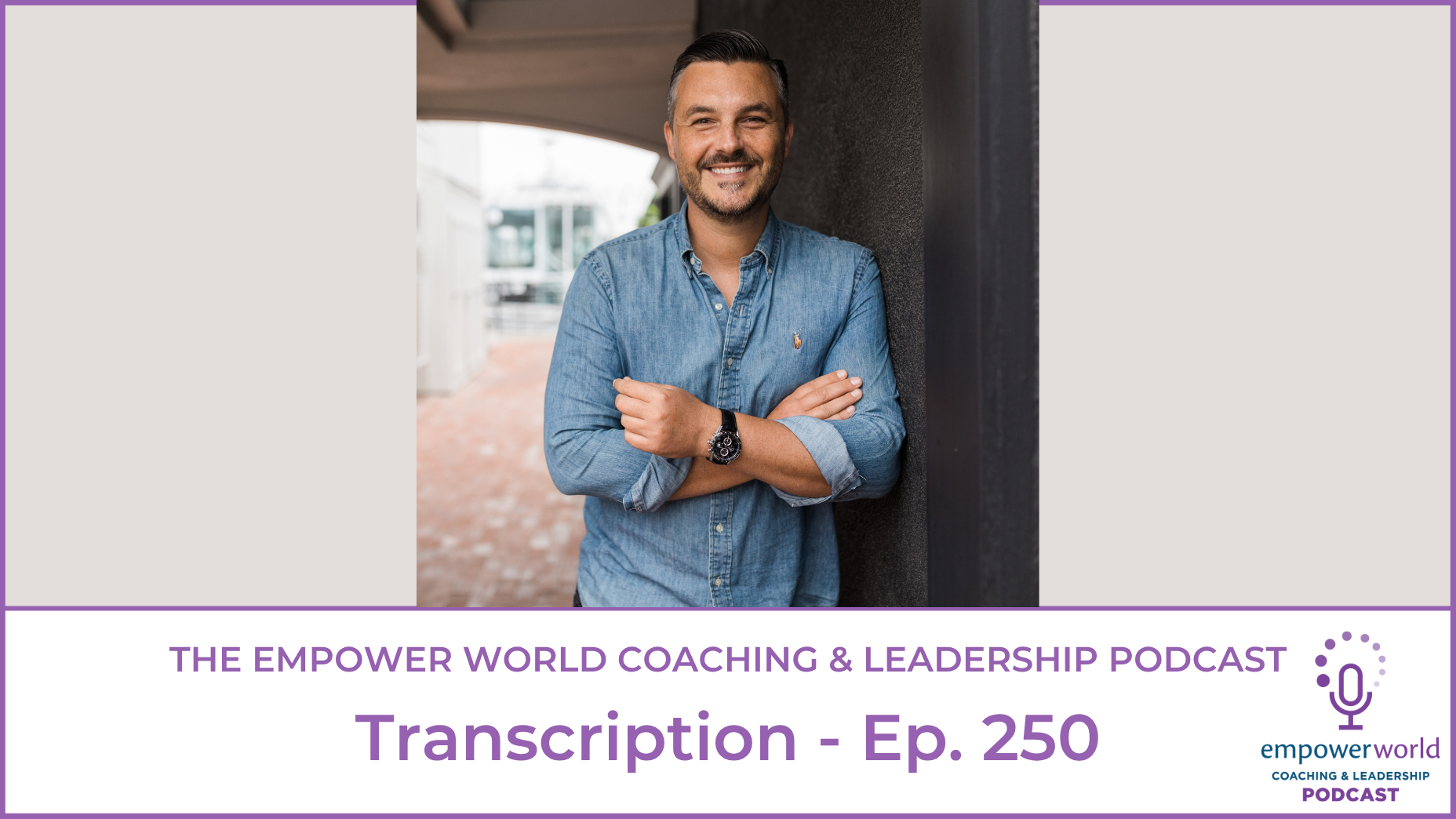
Colin Boyd
International Speaker, Trainer, and Coach
Jeanine Bailey: Hello, and welcome, listeners, to the next episode of the Empower World Coaching and Leadership Podcast. Today, I'm not with Marie, who is traveling abroad, I believe, or very shortly, but I am very, very fortunate to be with the wonderful Colin Boyd, here with me today as my very special guest. Welcome, Colin.
Colin Boyd: Thanks, Janine, it's great to be here.
Jeanine Bailey: Yeah, I'm so pleased you said yes. And you would have been in trouble if you said no, because we've known each other for a very long time. We met in our early days of training as a coach, so it was quite a while ago.
Colin Boyd: Yeah, we've been friends for a long time. When I saw your name pop up in my world, I was like, "Oh my gosh, I know Janine." So, I'm stoked to be a part of your world again.
Jeanine Bailey: And likewise, as I have invested in what you offer, Colin, and because I'm getting so much value from it. I know you've been on our podcast quite a few years ago now, but you've certainly evolved and developed, so I really wanted to bring you back in to support the coaches and leaders who coach to be able to look at how we can present ourselves, potentially in a presentation, that really invites, excites people to listen to our story, because what we want to share is how we can support others to create incredible transformation in their lives.
And of course, Colin, I've also got your book here, One Presentation Away, which I know is something that you're passionate about-that in terms of our presentations, the way we communicate, speak, our stories, our webinars, our keynote speaking can, again, really attract people to come into our world, and it's in that place we can make that difference.
So, Colin, I've done a bit of speaking. I'd love to hand over to you to introduce yourself before we dive into today's content.
Colin Boyd: Yeah, well, thanks so much, Janine. So hello guys, hope you guys are doing well. Yeah, so my name's Colin Boyd. I've learned in my coaching business-I've been running my coaching business for about 17 years now, and it was about 5 years ago that I started to realize that I wanted to help coaches, experts, entrepreneurs build presentations to get them clients. I realized that if I looked back over my journey of building my business, I've operated in various different niches, from career coaching to emotional health coaching, to performance coaching, to leadership coaching. I looked across all of it, and I realized that it was actually speaking that really drove most of the revenue in my business.
I started to look across the spectrum of the industry, and I realized that every single time I looked at a leader in the industry-and not just my industry, but a lot of industries-I noticed that the more they moved into leadership, the more they spoke. Speaking for me was not something that came natural initially. It used to completely freak me out; I would physically shake when I was going to speak. But it wasn't until about 5 years ago that I really wanted to teach speaking, because I realized that speaking had become an integral part of my business. I just think it's a powerful way to connect with people, influence people, and grow your business in a leveraged way, rather than just one-to-one selling from a presentation. So essentially, I help people build high-converting presentations and help them become the speaker that they want to be to grow their business, their brand, and their message.
Jeanine Bailey: Mmm, yes, fantastic, Colin. And of course, you have trained as a coach, so you really appreciate you're part of this industry that is all about supporting others to be the best versions of themselves, and you are specializing in supporting people like me, coaches, and leaders, to be able to present our stories in a way that, again, attracts people into our world. I resonated with you when you shared about that initial public speaking, physically shaking. I remember having brain freezes when I wasn't in this coaching world, when I was in another world-back in that world, the finance industry, back then, for me. I really was motivated to speak. It felt like a real challenge for me, but I was ready for that challenge. Although back then, of course, I wasn't really ready, because I was having these brain freezes. But coming into coaching, and what I do, it's been just because it's so aligned with everything that I believe in, that I'm passionate about, those brain freezes have never ever occurred again. And I still know that I can improve what I do as a coach, and the way I speak. So, I'm really appreciating everything that you've been sharing with me, Colin, so far.
In terms of for our listeners today, where, Colin, should we dive in to support our listeners to appreciate the power of being able to speak elegantly, beautifully, articulately in a way that is of service?
Colin Boyd: Well, I think we can start with, first of all, just the mindset, the perspective of someone coming in to do a presentation. Because a lot of the time, when you get prepared to do a presentation, maybe you want to run a webinar, or you want to run an in-person workshop or something like that, and especially if you want it to produce clients, you want the result to be that you get clients. A lot of the time, people can kind of go either of two ways. They go one way, which is they design a really salesy type of presentation that has very little value, is very surface level, and it feels a bit off, it feels a bit icky with the delivery of it. Or they go the other way, which is they build a presentation that's very how-to, lots of content, lots of information, very overwhelming for the audience.
So what happens is they come in, they deliver the presentation, and either, if it's very salesy, people will not enjoy the presentation. You might get a few sales, but it doesn't feel great for you or for the audience. And then on the other side of the spectrum, you deliver a great presentation, you get lots of nice comments, people clap, and they say, "That's amazing," but it doesn't turn into clients. Because a lot of the time, they're overwhelmed, and they say, "Look, I'm gonna do the 10 to 20 things that you've told me to do, and then I'll come back, and then I'll check out your program, your course, your coaching after that."
I think what we have to realize is, first of all, when you're building a presentation, we have to focus on serving the audience. Serving the audience in a sales presentation is different to serving the audience in a practical delivery presentation. So for example, if you have clients and your goal is to deliver a fulfillment workshop-you've said, "I'm gonna deliver a workshop for you to teach you a skill"-you teach them the skill; that's the goal of teaching them the skill. However, serving your clients in the context of sales is not teaching them a skill; it's teaching them to make a decision.
The thing that people are held back on in their life is usually not that they think they need more information. Most people, because they're in uncertainty as a prospect about something they want to solve, they're in uncertainty. They're looking for a solution to something. They think they need more information. The truth is, they don't need more information. The truth is, they need to make a decision. And the decision is to commit to themselves on the next level. Now, that commitment might be through your program-that could be a great next step-or it could just be committing to themselves on the next level. The presentation needs to be designed to facilitate motivation, decision, resolve in the audience's mind, not overwhelm them with too many things to do.
Jeanine Bailey: Yes, I really again appreciate what you've shared, because those sort of workshops, webinars that are about-and you can hear my awkwardness-about selling your services, it needs to be reframed. It goes back to the mindset. And what you importantly say is those webinars, workshops, discovery calls, whatever they may be, is when it's about supporting people to make a decision versus trying to push something on them. But actually, what you want to do is support them to become aware about themselves, so that then they can make that decision freely, without that pressure. And if they say yes to it, then potentially it's very aligned. And if they say no to whatever it is that you're selling, then that's okay. You're potentially not aligned.
Colin Boyd: Yeah, exactly. A lot of the time, people feel uncomfortable selling because they feel like they're trying to get people to do something that they don't want to do, or they're trying to get money out of them, or something like that. I think we need to reframe what selling is. Selling is just simply opening up an offer, or opening up a space, for someone to commit to themselves in an area that they want to commit anyway.
I think about one of my clients, her name's Lindsay, she's a single mom, lives in Buffalo in New York. She had an online course and a coaching program; she worked with wedding professionals, and she was just trying all different types of strategies. Very kind of overwhelmed, couldn't get much traction. She joined one of my presentations where I make an offer, and she joined our Sell From Stage program. Then she followed the structure, designed one presentation, and she ends up using that one presentation. Now she delivers it once a week. She wrote me an email the other day, and she said her income's gone from basically $1,000 a month to she's doing $30,000 consistently every single month in revenue, and she's only working like 20 hours a week. She's like, "This has completely changed my life."
If I think about it, if I'd just given her a few things that she could try or do, she wouldn't have got that result. How she got the result was she followed the whole process; she fully committed to it. That's how we need to think about when you make an offer, when you sell-you're truly setting someone up to change their life in a good way, in a positive way. Rather than feeling like you're taking something from them or taking money off them, it's no, no, no-you're creating a space for them to commit to themselves on the next level. The exchange of money is part of that transformation. If they don't pay money, a lot of the time they actually don't see as much transformation as they would.
Jeanine Bailey: Hmm, yes. So it's that transference of energy.
Colin Boyd: Yes.
Jeanine Bailey: So I'm hearing from you, Colin, there's certainly obviously a number of elements to this, so mindset being one. And that sounds, for me, incredibly important. You know, we've got to be in that space and frame of mind to be able to share our story, but also be willing to receive as well.
Colin Boyd: Yeah, absolutely.
Jeanine Bailey: And there's also structure, so you've touched on that as well.
Colin Boyd: Yeah, we can chat a bit about structure, for sure. With structure, for me, there's kind of three big elements to any presentation. There is the introduction, there's the content, and then there's the close. Depending on what the intention of the presentation is, it's gonna follow a slightly different structure. Usually the introduction and content are very similar, but the close will be different.
There's three types of structures that I teach, which is a sharp sell, a soft sell, and a no sell. The sharp sell is where you directly ask people to join a program. You make an offer, you say, "Hey, here's the next step, buy now," basically. The soft sell is you get people to book a call, and from that call you can have a conversation about helping them take the next step, join the program. The no sell is a classic keynote; there's no offer at the end, but if you design it right, you should have a line of people who come up to you at the end and say, "Hey, really love the presentation, but how do we work together?" That's the goal.
With the flow of it, I always like to go-the first introduction is about touching their hearts. It's about creating motivation for them about the topic, motivation for them about wanting to connect with you. So you share your conversion story, which we can talk about as well. Your conversion story is the story that when you tell it, it naturally makes the audience want to work with you. You're gonna share your conversion story, you're gonna frame up why it's important, then you're gonna move into your content. Your content is gonna be content that doesn't just teach; it's not just teaching ideas, it's truly shifting their perspective on topics.
What I mean by that is, the topic of selling is a topic that I shift a lot of people's perspective on. One of the content pieces that I'll teach when I'm running a training is the reframe of selling, because that's a really important reframe for people to understand if they ever want to learn to sell from stage or sell from a presentation. They have to see selling in a different light. That's really valuable, even though it's not practical, it's still valuable.
A lot of the time, people misunderstand value for practical. They think practical is the only currency of value, where value is actually reframing people's perspective. Value is actually giving people context on things. Value is removing resistances and misbeliefs about things so that people can actually move forward. That's value. Essentially, the content piece is going to be reframing, it's going to be creating desire, it's going to be showing a big, usually contextual model or framework. Then you move into the close, and the close is really where you ask the next step, whether that's to join the program, book a call, or an inspirational close.
Jeanine Bailey: Yeah, thank you for sharing those three different types of presentations. I guess what could be overwhelming or confusing for many is, you know, what do I put into that content? Because there could be the desire to oversell, or make promises without anything behind it, or it could be around experiences, providing people with an experience. So I'm just curious, Colin, what are your thoughts in terms of that content piece? What perhaps is valuable to share?
Colin Boyd: Yeah, well, I think you should teach some concepts that have value. So for example, I'll teach about storytelling when I'm running a presentation to teach people how to speak and sell. Storytelling is a really valuable piece of speaking well, and a lot of people don't include enough stories. You still want to teach content that's valuable, but what you have to be careful to do is not go too far below the what I call the "lose-the-sale line." The lose-the-sale line is where you get into too much detail and too many processes. What tends to happen is if you get into too much detail, too many processes, the audience will start to glaze over, they'll start to get overwhelmed, and feel like they've got so much to do before they take any sort of next step. You can still teach some practical things, but you just have to be very careful to not overwhelm the audience too much, because an overwhelmed prospect won't buy.
A motivated prospect will buy, so you have to make sure that you're motivating them to buy. It's concepts that teach and create desire as opposed to teaching them everything that they need to know in the content. You gotta think, you can go into your program, your course, your coaching experience, and go, "What are the key concepts that are really valuable in here?" And then you can put them into your presentation. But the key is to not teach too much detail in them. You need to teach why they're important, you need to teach what they're about, you could ask some questions, you could give some examples, but you just don't want to go too overwhelmingly into the detail, because that'll just overwhelm the audience, and then they'll say, "This is really helpful, I'll check out your program maybe in six months." And that's not what we want.
Jeanine Bailey: I experienced something like that the other day, looking at a Qigong course for myself. Yes, there was just way, way too much information. There was some really valuable information, but too much. I found myself switching off, and particularly coming towards the end, a whole lot of slides with lots of details on the slides, and I just wanted it to get down to the core of it. And I haven't looked back at it.
Colin Boyd: There we go. Yeah, that happens all the time. People don't realize, they think, "Oh, if I show the audience that I know lots of things, then they will trust me, and then they'll want to buy." But all it does, a lot of the time, is just overwhelm the audience, and then it just kind of slows down their decision-making process.
Jeanine Bailey: And Colin, you talked about-I believe I heard you say-creating desire. You run a program, but just checking in with you in terms of supporting people to create that desire, what tips might you share with the audience?
Colin Boyd: Well, creating desire is starting to elicit motivation in people. So for example, let's say if I'm teaching storytelling, I will teach why storytelling is so important. Why creates motivation. I will teach what storytelling might look like from maybe a framework or a model. I could teach, like, there's three things in storytelling you need to have. And then I might tell an example of the power of storytelling. I might ask some questions of, like, "Where is your story at at the moment on a scale of 1 to 10? Is it a 10? You've got it dialed, it's really clear. Or is it more like a 3 or a 4? You haven't really refined it. Where's it sitting at the moment?" So people are going to identify a gap. And then I can ask a question like, "Imagine it was a 9 or a 10, how would you feel about speaking if you knew every time you spoke and shared your story, the listeners naturally started to draw towards you, wanted to work with you? How would that feel in your body?" And people would be like, "Oh, it feels good, I like it." See what I'm doing there? I'm talking about storytelling, but I'm not going into too much detail, but it's creating desire to learn storytelling. But it still feels valuable because I'm teaching content, I am showing a general framework, but we're eliciting emotion, we're eliciting buy-in. So that's what I mean by creating desire.
Jeanine Bailey: Yeah, it's really supporting people, what I'm hearing, to potentially step into their future self, and to experience what that would be like, to try to embody that.
Colin Boyd: Exactly.
Jeanine Bailey: What is wanted? What is experienced from a holistic perspective?
Colin Boyd: Yes.
Jeanine Bailey: And Colin, you also referred to the conversion story earlier. Did you want to dive into that a little bit more?
Colin Boyd: Yeah, well, the conversion story is-most people tell their origin story, so they tell the story that just kind of shares the journey of how they got into business, why they got into business, why they're credible, and that sort of stuff. That's okay; it's not a bad story, but it's not always the right story to share. The right story to share is what I've framed as your conversion story. The conversion story is the story that best captures the transformation that you help people with. That could be an experience you had with a client; usually, as well, it might be a personal experience that you went through. There's a whole process around finding that story, and then telling that story in a way that when you tell it, the audience will go, "Oh, this person gets me. They've been through similar sorts of challenges, they've achieved something, and it sounds like there's a really clear path that I could follow to get a similar result." A conversion story does those three things. It answers the three questions: Are you like me? Can you lead me? And is there a path that I can follow?
Jeanine Bailey: Yes, thank you. I appreciate you sharing, again, some valuable tips to the listeners. What I appreciate through going through the program with yourself is really getting some nuances, some subtle things that I wasn't aware of, so it's been really helpful. I'm looking forward to getting back on the stage with that awareness and that knowledge and experience.
Colin, I know you've worked with some really incredible people in the industry since you've really focused on this part of your experience. Is there anything that you'd like to share with the audience about those experiences that can reinforce the things that you've been sharing, that is working incredibly well for others?
Colin Boyd: Yeah, you mentioned, Janine. I mean, we've got over 20,000 clients who have bought from us over the last 8 years or so. When I get the chance to work with some of the biggest people in the world in our industry-just literally at the moment, I'm working on a presentation; the guy's done about $2.3 million in sales in the last 4 days. He closes his cart tomorrow. I work with people all over the world. What I've realized is that even at the highest level, people get unsure, they still question their story, they question their content, they question all of that stuff. But really, really what I notice people do at the highest level is they truly decide to listen to the faith in their heart, and not the fear. They go after serving people, helping people, contributing. One of the things that I've noticed is that, yeah, just realize that if you are questioning your story, your content, all the stuff, it's normal. There's a normal part of the process. The goal is to not listen to that-obviously, to learn how to do it better-but to go after it, to trust the faith, and go after it, and put that in there. So that's my encouragement, I would say.
Jeanine Bailey: Yeah, fantastic, Colin. I also appreciate that you do offer a variety of different ways that people can access your experience, your knowledge, at all sorts of different price points, investment points, I'm going to say. So for people that are interested in finding out more about you, where can they go?
Colin Boyd: Yeah, I mean, if people want to create their conversion story, that's usually the first point of contact that I have with people. It's called conversionstoryformula.
Jeanine Bailey: Yes, and you have this-have I got it upside down? There we go. Yes. And it's behind you. Just for the audience's benefit, I am really enjoying what I have been learning from you, Colin, and it's a great setup. So thank you for the experience, and thank you for being here and sharing some of your wonderful tips, clues, ideas, insights for our audience. I know we're both passionate about supporting others to make a difference, and we know that we're not everybody's cups of tea, but we can still keep that ripple effect going. Thank you for being here.
Colin Boyd: Well, thanks for having me on, Janine. It's been a pleasure.
Jeanine Bailey: Yeah, an absolute pleasure. So thank you again. Listeners, love to hear your feedback and to let us know what you're learning, what you're taking away, and what you might like to listen to going forward. So thank you for tuning in.


