
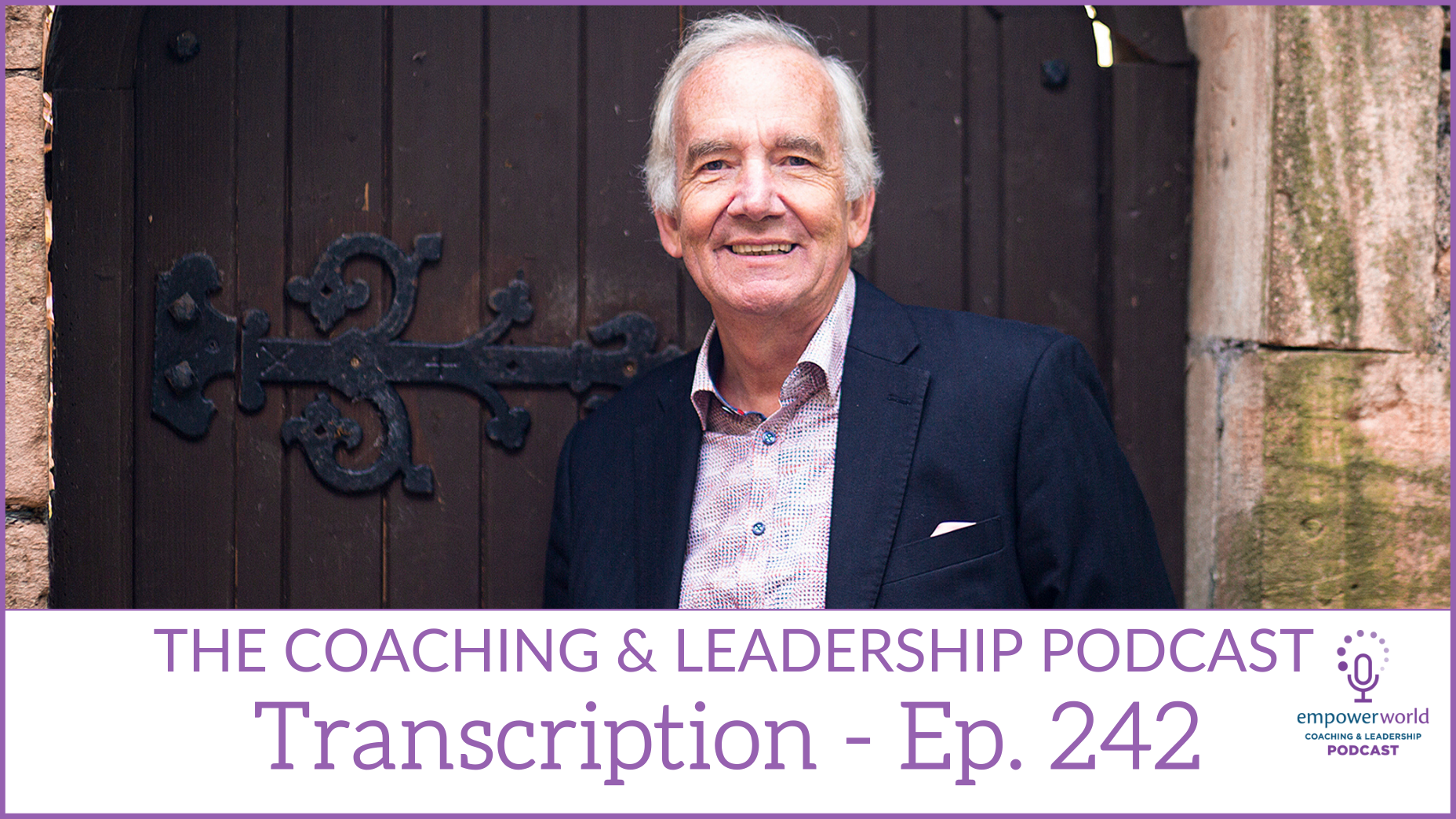
Professor Peter Hawkins
Global Leadership & Team Coach
Jeanine Bailey: Hello, and welcome to Empower World's Coaching and Leadership Podcast. Today, I'm not with my wonderful co-host, Marie Quigley, who's currently in South Africa exploring at this time of recording. And I am with the wonderful Peter Hawkins, Professor Peter Hawkins. I'm so delighted that you're here, Peter. Welcome.
Peter Hawkins: Thank you, Jeanine. Pleasure to be with you.
Jeanine Bailey: Thank you, and it is such a delight to have you here, because I know you've had a huge influence on certainly Marie and myself, in terms of how we coach, how we supervise, so I really want to thank you for being that wonderful influence that you are, certainly in our lives, and I know for many, many others across the profession.
So briefly, I'll share an introduction to Peter, who is the chair of the Renewal Associates, and one of the most influential authors, coaches, certainly in leadership, in coaching, in supervision, and I know so much more organisational development. Some of those wonderful books that you've authored include Leadership Team Coaching, Systemic Coaching, Team of Teams Coaching, which is a new book, and Supervision in Helping the Professionals. I'll come to you shortly, Peter, about your new book, which I hear how passionate you are about it. But also wanting to share, Peter, you also advise boards worldwide, teach master classes on leadership, cultural change, organisational learning. You've been instrumental in how organizations build collective leadership and create value for stakeholders, and so much beyond.
From the ways that I've met you, Peter, through the ICF Australasia, in the Transform 2020 conference, certainly on panels with you, with the Global Supervision Network, and through many other ways, that you are very conscious of how we as human beings impact our precious planet as well as communities, other communities that perhaps don't have the ability to tap into the resources that others can. And I'm trusting this is okay to share, that you have this awareness that we all have a responsibility to ensure our actions or non-actions are ecological, ethical, that they support the greater good of our planet.
So, Peter, thank you for being here, and there's potentially more you might want to add to your experience, and I know that you're very passionate about this new book that you've launched, Beauty in Leadership and Coaching. So, Peter, again, a big welcome over to you to share whatever you need to share with our audience.
Peter Hawkins: Well, I would add, Jeanine, that perhaps my two most important roles that are not mentioned are being a grandfather and being a gardener. And that is, you know, having the privilege of living into the second half of my 70s, you realize that the most important thing you need to focus on is what are we doing for the generations that are coming after us. Both gardening is, was it Thomas Jefferson said, live as though you'll die tomorrow, but garden as if you'll live for 300 years. And perhaps that also applies to coaching, that is, you know, how are you helping the next generations of individuals, teams, team of teams, organizations be future fit for the world of tomorrow.
Jeanine Bailey: So important, Peter, and I think the more that we as coaches and professionals who have the ability to be able to support others to think systemically, to reflect systemically about this beautiful planet that we are so privileged to live on, the more that we can hopefully create change that supports sustainability and the planet for millions of years, hopefully.
Peter Hawkins: And I think, you know, that there's a real necessary turning point in the whole coaching world, and shifting from egocentric consciousness to ecocentric consciousness. We kind of really need to look at how coaching has, in many ways, been part of rampant individualism. As you mentioned South Africa, and years ago, I did a lot of work through the changes in South Africa down there. And I remember one frontline tall black male leader down in Cape Town saying, when I listen to this stuff about coaching, it sounds like the people with the big offices, the big paychecks, the big cars now get the big coaches. He said, it sounds like coaching is very expensive, personal development for the already highly privileged. And, you know, that hit me in the stomach, and this is 20 years ago, really, and since then, you know, I've been very much looking at how is coaching not egocentric but ecocentric.
That's the book we talked about before we came online, the book that I did earlier this year, well, I finished it last year, but came out in January, Beauty in Leadership and Coaching. Its subtitle being, and its role in transforming human consciousness. I mean the role of beauty, the role of leadership, the role of coaching in transforming human consciousness. It is such a passion of mine, because I think we really need to rethink both leadership and coaching in very radical ways.
Jeanine Bailey: Yeah, absolutely, Peter, and thank you for making this book available, and bringing it into the world, and supporting that expansion of thinking of how we can create a much more equitable world going forward. So, I am very curious about perhaps what are some of the key messages that you share in this book that you'd like to share in our podcast today to, again, support the profession of coaching and leaders to be able to again, think more broadly and support their clients and their team members to be able to make a difference in the world.
Peter Hawkins: Well, the book starts with the what many call the polycrisis, which would be familiar to many of the people listening. You know, the climate change, loss of biodiversity, pollution, but then inequality in nations and between nations, migration, the growth of mental distress and illness. And it goes through that, a well-known list. But then says, well, the polycrisis is that all of those are interconnected. We cannot solve any of them, and our current consciousness tends to split them all up into specialisms. But they're all interconnected. You know, you cannot solve the climate crisis, as the COP conferences keep discovering, if you don't address inequality across the world. You know, you can't deal with migration unless you deal with climate crisis and inequality, and so forth.
But then I argue that at root, all of those great challenges are symptoms that we have not evolved human consciousness at the rate we humans have changed the world. And in the second chapter, I argue that, well, actually, since the growth of the Reformation, scientific revolution, we have shrunk human consciousness from participatory in the world around us, to community, to individual, then up into, with people like Descartes and Newton, up into our heads, and then even further from our whole brain into our left hemisphere neocortex. And then I argue that beauty is one of the great guides to do the return journey. How do we not only use our full brain, but our heart brain, our gut brain, our embodied knowing and intuition? How do we move from, if coaching has, over the last 30 years, helped us move from IQ to EQ, how do we go beyond that to WeQ, or collective, collaborative intelligence, which is what we most lack to face these challenges. And then how do we go to more than WeQ, which is participatory consciousness with the more than human world?
And that journey is one, I think, should be at the heart of every individual coaching, team coaching, organisational transformation, country transformation, at all levels. And that means, and I argue for a radical new paradigm in both leadership and coaching, and how we think about them.
Jeanine Bailey: Yeah. Sorry, Peter, what are you,?
Peter Hawkins: Well, I could say a little just about that. So, I did, when I was part-time professor at Henley Business School in Leadership, I did some global research called, Tomorrow's Leaders and the Necessary Revolution in Today's Leadership Development. And part of that research, which I did with partners right around the world, interviewing CEOs, HR directors, and future leaders nominated by those organizations, we came to the conclusion that most leadership development is not leadership development, it's leader development. And that's the same with so much coaching. It's not leadership development, it's leader expensive personal development for the already highly privileged.
And that leadership does not reside in leaders. Now, if you think about it, and I, you know, when I give big talks, I say, can you point to where leadership is in the room? And they either point to themselves, or they point at me when I'm giving the talk, or some people go, here, when I say, look, for leadership to happen, you need to have a leader, but a leader without followers is a voice in the wilderness. You have to have leader and followers, but even if you have leader and followers, you don't have leadership. You know, Taylor Swift has billions of followers. That's not leadership. Right? That's celebrityism, celebrity stalking, you know, or the Twittersphere. To have leadership, you need a third element: a leader, followers, and a shared purpose that requires collaboration. And I would argue it's the purpose that's the most important of those three. Yeah, I argue that it's the purpose that creates the team, not the team members that create the purpose. It's the purpose that creates the organization and exists before the organization come along, or the team members arrive. Otherwise, you wouldn't appoint a team.
So this whole shift to seeing leadership is a relational and collaborative phenomena, yeah? I think it's very important. Then with coaching, the new paradigm I argue for there is that we have to stop seeing the person opposite us is our client. The coachee is our coaching partner, not our client. As soon as we call them the client, we fall into the arrogance that we're doing the coaching. Then we ask for feedback on our coaching, which is extraordinarily egoistic and arrogant, rather than if we see them as our coaching partner, we should be shoulder to shoulder, not on their agenda, but on the agenda that life is presenting them every day, every hour, every week. You know, what's knocking on their door? What's coming over the horizon that they need to find a new response to.
And I love this quote, not just because the organization I run is called Renewal Associates, but it's from Ursula Le Guin. She says, the dance of renewal, the dance that made, or I would say makes the world, is always danced here on the edge, on the edge of the foggy coast. What a lovely sense, and I think real valuable coaching is always at the learning edge, where neither coach nor coachee have the answer, but we're in partnership, through collaborative inquiry, or inquiry, but with an I, collaborative inquiry into what is life asking us to respond to. Yeah. And that's where coaching needs to happen.
And by the way, a lot of another thing we have to let go of is that all coaching interventions are questions.
Jeanine Bailey: Say more about that, Peter.
Peter Hawkins: Well, in the book, I look at a lot of interventions that are not questions, like seed sentences, where you give half a sentence, which often provides a much better springboard for creativity, or, you know, they come and say, well, I need help with communication. You just say, with? And they say, oh, with my boss, about? Or about, how they can support me better by, you know, warm words.
Jeanine Bailey: Yes, or reframes.
Peter Hawkins: So I in the beauty book, I have this whole practice from grumble to gratitude. And it starts when someone brings you a problem, you just gently, very gently, reframe it and play it back. That's a challenge. Oh, so you have a challenge in, And the second step is you always locate the challenge not in a person, but in a relationship or connection. You have a challenge. You haven't yet find a way of getting the support you need in partnership with your boss. And those two simple first two steps of this practice are so fundamental, right? Because it immediately begins the relational and systemic turn within the coaching, the first shift out of an individualistic, egocentric, problem, atomizing left brain way of engaging.
Jeanine Bailey: Hmm, yeah. Thank you, Peter, so much. So much richness and thoughts, ideas, things to reflect upon. And I really resonate with what you have shared in terms of how we can be as coaches, partnering with the people that we work with, to support them to identify what is here, what is presented here that is calling for you to be able to become much more conscious about. What's the learning here? What's the wisdom? The challenge, whatever it may be.
Peter Hawkins: And, and, and, you know, in my radical old age, I also say there's no such thing as individual coaching. You might be coaching with and through an individual. You're never coaching an individual. Because, just quick story, I was when I was doing a lot of work in South Africa, and I was chairing a small consultancy coaching organization down there. I went to see their new offices, and they took me all around, they had these coaching rooms, and I said, but there's only two chairs in here. They said, yeah, but that's for individual coaching. I said, but you need at least 6 chairs if you're doing individual coaching. They looked at me a bit strange. And I said, you know, that one of the things we have to do is to realize that when the coachee arrives, the team dynamic arrives inside them, the organisational culture arrives inside them, yeah, arrives inside them.
Jeanine Bailey: Their family dynamics arrives inside.
Peter Hawkins: The ecology is not something out there. It's flowing through us, so the ecology is always in the coaching room.
Jeanine Bailey: Yes.
Peter Hawkins: Therefore, you know, we need to start our coaching, I train people now to the very first meeting, to, you know, first of all, how do I say, well, tell me everything I need to know about you, and for us to work together in just 2 minutes. Not always, because I don't want their if I say, tell me about you, they give me their LinkedIn profile, you know. I've read that before I've arrived. I want to find out how they show up, that I might ask them about. What are you passionate about? What makes your heart sing? Take me to a moment in your work where you felt really alive. So we've got some heart contact.
But then in the first 10 minutes, I'll ask, well, Jeanine, I'll say, you know, who does your work serve? Who do you create value for? And who beyond that? And who beyond the organization? And then, you know, who beyond the customers? Who beyond the investors? So, and who beyond the human world? And what beyond the human world? And then I'll ask, if we brought all those teams, systems, people into the room right now, what would they be saying is the work, Jeanine, that you and I need to be doing together? And that way, we're opening up the space, we're populating the coaching room. We're looking at we're going into a relational, not an individualistic world, where another focus is how do we increase the value we are co-creating with life in the world around us.
Jeanine Bailey: Yes. Yes. It's a beautiful example, Peter, that you've brought for our listeners as to how to bring that whole ecology together in that partnership with each other as a coach, as someone that you're working with to support them, to expand their awareness, to be able to make those ecological conscious, ethical choices.
Peter Hawkins: And it's the same if you're working with teams. The team members aren't your client. Even the team is a living organism isn't it? It's your center of focus and your coaching partner, but you're focusing on who does the team co-create value with, and what does that world out there get any different from this team over the next two years. So, you know, the phrase that's echoed a lot in my team coaching books, in the new book on team coaching, is how do we work future back and outside in? How do we look at who do we create value for? That's the outside in. And what's the future requiring different from us?
Jeanine Bailey: Yeah. Beautiful systemic lens to look outward, but also what can we do inwardly to impact?
Peter Hawkins: Yes. So, so, so, what do we need to shift here in our own reactivity, in our own assumptions and beliefs? What do we need to let go of in order to more fully respond to what's coming over the horizon, what's knocking on our door, asking us to be more than we currently are.
Jeanine Bailey: To create that ripple effect.
Peter Hawkins: Hmm.
Jeanine Bailey: That can go out across the world. Peter, there was something that you shared earlier as well, which I really appreciated in the in terms of the different isms that we can bring as coaches, as professionals, into organizations, that organizations are aware that they can bring these different types of ways of support, but potentially can be not always, but potentially can be narrow in their thinking. I've got a budget. My team are really busy, we can only do,
Peter Hawkins: Absolutely.
Jeanine Bailey: But I think you really importantly brought in purpose can really if we can highlight purpose to organizations, and those in the teams to be able to bring them together to recognize, actually, there's more than just one way, there's many ways that we can support that. I'm just noticing, approaches from organizations recently who sort of have that very closed approach to creating cultural change. As I share that, I notice you smiling. I'm wondering what's coming up for you right now.
Peter Hawkins: Well, they you know, because we train so many systemic team coaches around the world with our online programs, I think they we've trained well, over 3,500 people from 100 countries. And they always ask me, you know, how do you sell systemic team coaching? The answer is, I don't. I never. Yeah? You know, one CEO said to me after having had a really nice lunch with him about all his challenges, he folded his arms when we got to the third course and said, persuade me why we should have systemic team coaching. And I said, well, why would I do that? He said, isn't that what you sell? I said, no. Now, I've come here to discover, and, you know, I've really enjoyed hearing about your challenges, and to discover what's the journey you need to go on, and whether I could be helpful partnering you on that journey. And, you know, whether partnering on that journey is more valuable than the hundred other things I could be doing with my time. So let's have that conversation. And he suddenly went, oh, oh, well but,
You see, we it's all part of this left hemisphere HR department's buying a product, and coaches selling a product, and team coaches and consultants selling a different product. And in the Team of Teams book, you know, I I'm to a heartfelt play for the fact that the development profession is even more fragmented and full of silos than many of the organizations we're trying to help. So, you know, I've I've probably done talks among 13 different major coaching bodies. Right? And they compete with each other. And then you have the coaching competes with psychology at work, counseling, and then it then we have team coaching, and team facilitation, and systemic team coaching, and team building, and then we have, you know, appreciative inquiry, and organisational learning, and organisational development, and dialogical organizational development, and organisational transformation, and what the world is needing is not that fragmentation.
Right? We have to realize whether we're an HR I argue that HR and strategy shouldn't be separate. They should be separate from learning and development. We're all in one profession, which is I call the future fit function. How do we help individuals, teams, team of teams, organizations, stakeholders, humanity be fit for the world of tomorrow. And fit is not it's People misunderstood Darwin. Fitness is not about going to the gym, psychologically or physically. It's about your agile responsiveness to the changes in the world around you, being able to fit, being able to adapt, right?
Gregory Bateson, who was my great teacher, very early on, he's he talks about how he misunderstood Darwin. The unit of survival is never the individual, the team, the organization, the species. Right? It's any one of those in dynamic relationship with the ecological niche they are part of. It's the same with flourishing. We still think well-being resides in individuals. Right? Or psychological safety resides in the team. These are wrong concepts. Flourishing, you don't flourish by focusing on your own flourishing. Flourishing is a relational phenomena. If you're not making the community around you, the team around you, the organization around you, the community around you, the ecology around you flourish, you won't flourish. Anyone who negatively impacts their ecological niche, then that negatively impacts them.
So, or as Bateson says, you know, any species that destroys its ecological niche destroys themselves. So, systemically, unless we're serving every system that we are nested within, we cannot flourish. Every system we're nested within is nested within us.
Jeanine Bailey: Yeah. And that, of course, goes beyond us as human beings, that, as I know you know that, Peter, of course, it's out there in nature, and nature from my perspective, minus the human beings, has a way of being able to sustain itself, and somehow we are interrupting that, all of those patterns. And so, you know, what you bring, Peter, is so important for us to become so much more aware of the impact that we create as individuals, but also as collective.
Peter Hawkins: Yeah, and I noticed your hands. It actually starts here. As Arne Naess, the founder of Deep Ecology, said, you know, we won't change the ecological crisis through rationally trying to solve it. We'll only do it if we actually have the shift in our hearts to realize it, that actually, as the First Nations Americans say, all my relations. Everything that lives is all my relations.
Jeanine Bailey: And that is a heart turn.
Peter Hawkins: Not not just a conceptual term.
Jeanine Bailey: Hmm. Yeah. You know, as you share that, Peter, I actually feel quite emotional as you do share that, and I feel very attached to obviously human beings, but you know what, I'm staring out the front of my window, and there's this beautiful I think it's a maple tree, and it just represents nature in all its forms for me, and and my heart breaks, that we're not so careful about our back garden, or our front garden, so to speak. But I know that there are people like yourself, like many others that are really creating a conscious movement to be able to support the consciousness of of the planet. So, again, I really appreciate the work that you are doing.
So, Peter, I know, oh, go ahead.
Peter Hawkins: I was just gonna say, as you were saying that, and I'm just about to give a talk on here in Bath, to the Bath Interfaith Group, because it's Interfaith Week coming up, or what could we learn from the great Sufi poets to face the great challenges of our time. And, Hazrat Inayat Khan, who was a great Indian musician and Sufi teacher, there is one holy book we all share beyond all creeds and all beliefs, and that is the holy book of creation.
Jeanine Bailey: And nature.
Peter Hawkins: And probably the most well-known Sufi poet, Mowlana Jalaluddin Rumi, says in the beauty of God's universe, why have you chosen to fall asleep in such a small, dark prison? And we can think about that small, dark prison as being our obsessed, grasping, getting egocentric left hemisphere way of being.
Jeanine Bailey: Yes.
Peter Hawkins: And beauty and nature are what calls us out of that prison. Beauty in nature are what calls us to open the windows of the prison and bash down the walls and actually see just how much life is giving us every day of every moment.
Jeanine Bailey: Hmm.
Peter Hawkins: And to realize that that, you know, I'm just about to do a blog on why nature should have a seat in every boardroom. Because it's the biggest investor in every single business in the world, and every single charity, and every single government in the world, so it should have a seat at the table, everybody's table, everyone's dinner table, and every, and every podcast.
Jeanine Bailey: Yes.
Peter Hawkins: So, thank you for bringing that here, and yeah. And your heart here.
Jeanine Bailey: Thank you, Peter. And your heart. And as you have been sharing this beautifully, the sun has been coming out as well, so it feels like everything is opening up, so thank you so much, Peter.
Peter Hawkins: Well, thank you, Jeanine.
Jeanine Bailey: So, as we do wrap up, Peter, I'll just check in if there is any parting wisdom, questions that you might have for our audience as we depart.
Peter Hawkins: I think if you ask them what is it, you know, my one strategy question it works at all levels, but you could ask your next podcast guest what is it that you uniquely do that the world of tomorrow most needs? And we should all ask that question, and it changes, of course.
Jeanine Bailey: Yes.
Peter Hawkins: So you could do that, and you could do that with now, I'm just about to celebrate 50 years of living with my wife, and, you know, what can our relationship uniquely do that the world of tomorrow needs? Is something changes through a long relationship. What can the team uniquely do? What can our organization uniquely do?
Jeanine Bailey: Beautiful.
Peter Hawkins: And what could this podcast uniquely do that the world of tomorrow needs and requires?
Jeanine Bailey: A beautiful question, thank you, and I might go and ask that question of my husband after this podcast.
Peter Hawkins: Great.
Jeanine Bailey: If he's awake, which I trust he will be, but, and I really appreciate you bringing in your family as well, your wife and your grandchildren, into our podcast today. I have met your wife, she supported online, also supported the ICF Transform 2020 conference a number of years ago, so, and right. I really appreciated her wisdom, together with Eve Turner, so thank you.
Peter Hawkins: Eve.
Jeanine Bailey: Hmm. Beautifully. Thank you, thank you, Peter. And actually, one more question. Is there anything that you would invite our listeners to follow, in terms of yourself, so that they can find out more about you and what you bring into this amazing world of ours.
Peter Hawkins: They're very welcome to join me on LinkedIn, where I do blog regularly, or to go to www.renewalassociates.co.uk, where all the past blogs and a lot of talks and podcasts are there. And, as I said to you earlier, every year I do do advanced retreats where we look at how do we work from source, and not from effort.
Jeanine Bailey: What does it mean to live and work from source, which,
Peter Hawkins: Hopefully will be my next book, once I've done new editions of some of the old ones.
Jeanine Bailey: Always, always on the go, Peter, always creating amazing content and again, supporting and supporting the world to be a better place. Thank you.
Peter Hawkins: Thank you. And thank the listeners without whom we wouldn't be having this conversation.
Jeanine Bailey: Absolutely, absolutely, and I trust they will gain so much value.


