
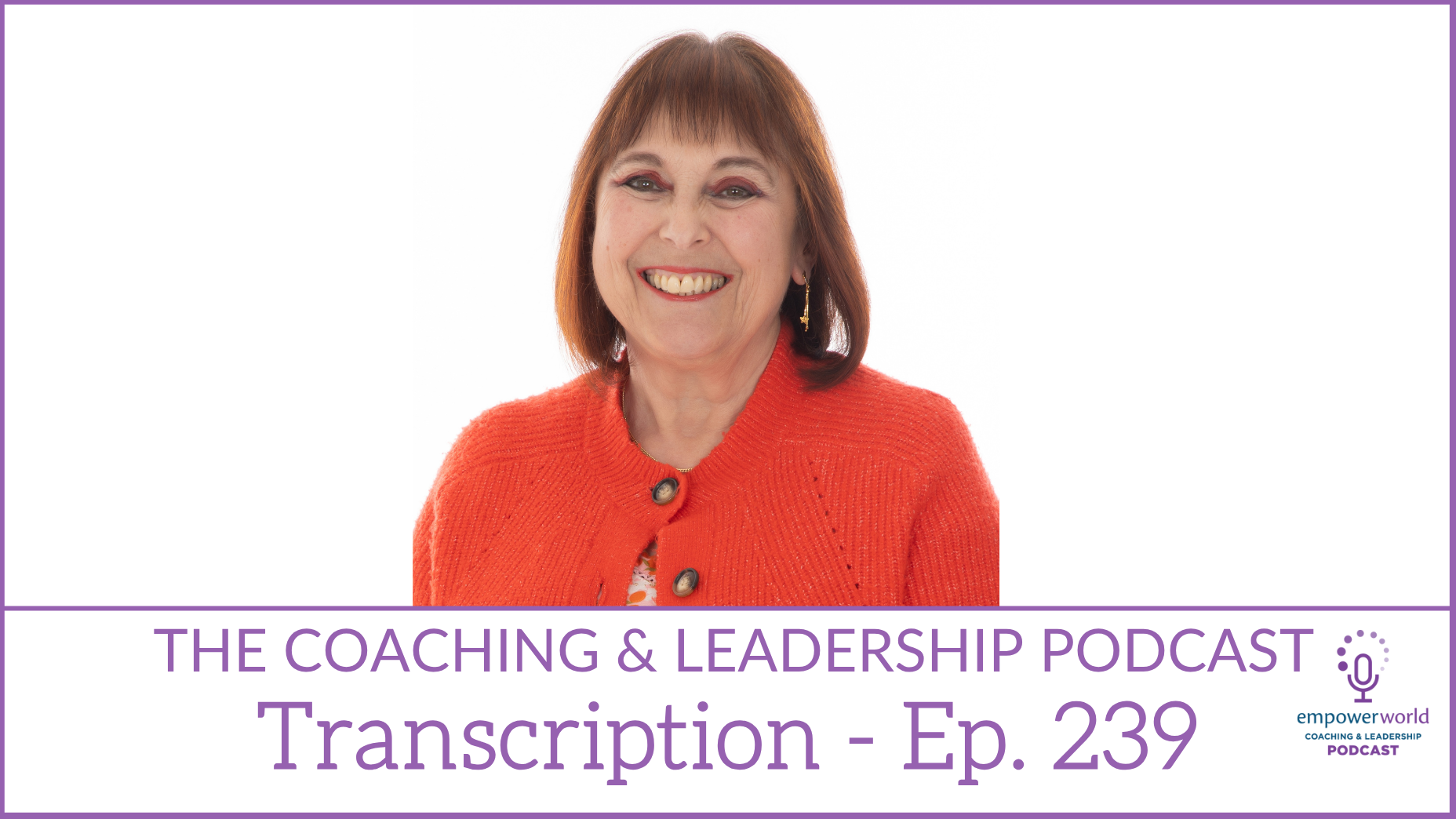
Eve Turner
Global Leader in Coaching, Supervision, and Climate Action
Jeanine Bailey:
Hello, and welcome to the next episode of Empower World's Coaching and Leadership Podcast, and I am so delighted to be here with the wonderful Eve Turner. Eve, welcome to our podcast. I know I've been wanting to get you on board for quite some time, and now here you are, so I'm very, very delighted and I feel very privileged to have you here, so thank you.
And very briefly, I'll just share the way that I met Eve was initially through Damien Goldwag's coaching supervision program, where Eve came on for a session, and I remember it being very insightful and very informative, and I thought, what a wonderful woman and supervisor. And I would really, really be keen to work with her. And, of course, time went on, and through that training, I got invited to join the Climate Coaching Alliance 24-hour conversation, which went across the various different time zones across the world.
So I decided to join in Australia time, which was where I was at that time in 2020, and I joined Eve's session. And through that session, Eve and I got to be able to speak one-to-one, which was a delight once again. And Eve, I really thank you for the invitation to join the CCA at that stage, be a part of setting up Australasia, meeting the wonderful Josie and Alison, your co-conspirators, let's say, of the CCA, which was very important, because at that stage, Australia was experiencing incredible bushfires and, of course, climate change discussions were getting much more fierce. So it was really important for me to be part of that, so I really thank you for that.
So you're hearing from me a little bit about Eve's background, but I'd love to hand over to you, Eve, to share with our audience your background, because I know there are so many different facets to what you offer to the world.
Eve Turner:
Thanks, Jeanine. And actually, I'd love to talk a little bit later about how you've got involved in some of the work we've done together. But I suppose I've always had, if I think back to being a child, one of the things I remember most is this sense of justice and injustice. That's something I remember from very young. I don't think that's that unusual-I think young people and children do have that sense. And I think that sort of played out throughout my life in different ways, and probably links to climate change, but it also links to all sorts of other things, including ethics.
My first career was as a musician. I was a classical guitarist, and I was doing a degree in music in London. That was fantastic, and I used to sit in my room and practice six hours a day, which you have to do if you want to be a reasonable musician. On your instrument, you have to practice-there’s no shortcut. I did that for quite a few years, and I was doing my degree, but there was a point at which I thought, this isn’t the life I want. Even though it was possible I could have had a career as a classical guitarist-it was possible, not definite-there was something about feeling quite lonely, sitting in my room practicing.
Classical guitar isn’t an orchestral instrument, so it wasn’t like I was going off to rehearsals and meeting my mates in the orchestra. So, in that sense, it was perhaps not the best instrument for me. At some stage, through working on classical music programs on radio, I ended up working for the BBC and eventually became a journalist. I can’t really tell you how that came about, except that I was very annoying! The news editor in the radio station I was working in had a very clear view that people had to be trained as journalists, so he wasn’t going to use me as a journalist. But I was so persistent that after my shift every day, I would go into the newsroom and say, “Please let me do stories.”
He used to take stories off the spike-the spike in a newsroom is where you put stories you’re not going to cover because you don’t have the resources or don’t think they’re that good-and he’d say, “Go and see what you make of that then.” So I did. My afternoons, having worked from 6 till 2, I’d go out and cover stories, and in the end, he started using them. So ultimately, I did become a journalist, and I had a wonderful career in the BBC, which I was very proud to be part of. That lasted for many years and ended up with me running a division with about 250 staff.
What was important then was that I trained as an internal coach. Being an internal coach was a fantastic opportunity because the BBC training was really top-notch, and it included things like supervision and regular CPD. You had to be part of a group that got together to talk about things and continue practice. So you didn’t just train-you carried on with a support system. That was the bridge to the next career.
I’ve always had the sense that the whole is more than the sum of the parts. I saw that particularly in an orchestra. I had to conduct an orchestra once, and though I wasn’t very good because I’d never played an orchestral instrument, the team had to help me. But that sense-that there are all these different parts going on and then somehow they come together and it’s just amazing-that’s always stayed with me. I suppose that led to my interest in systemic work and how things all connect together.
That’s quite a long explanation, but that’s how I got to where I am now. And I just love what I do-supervision, coaching, writing, research, and meeting wonderful people like you. It’s been a fantastic career, really.
Jeanine Bailey:
Oh, thank you, Eve, for sharing your really fascinating background. You know, we had a chat beforehand, and I was learning this about you, and I just thought, wow-that is incredible how you've had these varied experiences, but how they all come together and support what you do now. I can absolutely resonate with that, although my journey is a little different. I started off studying accounting, which is just so not me, and working in the finance industry, working in recruitment-but ultimately, like you, having that little voice as a little girl that said things weren’t fair for many.
I remember thinking, maybe I should be a politician-maybe I can influence the world that way. But I haven’t gone down that path. To then be able to get to that point of listening to my values and what connects or inspires me-like you were sharing earlier, Eve, about being a musician being a solitary career and knowing that you wanted to connect with people-I felt that too.
But I know, Eve, you’ve also set up some incredible organizations in support of coaches-the GSN and also the CCA. I’ll hand over to you to share a little bit more about those two organizations, because what I really appreciate is that you do so much. Even though I don’t know how you do it, you’ve also set up these organizations-and more than those two-to be able to support outwardly, upwardly, to create a better world. So say a little bit more about those organizations that you’ve inspired and helped to set up.
Eve Turner:
Thank you. I think we all do better when we’re in community, when we work with others. For me, working with others and connecting is such an important part of our work. If we can connect and listen without judgment-what coaches do-just hear other people's views, that sort of connection and that setting up of community is so important to our world.
When we don’t listen, when we rush to judge, things go wrong. And we’re talking in 2025, and of course, there are all sorts of challenges in our world. I don’t want to be simplistic about it, but what you said is so important-we need to hold on to our values and work within them. Underpinning all of that, for me, is ethics. Ethics is at the heart of everything we do. If I had to say one word that ties everything together, it would be ethics-the ethical ground on which we stand, which includes our values.
For me, there’s always been a question: what is mine to do? That question is different for everybody, because there isn’t one answer. For example, setting up the Climate Coaching Alliance with Josie McLean and Ali Weibrow in 2019-we were all so clear that we wanted people to join regardless of what they knew or didn’t know. Everyone was welcome: come in, talk, find out things. We had the Echo Phase Cycle, which has been used a lot, and maybe we can put a link to it for people with the podcast. It starts by being curious-finding things out, learning more, getting information-but there’s no expectation that anybody will do any particular thing.
At one end of the cycle, there’s activism, but that’s not for everybody. And what does activism mean? I would say I’m quite active, but not necessarily in the way some people define activism. For me, it’s through writing, talking to people, workshops, research-but not necessarily demonstrating on the streets. I think we all have to do what’s right for us and find our own way. That was always the case with the Climate Coaching Alliance.
I love that you remember the bonkers idea we had in March 2020-we’d only just set up the CCA, and I had this idea (and Ali thought, “Oh, great idea!”) to go through every time zone in 24 hours. It was wonderful, because we had people taking part all across the world. That sense of establishing community has always been really important.
You mentioned the Global Supervisors Network, and that really came about because, for supervision, there wasn’t much ongoing professional development. There was a lot in coaching, but in 2015, when I was thinking about it, you couldn’t really get much after your training. So the Global Supervisor Network was created to provide ongoing learning and development-because there are all these amazing supervisors in the world, and we can all come together and share our expertise.
In the early days, when there were maybe 30 or 40 members, the idea was that everyone would contribute something. But now, there are over 400 members, so people may never have to do anything-but it’s still a fantastic community that brings people together.
The last community I’d mention is one that relates to how people see our profession. Often, professional bodies like APAC, IAC, EMCC, ICF, APEX, and so on, are seen as almost competitive with each other-they have their own accreditation or credentialing systems. But what if we all got together and worked toward something greater than ourselves? That’s what the SCC-the Sustainability Coaching Coalition-is about. It’s a collection of 13 signatories, including some of the largest professional bodies in the world from coaching, coaching psychology, supervision, and mentoring.
What we’re doing is looking not just at climate change-because climate change is an end product of other decisions we make around economics, health, and social equity. As a result of those choices, we end up with climate change, because we decide we can use the Earth’s resources infinitely. This idea of coming together was new for professional bodies, which hadn’t looked deeply at this area before.
There was a lot happening in 2019-like the Australian wildfires-and in July 2019, there was an open letter to the coaching profession asking, “Are we going to stand up and say, what do we need to do about this as a profession?” The SCC has since become something that looks at these issues through the lens of social justice, equity, and the UN’s Sustainable Development Goals.
Some people might question whether that’s the role of coaching, supervision, mentoring, or coaching psychology. My question is: what is our role? It’s not to tell people what it is, but is our role to sustain “business as usual” when we know things aren’t fair? Many people in the Global South have been hugely impacted by climate change, yet they haven’t caused it-it’s been driven by the Global North.
So the SCC, with its 13 signatories, is an important and active area with round tables and collaboration. The more we can work together, the more we can do. It’s all about connection.
Jeanine Bailey:
Yes, thank you, Eve, for sharing, and you certainly answered the question that I was going to bring in, in relation to some coaches who may say, you know, do I need to take on that responsibility? For me, what I learned in my coach training is to support people to make ecological decisions. Is it good for self? Is it good for their immediate circle or system? Is it good for the greater good? Is it good for planet Earth? And that’s what I learned when I started coaching, and I thought that was brilliant, because it was a way for me not to be the expert in people’s decision making, but a way for people to check in with themselves - is it good for me, is it good for others, is it good for the greater good?
That’s what I love about coaching. We get to support people to make decisions that look at the systemic impact of their choices, to really check in - is it a decision that is good for all of us? So, thank you for answering that, and I’m sure that’s a question that might come up for some - do I need to be concerned about these things?
Eve Turner:
Yeah. And I think it’s really important because we understand that it’s not for us to impose an agenda on people. I suppose my view is that there’s the work - you know, if you were my client and I was your coach, there’s the work we need to do together. What is the work we are being called to do? What is this situation asking of us? That tends to be how I would see it.
But it would never be about saying to somebody, “What do you think of climate change?” That wouldn’t, to me, be appropriate. I think when it comes to things like contracting, which to me has always been something hugely important in our work, one of the things we might consider is: what’s the world you want to leave behind? It might be thinking about future generations. Because I think if we ignore future generations - and sometimes business decisions do - they may look to the next 10 or 20 years for strategy, but what about our collective grandchildren and great-grandchildren?
What’s the world we want to leave behind? If we can see it through that lens, if we think about how trends are changing - where will our future customers, our future staff come from? What do they want from life? Which might be different from what people wanted 10, 20, or 30 years ago. I think there are ways of bringing this up that are quite within an ethical frame. So that’s how I would do it.
And I think the connector for a lot of people is thinking about future generations, and sometimes it’s very personal - about my child, my grandchild, my great-grandchild - but actually it is about the collective too. What do we need to do to be good ancestors? There’s a wonderful book by Roman Krznaric called The Good Ancestor. What do we need to do to be good ancestors?
I was listening to a talk last week by Kate Raworth and Roman Krznaric, and Kate Raworth, who wrote about Doughnut Economics, said we’re the only species on the planet that’s actually desecrating - this is what she said - our own nest. Most species look after their nest, they look after where they live, but actually we’re not. We’re in danger of desecrating our nest. So, there’s a lot for us to think about, but we must be careful about how we introduce it.
Jeanine Bailey:
Yes, that is beautifully shared, Eve, in terms of how we can incorporate or ask our clients to reflect on the systemic impact of their choices. Bringing that in at the contracting stage is, I believe, really powerful. That’s certainly something I learned when I was very much involved in training Indigenous, Māori, and Pacifica women and men to become coaches, and therefore coaching one-to-one as well.
It became very apparent to me that it is important to ask those questions about the future - what’s the legacy that you want to leave behind? Māori are very connected to the land, the sky, and the sea, and that really heightened that awareness for me. It changed how I contract with all my clients from that point on, with that awareness.
Also, having the opportunity to join the CCA, the Climate Coaching Alliance, and to come along to so many wonderful sessions offered through the CCA - and that continue to be offered - there are just so many different ways we can support our clients without imposing our perspective, but actually making it a choice for our clients to decide what is good for them.
Again, I really appreciate those three different communities that you have built, Eve - that you have supported and collaborated on with some wonderful coaches and leaders in our profession. I’ve really appreciated the opportunity to be part of the CCA and the GSN, the Global Supervisors’ Network, as well, as a volunteer. So again, just huge appreciation.
Eve, I know we’ve talked for a little bit here, but as we come to this point, what are you perhaps starting to notice through our conversation that might be important to share with our listeners about how we show up - who we are, how we can potentially contribute - or maybe something else? I’m just curious as to what might be coming up for you right now.
Eve Turner:
Oh, it’s really interesting what you just said. I think as I’ve got older - and maybe this is the relaxation of being older - I’ve felt I don’t want to hide anymore. I’m not saying I ever really hid, but I think I’m very open now with people about who I am and what I care about. Sometimes in coach training, there’s this idea that you leave yourself outside the door. Well, how can you? You take into the coaching room everything that you are and everything you care about.
So yes, I’ve really valued thinking about that, and how important it is to be truthful about who you are, what you are, and what you care about. That’s not because you want to impose. I have a large supervision practice, and I don’t spend lots of time talking about myself in that, but when I’m talking to potential supervisees, I’ll be very clear about the things that are important to me. I care about systemic working, I care about equity and climate change - just being clear that these are things I care about.
It won’t be so much about the techniques or tools I use, it will be more about the bigger picture. Maybe that’s something that comes with age - I’ve felt freed up to do that. And I’m realistic. I think when I was younger, and I needed to pay a mortgage, maybe I was more concerned about things like that. But now, yes - just being open and clear about who I am.
And I love what you’ve said too, Jeanine, about not only the training you’ve had - because I think when you talked about having a training that looked at the eco-world, that’s actually quite unusual for when you were being trained. And then the interest that took you to work with Indigenous people - where did that come from? Because I’m fascinated by that; it’s obviously really important to you too.
Jeanine Bailey:
Hmm, yeah, it really is. Thank you for asking. When I began my coach training with my business partner, Marie Quigley, in Qatar, we were very fortunate to attract a very diverse community into our training rooms - people from all around the world. Qatar is known for its very diverse population, and I was very fortunate to be able to train, coach, mentor, and supervise people from all around the globe.
That really met my values of wanting to support people to bring out their best, to be able to work with people from different countries and cultures - something I knew as a young girl that I wanted to do. So, I was meeting those values many decades later, but I met a wonderful Māori woman who joined a training. She was a friend of mine, and I invited her to join - and she did. It was through that training that she created a vision to go back to New Zealand and carry on the tradition of her grandmother, who was very instrumental in retrieving land for Māori. She had a huge influence in making that happen.
Rachel decided that she wanted to go back to New Zealand to empower 100,000 women by 2025. That was back in 2014 or 2015. She said, “I have created this vision, and Jeanine, I’d like you to partner with me to make that happen.” Because she knew that I was returning to Australia to live more permanently, it was easy for us to connect. I would go over to New Zealand and partner with her to train these wonderful, amazing women. It was such a humbling and incredible experience that I’ll never forget. I feel quite emotional now as I think about it, because the Māori truly believe in themselves and their culture, which is so deeply grounded in the Earth, the sky, the sea, the people, and their traditions. It was just such a privilege to experience that.
The reason it connected so deeply with me was that we also wanted to train Indigenous Australians as well. I have two aunts who are Aboriginal - two of my dad’s brothers married Aboriginal women - and through their upbringing, they had lost their traditions and their ways of connecting to their source and culture. For me, that felt deeply wrong, and it stirred a sense of justice. Being able to do something about that, somehow, in my own small way with Rachel, really meant the world to me.
That’s the background of how I got involved and why it’s so important to me. I’m so passionate about it. Even though the program has now become interdependent - with trained coaches, Māori coaches, who now deliver the training - I’ve been able to step back a little. I still support Rachel in different ways, but I’m also so delighted that they’ve created their own ICF-approved program that brings in their cultural ways of being and doing. It’s incredible and a fantastic achievement.
Eve Turner:
It is a fantastic achievement, and I was so thrilled and grateful when you wrote about that for our book Ecological and Climate-Conscious Coaching, which I have right here. It’s truly remarkable and very moving. You say you’re moved, but I actually feel moved too when I think back to some of the songs they use - I don’t even know what to call them, but they’re just so beautiful and meaningful. Thank you for being involved in that.
Jeanine Bailey:
Thank you for the reminder, Eve - I had forgotten about that. It was a real privilege to be asked to contribute in that way and to share the success of what Rachel has created and continues to build upon, supporting Indigenous communities not just locally but globally. She’s really making a wonderful difference, and it’s lovely to have been part of it in a small way.
Eve Turner:
In a way, it comes back to the idea that we can all do what we can, in the way that feels right for us. We can all contribute - we just need to find the way that’s right for us to do so.
Jeanine Bailey:
Absolutely, absolutely. Well, thank you, Eve. As we wrap up our conversation today - I’d love it to continue, but I know we must finish shortly - is there anything else you’d like to share with our audience? We’ll include your contact details and links to the various things we’ve mentioned, and perhaps even the books you have behind you. I know we haven’t touched on those either. Is there anything else you’d like to share before we close out?
Eve Turner:
I’m just very grateful for the opportunity to talk about these things. What I’d like to share is that, without pressure, there’s always something we can do. We’re so good, as coaches, not just at asking questions - that’s only part of what we do - but at being with people, sitting with them, being present with them, and supporting them.
I’m reminded of Josie McLean, who does a lot of work in Australia. She was working with a particular team, and she gave them the opportunity to talk about what kind of world they wanted to leave behind. It was meant to be a strategy discussion, but it opened people up in a way they hadn’t experienced before. It gave them a rare chance to think about what was truly important to them.
That’s something we can all do - give people the opportunity to reflect on what really matters, not just the strategy or how to earn more money over the next 10 or 20 years, but to ask, “What’s the world we want to leave behind?” Josie has found that this question often moves people deeply, and they’re grateful for it. We can all offer that kind of space.
Jeanine Bailey:
Yes, and coaching - as you say - offers that opportunity. Of course, we can ask that question even outside of a coaching conversation, but in coaching we also offer presence, and the ability for someone to feel truly heard, seen, and acknowledged. To know that what they share is honoured and sacred. It’s a wonderful opportunity for people to be authentic, to reach in, and to tap into what is truly, deeply important.
Eve Turner:
Beautifully said - thank you.
Jeanine Bailey:
I’m just feeding off what you’ve shared, Eve - so thank you, thank you. It’s been an absolute pleasure and delight to have this conversation with you. I trust our listeners will take away so much value from what you’ve shared, and we hope some of them can join us in the many different spaces and communities you’ve created, Eve, and so much more. Thank you - I’m very grateful.
Eve Turner:
Thank you, Jeanine - it’s been lovely.


