
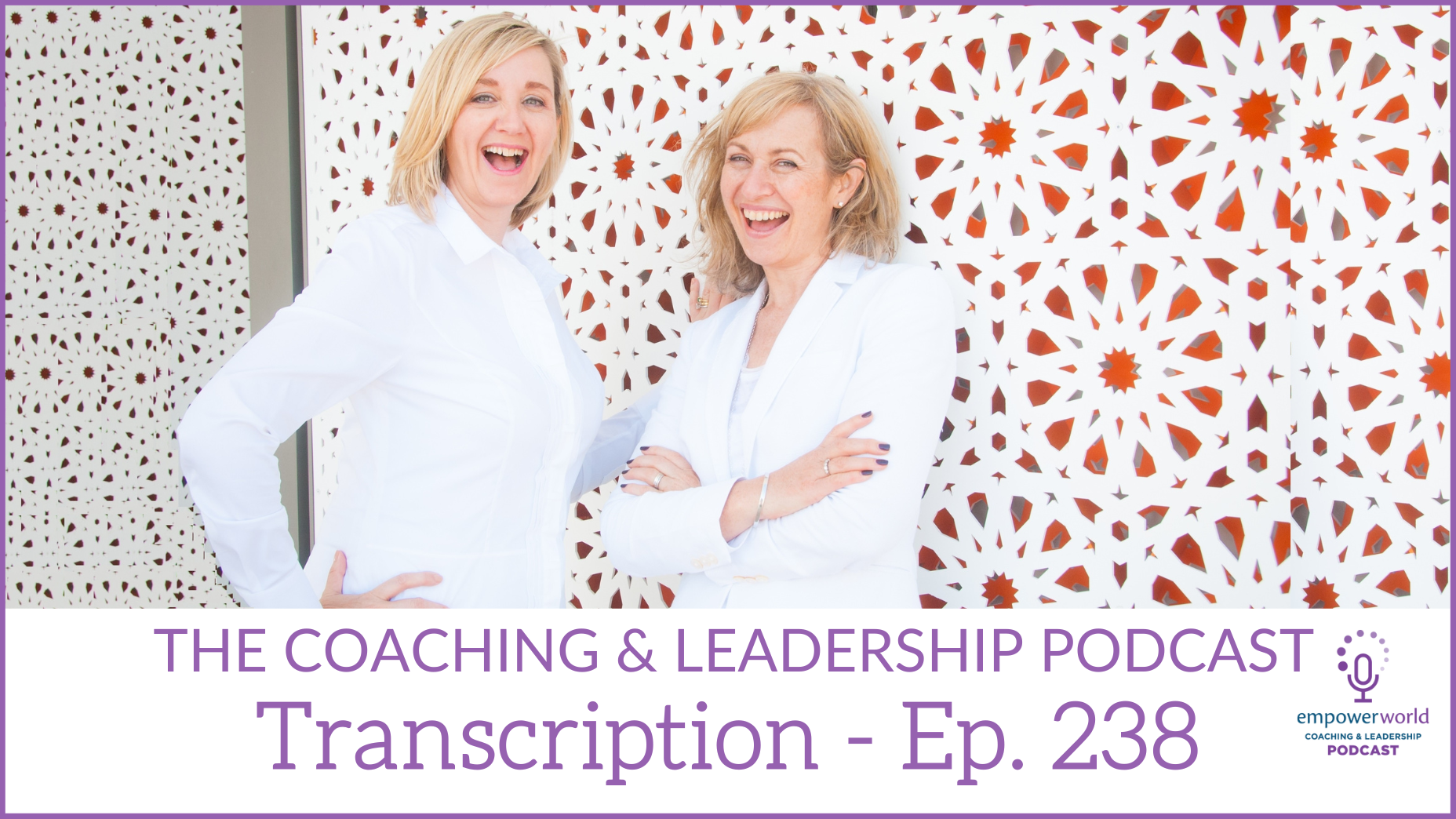
Jeanine Bailey and Marie Quigley
Directors and Cofounders
Podcast Episode 238 - Cleaned Transcript
Jeanine Bailey: Welcome, listeners, to the next episode of the Empower World Coaching and Leadership Podcast, and today I am absolutely delighted to be here with Marie. Hello, Marie!
Marie Quigley: Hello, Jeanine. It's been a while since we've been together, so great that we've made time today.
Jeanine Bailey: Yes, we've both been on many happy travels and lots of different kinds of engagements, so it's great to be back here in the room with you. So, and today, of course, we caught up before recording this podcast, and we were… Looking at what perhaps we could focus on today, and reflecting upon the sorts of things that we find that we are working on with our mentees, our supervisees, our coaches, sorry, our clients. And so something that came up was, as we were just sharing what could be some possible ideas to work on, is how sometimes when we are coaches, when we are struggling, when we… there is… perhaps something that is challenging or difficult to lean into, it's potentially a really good sign that, actually. We need to continue on our own journey of personal work. The work that we do for ourselves, to put on our, again, what we call the oxygen mask. to be able to show up fully for our clients, so… so that's what we thought we'd focus on today, Marie.
Marie Quigley: And what… what… as we're… as we were exploring. Part of the reason we thought about this was because some coaches can get caught up Thinking that things have to be a certain way, or that perhaps the competencies don't fit with how they want to coach, and they get very hung up on Wanting to do it a certain way and believing that they can't be flexible. And that's often a sign that you're stuck in your own thoughts or your own patterns. One of the key things about great leadership is that the more flexible we are. the more we can lead in different ways. Of course, we don't want to bend over backwards all the time. We might have a philosophy that we want to adhere to, but there's great wisdom in being open-minded enough to be curious. If these… if there are these coaching competencies. well, why have that… why are they there? How can they have been created so that coaches who coach at MCC level, for example, are flexible, are dancing in the moment. are being brave and courageous in their work. How can an MCC do that and still align with the competencies if we aren't able to move and dance and think in a different way?
Jeanine Bailey: Yes, it's… it's some really great points that you bring in here, Marie, and yes, it's… it… What we can hear when… Potentially, the coaches that we're working with are… Perhaps pushing back on the competencies. It's… what I hear is that lack of trust.
Marie Quigley: in…
Jeanine Bailey: the coaching process. And you and I, as we are MCC coaches, and we know that we… We flow and dance with our clients, we follow what they bring in, we listen deeply beyond the words. We understand and appreciate, actually, these competencies that the ICF have created when we really embody them. They are so, so powerful. So… so we know that. So when we… when we're working with the… the coaches who are pushing back, we… as you shared, Marie, we can hear the… The beliefs that are… getting in the way of leaning into and exploring what those competencies really, really mean. That's what came up for me as you shared, Marie.
Marie Quigley: Yeah, I hear that, and I think… You know, we do want to challenge things. Our job is to see things from different perspectives as coaches, that's what we help our clients to do. So this isn't about taking any competency, and it's interesting that the competencies of all of the major bodies ICF, EMCC, and AC are really heavily aligned together. If you look at the wording, they're very similar wording. And, It is interesting to challenge these competencies, but the way I look at it is, how can I bring these competencies alive in my work, in the way I turn up to my coaching? So, we… we all might have different ways of being. Some might… some coaches are very funny, I think I'm sometimes very funny. Other times, they can be very quiet and serious, and that's absolutely perfect. We want Our coaches to bring all of ourselves to our work. And how can we bring our unique sense of self and still align with something that actually keeps us in the role of a coach, stops us moving, perhaps, from into therapy or consulting or advising? And leaves the power with the client to do their own thinking. There's a lot of, cogs at play, that's what's coming up to me, lots of cogs at play that we've got to kind of move with as we dance with this work.
Jeanine Bailey: Yes, absolutely. It's, as the experts say, it's an art and science. As to what we do as coaches. So there is a structure, there is a light structure that we utilize as coaches to support our clients to navigate through their challenge and their opportunity. And so, it is, I believe, about experimenting, being open. Being to… being prepared to try… new things on. And also to be Authentic, too. So potentially trying those, those different ways of being and doing as a coach is still authentically aligned with yourself, but it is perhaps being open to… you know, maybe it doesn't have to be that black and white, maybe there's some other colors in here where I can bring those other colors that are within me into the coaching process. So, it's… It's just being more aware about, am I resisting? Or am I prepared to… experiment. to support… myself to embody those… those competencies, which these… various different bodies, as you say, Marie, they're very… they are very similar, the EMCC, AOC, ICF, etc. They are very… they recognize very similarly How we can coach our clients in a masterful way. And, and let our client lead.
Marie Quigley: Let them…
Jeanine Bailey: be authentic. And vulnerable, and courageous, and all of those things. In support of what it is they want to get out of the session, so… Yeah, leaning in to… to what's possible.
Marie Quigley: Yeah, when you're talking about that resistor, Jeanine, what comes to mind? It might be old, it might be out of date now, but it reminds me of Judith Glazier's model, where she talks about moving from resistor to experimenter. And if we're in a resistor mode, we can't see much further than the front of our nose, so we will think that the competencies mean we have to tick a box. But actually, the competencies, from my perspective, the way I've grown as a coach, is I've really started to attune, or many years ago, started to attune To what's happening to me, to my emotions, to my body responses, to my cognitive responses. how my body wants to move, or run away, or stay, or… So, the more we pay attention to how we are responding to something, there's some wonderful lessons in there to teach us about who we are being as coaches. And of course, who we are being as coaches is how we will come to the coaching session. So if we are in resistor mode, thinking, oh, this isn't working for me, that will come across in how we coach. There'll be… almost a staccato rhythm to your questioning. There might be a pushing or a shoving of the client, because you're thinking about. The competencies and how to fit them in. There could be a leading, because you're kind of resisting some of this flexibility that I think the competencies offer. So you'll see them, this resistance, in the patterns of your coaching. And I think that's why it's so useful for me, and I'm guessing for you too, Jeanine, is to get your work listened to. to bring a mentor in, so that you can send your recordings to think, how am I doing here, and where are my gaps? And then also bring your cases to supervision, so that you can talk through who you are being in the work.
Jeanine Bailey: Yes, absolutely. It's so, so important that we… and it's certainly part of the ICF core competencies, Competency 2. To continue to develop and, go on that Consistent, continuous journey of reflection and… and growth and support. To be able to… Go on that journey of… Expanding awareness, mastery, incorporating… you know, what we do even more masterfully. There's always, always something to learn, and… There was something that I meant to share a little bit earlier, but it's… and it's about that authenticity piece, so… so those core competencies, they really do allow us to be authentic. It's… As you shared earlier, you know, some coaches think it's a tick box exercise, but actually, those competencies, when we really do embrace and embody them fully and completely. It allows us to be our unique, authentic self, because if we were all the same… That could be interesting, but we're not, and, you know, we will all attract our own unique clients to ourselves, so it's not a competition. It's… it's really about finding our… our tribe, our people, or the coach that works For us, that's going to bring out Our ability to develop ourselves in A place of… Trust, safety, stretch, whatever it may be, so… That's what came up for me, as you shared, Marie.
Marie Quigley: Yeah, beautifully said, Jeanine, and I'm thinking of a coach that I work with who was really focused on moving to solutions, so they were great at Competency 8, facilitating growth and moving forward. And what happened was, in every coaching session, they stood up. And they were really near the screen, and I reflected back, gosh, you stand up in every session. They said, well, yeah, you know, it's about action, it's about moving forward, and I said, I wonder what it would be like if you sat down. And that allowed a very different energy to come in, so that they could kind of relax a little bit in this. And then they were able to focus on their own presence, deepen their presence. They let go of the belief that I have to get the client somewhere, so I have to be in… action mode before the coaching starts, and already… so it was… it was the shift in the coach that allowed this deeper conversation to happen with the client. And because of that. Then the goal became more powerful, the depth of the conversation was more beautiful, and then the outcomes were even more profound. So, it was so interesting to see that shift.
Jeanine Bailey: Yes, how beautiful, how beautiful. And you touched on something earlier about, also, the, you know, listening to ourselves, and listening to the… to our… responses to what our clients are sharing, and so… and I know that this is something that we teach our participants that go through our programs to Come into that presence. build that awareness about our own responses, because when we are in trust and rapport with our clients, when we're truly present, you know, we're reflections of one another. So we will potentially be experiencing what our client is experiencing, or vice versa, so… So, using ourself as an instrument is so incredibly… so incredibly powerful. But, you know, I hear… For many, that might be a bit difficult. That might be, you know, there'll be all sorts of rules about that, and Again, not… not trusting that… that process of… experimenting, and… and going… and really going into that, journey of self-awareness, and how that can be used in a way that supports our clients to create different perspectives about… about what they're experiencing. So… And so that… Potentially is not so clear in… in the competencies that… that we… that's how we can support our… our clients, and so that's why we really, recommend Being, you know, that openness, that willing to experiment, work with a mentor, work with a supervisor, work with an experienced coach, so that you… and do the work for yourself, so that you can really appreciate How these competencies can be so powerful, natural, Easy. and I would say effortless, once, you know, once we've sort of… stepped into that way of being and doing as a coach, it becomes much more… Easy and natural.
Marie Quigley: Yeah, something that's helped me from the early days all along, and I still do it now, and it doesn't… it's not that I spend a lot of time doing it, but it is a… way of capturing how I am being in the work, and noticing what's happening for me, is to just write a few notes after your sessions, and so that if you are noticing that there is something stuck with you, or resistant, or you're kind of frustrated. That's an indicator that you've got to do your own work. So, if you can spend even just a few minutes writing down, keeping a kind of reflective diary, but it doesn't have to be that heavy, just some notes about who you are being and how you are experiencing yourself, that can be a real indicator of whether you're on or off track in the work that you're doing.
Jeanine Bailey: Yes, it's a great… a great piece of advice, and those… just those little inklings of, hmm, something's not quite landing, or I didn't feel quite comfortable about that, or something feels a little bit off, or there's an… maybe a stomach sensation, or… Maybe there's a lightness, who knows what it may be, but… Paying attention to that. And as you say, Marie, writing it down, reflecting on it. And if you're working with a supervisor, bringing it into supervision to explore what's behind this, because we do say our emotions, our energy, our sensations, they are our compass. They let us know if we are on track or off track. With who we are being. And so, really getting curious about What this could mean, particularly with support, or with… Reflection, can open up, again, new, wonderful awareness. Which can lead to new ways of being and doing as a… as a coach in service… in service of your client.
Marie Quigley: Yeah. And I think it's worth remembering, it's not only the resistance that is the teacher. There will be times you will feel so joyful and so uplifted in a session. So noticing that too, because how you've created that could be a really good lesson for, with other clients, how you could perhaps create it. Now, I know there's a two-way relationship here. We might not like all of our clients. There might be… Habits and behaviors that we struggle with with our clients, but we can still do incredibly brave work. If we're in deep presence with ourselves before we turn up for the coaching call, if we are aligned with our philosophy on how we believe coaching should be, if we trust, as you said, in the process, then powerful things can happen.
Jeanine Bailey: Yes, absolutely, Marie. Yeah, so… so we encourage… Coaches and leaders, and leaders who coach, to really Do the work. on self. First and foremost, you are the foundation. You are the found… you are the instrument. So looking after your own instrument by… Continuing that growth, that journey of self-discovery. is going to be so powerful for you and for others that you serve, so… Marie, what else would you encourage, suggest?
Marie Quigley: Hmm. And we've covered a lot, so it really feels to me just start questioning yourself. Don't assume that it's the competency's fault. But you can't fit your work into it. It's not about fitting your work into anything. It's about really embodying who you are and the process of coaching in an open and flexible manner that is serving your client. But they're there to help us deepen… those competencies, apologies, are there to help us deepen our work. If we look at it from that perspective, it's a very different, Way of being.
Jeanine Bailey: It is, it is, and it's… you know, we often… and I'm sure many listeners here trust the process, they've heard that, trust the process, so we would say, trust the competencies, which are all part of the… the coaching process. So, really good advice, Marie. If you… if you notice that you're resisting, then Have a look within. To identify what could be worked on.
Marie Quigley: Absolutely. So, listeners, thank you for listening in, as always. If you like what you hear, we'd love you to share, we'd love you to comment, we'd love you to tell us what more you'd like us to talk about. If you'd like to train with Empower World. please get in touch with our support at Empower World. Our next coach training is coming up very soon in October, and we'd love to keep learning and sharing our learnings with you, so thank you very much.
Jeanine Bailey: Thank you, listeners.


