
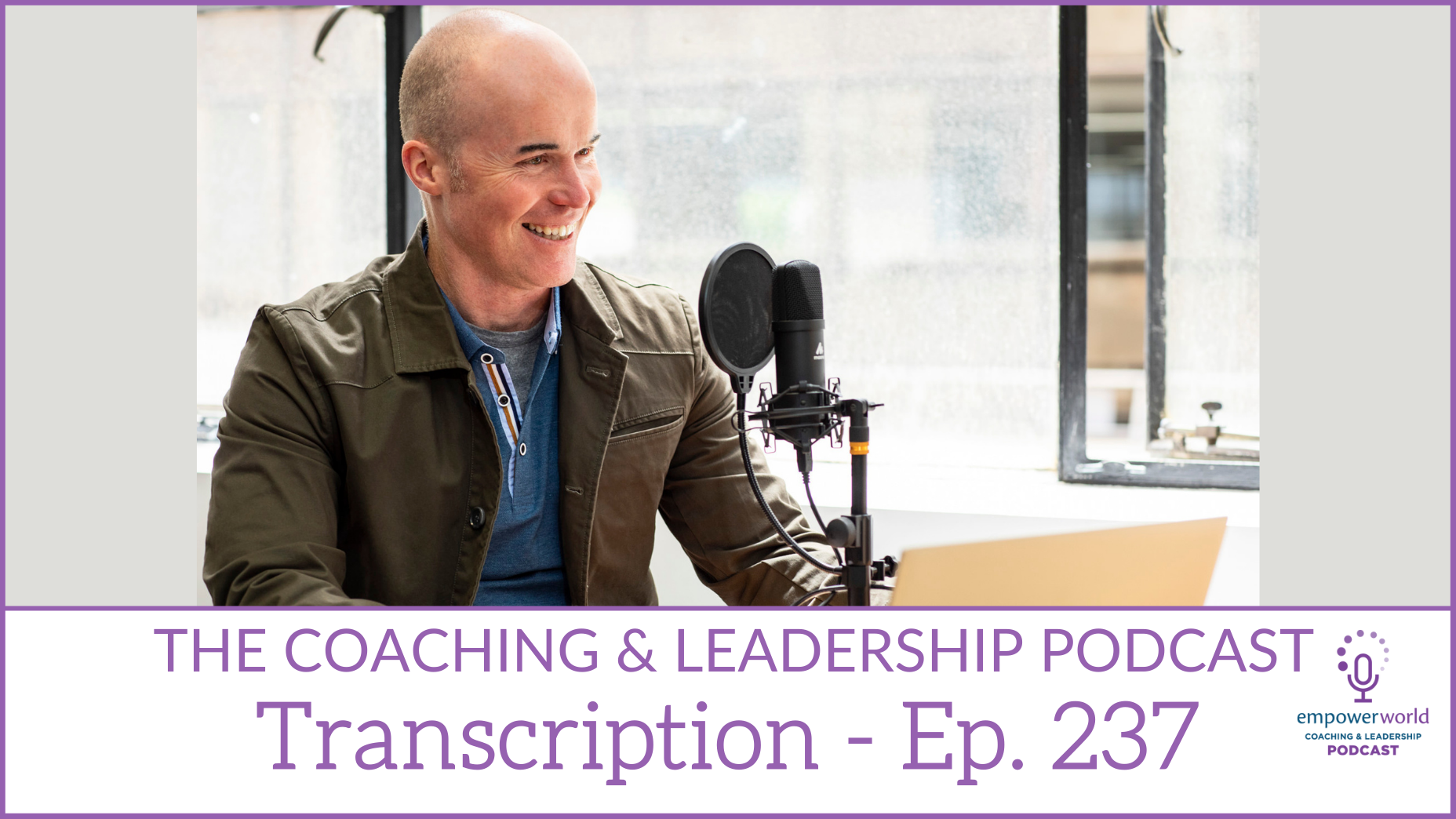
Joe Pane
Emotional Fitness Expert. Author of "Courage To Be You - A Guide to Mastering Uncertainty."
Jeanine Bailey: Hello, and welcome, listeners, to the next episode of the Empower World Coaching and Leadership Podcast. And I am here again, a couple of weeks later, with my wonderful friend, Joe Parne, who I did my coach training with many, many years ago. You have accredited over 7,000 coaches, which is incredible, and now you're doing your own thing, but I'm going to let you introduce yourself, but I am really pleased to see you here again. We recorded a podcast a few weeks back.
Joe Pane: On extended disk.
Jeanine Bailey: But I've brought Joe back in again because he has created his own incredible program called the Emotional Fitness Formula, in which he accredits coaches and leaders to utilize these five core principles based on emotions, values, and so much more. And so, I… I've… felt it was really, going to be insightful to bring you back, Jo, to share what this program is all about, and it… and… you know, from my experience of your work, this is based on some of the wonderful insights that I learned from you when I first started to become a coach, so it's great to see that you've created this program in your own unique way, your own unique way of how you share core principles of how we live our lives, choose to live our lives, or not choose to. So, so Joe, welcome, a big welcome again, and I'm going to hand over to you to introduce yourself, because others may not have listened to Extended Disc, so Big welcome over to you in Australia.
Joe Pane: Well, thank you so much, Jeanine. I appreciate you having me on again. It's fantastic, and it's, as I said to you on previous occasions, it's phenomenal to reconnect with you after all these years. Yeah, so I started my coaching and training business back in 2006. I've got a background in psychology and sociology, which is what the two areas I majored in. Back in the day. And I also worked for a number of years in the world of occupational health, in the manufacturing world back in the 90s, which is an entirely different story. And in 2006, I kicked off with my coaching and training business, and yeah, that's been going, you know, pretty… I'd say it's ups and downs is when you first start, but … I'm in my 20th year now, and loving it more than ever before. And about 4 years ago, roughly, something like that, based on the culmination of the previous 15, 16 years of work, I created these frameworks and thought systems, which is called the Emotional Fitness Formula, which Fundamentally, its core mission is to transform people's relationship with uncertainty. And I believe that outside of our relationship with people, this is the most important, most crucial psychological relationship we could possibly have, because uncertainty is the precursory seed. It's the fabric of life. It's a requirement of life for us to grow. It is like the, the nutrition that you give a tree or a plant to grow, like this plant here on my screen. It is nutritionist, and, if that is such a word, but… Nutritionists, we'll just keep that as a word for now. It actually feeds our growth, and … and growth, to stating the obvious, is, … crucial to our survival, because we need to grow to keep up with who we're becoming, so we can handle and navigate and embrace the responsibility of the next level that life brings, because our responsibilities are continually expanding. So. The work was, yeah, based on all the coaching hours and trainings and presentations, and all of the frameworks Have been delivered to multiple different, industries, backgrounds. different types of people, social, like, the whole thing. And, they've been proven to work. So, yeah, that's, a brief sort of history.
Jeanine Bailey: Fantastic, Joe, and I really love how you have you know, really brought all of that learning and experience from, as you say, the background of psychology, moving through to coaching. You know, there's… there's so much… I know you are a an information gatherer, to… Enhance your wisdom, enhance your knowledge. to support coaches, to do what they do. And, of course, we know, as coaches, we are not… Solving our clients' problems. We're not leading our clients to their answer. But what I believe is, having this awareness of… How we as humans human beings' operation. You know, what's… what lies beneath our… our thinking is really, really insightful and helpful. to support our clients. Not to lead, but just having that awareness of What perhaps is, … Getting in the way of our clients. … desires and what they want to really experience, so I think… I think this really just helps us as coaches to expand. and live our best lives in support of our clients that we're also supporting. So, so again, really appreciating What you've done to be able to… Pull all of this incredible wisdom into a framework That can really help us understand ourselves. And… support when we're working with our clients, so….
Joe Pane: So, Joe, this….
Jeanine Bailey: Emotional fitness formula. there's five… I understand there's five foundations or principles, but for our audience, can you share a little bit more about what… what this is?
Joe Pane: Yeah, absolutely. So, getting back to your point about coaching, and really, it's… the focus of coaching in its purest form is to, you know, resolve the thinking that created the problem in the first place, to get to that root cause. And our thought systems, the quality of our thought systems, is our life. It really is. So, the emotional fitness formula, with its five core focus points, or 5 core principles, these are 5 different perspectives or angles that we can Help coaches help people. How to navigate difficult situations, how to navigate crises, challenge, adventure, problems, how to navigate hard things. And because we are inevitably faced with some form of uncertainty at various points in our life, you know, from the macro through to the micro. So, yeah, the emotional fitness formula, in order of poundage, so this is an order of power and effectiveness, is that the first part of the emotional fitness formula is Identity. And identity is absolutely the single most powerful force in the human condition, because not only will we do anything to remain consistent with our identity, it's also based on what we allow ourselves to be defined by. And what defines us owns our entire psychological landscape. So, for example, if I'm defined by the results I'm getting in my work, in my career, in my business. then the wins and the losses that inevitably come with that, I'm going to be hypersensitized to those wins and those losses. The wins will go to my head, the losses will go to my heart, and I will be profoundly, affected. Because I'll be taking those wins and losses deeply personally. And so, when the losses come, inevitably, it means that it's going to be more difficult for me to get back up because of the personalized nature of that experience. So in the program, it's about helping a client guide themselves away from the roles that define them, and start moving more toward the character that defines them, which is a very, very different way of navigating with your thinking through anything that's difficult. And suddenly, the business owner who defines themselves by their character, for real, rather than their role. can navigate those situations a lot more… not easier, but more efficiently. And that's another thing about emotional fitness, is that it's not designed to make uncertainty easier, otherwise uncertainty wouldn't be uncertainty. It's about giving us the clarity and the direction to navigate through any form of uncertainty. So identity is a big part of it, and there's a whole Area of identity that, explains the different phases and stages that we go through individually, that businesses go through, that leaders go through. These are universal stages, which we haven't got time to cover here, but, because it would… I'd be here for another hour and a half just on that point. But, identity is very, very powerful. The second part, to the emotional fitness formula.
Jeanine Bailey: Sorry, Joe, if I can interrupt you there.
Joe Pane: Yeah, of course.
Jeanine Bailey: So the… and look, what I love about what you have shared, it really does… fit beautifully into the core competencies, the ICF core competencies.
Joe Pane: Huh.
Jeanine Bailey: Which is about supporting people to understand the who. So, the being of….
Joe Pane: Hmm.
Jeanine Bailey: Clients that we work with. So, you know, that really fits in nicely, because potentially new coaches will be much more about the story. … So, not… not focusing on coaching the person, more about coaching the problem. So, you know, what you are sharing is really… fits in with, you know, when we're coaching at a masterful level, we are supporting the people to understand who they are, or who they tend to be, or who they really want to become.
Joe Pane: Yes.
Jeanine Bailey: Getting into the weeds, so to speak.
Joe Pane: Yes, yes.
Jeanine Bailey: sharing that. Back over to you.
Joe Pane: Yeah, that's such a great point. And another way of putting it is, this might sound a little bit more, sort of, harsher, but really what we're doing is we're coaching the pattern, not the person. the pattern and the thinking, because that's what shifts. You shift that, and … and ultimately, I mean, the other definition I have, which is rather unofficial, is to me, coaching is about helping people fall back in love with themselves. That's what I think it is. So… so yeah, identity is, very, very powerful. And the second one is, second part of the emotional fitness formula is the life stages. So, these life stages refer to the universal journey that we're all on, which is the journey from ambition to meaning. How, as we, as our responsibilities expand, and the years pass us, and the decades form, and we get to the, stages of, 40, 50 years of age, roughly. is that, our priorities shift, and how we see the world changes. And often, a lot of people between the ages of 40 and 60 go through some kind of crisis point. And, this is known as, well, in the world of emotional fitness, it's known as the journey from… the shift from ambition to meaning. And this shift is very challenging, because It impacts, … it's a phenomenally big, significant evolution in your values and priorities. Everything changes. I mean, I remember when I went through this personally, back in 2003, 2004, I had a 15-month sabbatical away from all kinds of work, attending all kinds of 7-day asylum retreats and vision quests, and a whole host of different… ways of experientially trying to navigate through, this shift from ambition to meaning. And essentially what it means is We're moving away from the egocentricity of what ambition defines us as, and moving more toward the heart-centric nature of meaning, where our psychology begins to align itself more and more with nature. where nature… everything in nature exists because of its value that it brings to its local community. A leaf… a cell… the whole host of cells, or a cellular community that's inside of a leaf. each of those cells will remain vital and alive as long as each cell is contributing to its local cellular community. The moment it stops contributing, it loses its sense of existence, it gets annihilated by nature. So it's the same in our lives. So. This journey from ambition to meaning, has proven to be very, very useful in placing language around incredible confusion that people go through when they're experiencing the uncertainty of an identity shift. When they're experiencing the uncertainty of their roles changing in front of their eyes. It's… and for a lot of people, it's a crisis point, because in the emotional fitness world, we define a crisis as… Something that you dearly love has come to an end, and it's not your choice. So whether it's the end of a career, end of a job opportunity, the end of a relationship, it's someone passing away, whatever it might be, it's a crisis point. And the thought systems and frameworks in EFF really help people, again, not make uncertainty easier, but to give them that direction to navigate those difficult times. And then you've got the third… did you want to ask… sorry, Jeanine, I'm on a roll here, pardon me, go on. Oh, that's wonderful.
Jeanine Bailey: But I can so resonate with that story that you've shared, or that description of what you've shared in terms of ambition to meaning, and I know that that was something that I was going through at the time when I started to become a coach. I recognized at that point in my life, that something was missing. But I knew that I was meant to connect, I knew I was meant to support people, but I didn't know how. So I felt lost, and I know that that also will fit in with… with values, which I know you'll bring in shortly, too. But it was, how do I, you know, how do I do what I know innately is within me to… Be able to support others. And so, through the coaching, you know, when I was able to be introduced to coaching and go on that journey, that I recognized, this… this is more than me, this is so much more.
Joe Pane: Let me….
Jeanine Bailey: This is about….
Joe Pane: Awesome.
Jeanine Bailey: This is about creating something… amazing that is going to empower others. And so, I really appreciate it, you know, yes, it's lovely to have a business and do well, but actually, what continues to drive me today is knowing that Empower World has… has helped so many people, and has made such a huge difference in people's lives, so… so that's… that's what gives me… joy. So… and again, coming back to the core competencies, when we're working with our clients, it's supporting them to understand what is bigger than themselves that has meaning for them. You know, what… so asking questions to support them to think systemically.
Joe Pane: Hmm.
Jeanine Bailey: What is going to be good for them, but also good for others, good for the greater good? What is going to give… That joy that is not potentially material-related, but actually.
Joe Pane: Hmm.
Jeanine Bailey: Connecting with others. And of course, we know that the level of connection can be, for introverts, not so expansive, and for the extroverts, maybe a little bit more expansive, or something in between. But yeah, that's what comes up for me, is you share that….
Joe Pane: Yeah. I'll make sure I stop after the next point.
Jeanine Bailey: Hey, Jeanine, you bring up a really good point, because a lot of people do come to learn coaching, and based on.
Joe Pane: excuse me, my experience… excuse me, based on my experience of having to… I've been talking a lot today on Zoom, based on, what I've done with, the 7,000 coaches that I've accredited, you know. I found that the… a significant portion, like, a lot… most of them. were attracted to coaching because they were in that transitional shift from ambition to meaning, looking for a way to make money in a meaningful way, which is, where success is defined by the value you've brought to somebody else, in comparison to the success definition of the ambition-driven world, which is all about me, me, me, and my awards and rewards for being the best, and all that kind of stuff. So it's very, very different. Yeah, the third core focus point, or principle, of the emotional fitness formula, as you've just mentioned, is values. And in the emotional fitness work, in the EFF, the emotional fitness formula, we call it EFF, we define a value as an emotional compass. An emotional compass that leads us to realizing our deepest desires that live in our unconscious and in our hearts. Venues, … it's confusing for a lot of people, because I've been in front of many audiences where I've… it's become clear that people don't know what their values are, and the reason being is because they… confuse their values with their morals. You know, a moral is, is a different conversation. It's more like a behavioral standard, you know, to be integrous, to be respectful, to be responsible. These are kind of like standards of human behavior that are more universal kind of thing to the local community, or whatever it might be. Whereas values are unique, and, values are… things that we do. There are activities that we do that bring us joy, that bring us fulfillment, bring us meaning. And this is important when it comes to our relationship with uncertainty, because doing activities on a weekly basis, whether they're ritualistic, or they're hobbies, or they're both, is that they bring us a sense of joy. When I've got something to look forward to in my week, or multiple things to look forward to in my week, because I've got these hobbies or rituals that I'm doing that bring me joy, it helps me navigate the tough day more… more effectively, because I've got something on the other side to look forward to. Makes a massive difference to reducing anxiety levels. So that's, that's a really powerful one, the values.
Jeanine Bailey: Yeah, and thank you for pausing. And so, yes, those values are… the ones that bring us joy are what I believe are our highest values, the values that we… Really appreciate and ideally want to live into, step into as much as possible. But of course, if we are not feeling joyful, if we are lost, if we are confused, then potentially, we are, and I believe this, we are living according to someone else's values, or a culture's values, so we've been potentially programmed To live or make choices by values that belong to someone else. Because they potentially don't align. with us. And so, I believe… You know, a lot of coaching, and again. fitting in with the core competencies is about supporting our clients to understand, you know, what are their highest values, what are the things that they truly appreciate that.
Joe Pane: Yes.
Jeanine Bailey: when they've got that conscious awareness, then they can make those choices to move into them, easily, effortlessly, hopefully. But if they're aware of The choices that they're making don't bring them. Joy, energy, inspiration, then… What needs to be explored here? What, what perhaps is not my truth? What beliefs am I holding that aren't true, that holds that value that is not giving me joy and inspiration? what needs to shift and change. So, I think values… supporting our clients to, as coaches, to understand their values consciously, and be aware of what Again, brings us most joy and inspiration.
Joe Pane: It's to improve the quality of….
Jeanine Bailey: of life.
Joe Pane: Yes, absolutely. And a value is something that you must know how to do. You know, if you don't know how to activate it and do it. For example, running, for me, is an activity that brings me a lot of joy, and that's an expression of a value, whether you call it health or vitality, lifestyle, call it whatever you want. it's, something that we do, and I often say, when I'm doing workshops in organizations, if they've got a value that is, you know, creativity, for example, the first question that's got to be asked is, well, how do you do that? If you don't know how to do it, then it's not a value, it's just a word. So, yeah, that's the… and there's a whole conversation we can have around that, but that's… that's the third… the third part of the emotional fitness formula.
Jeanine Bailey: Thank you. Continue, please, Charlie.
Joe Pane: So the fourth one is, I love this one, it's emotional flexibility. And the key thing here is to recognize that most, not all, but most of our emotions are completely and utterly fabricated by our egos. So, an emotion cannot respond to facts. An emotion responds to the meaning that we give the facts. Our emotions respond to the interpretation that we give. Now, the quality of the meaning that we give something that we're observing or witnessing is absolutely determined by our thought system, the quality of our thoughts. So. Because what we focus on and what we place our attention on is pretty much what life is. And so the meaning that we're giving, whatever we're experiencing. is, very, very powerful in producing how we feel. The illusion is… the emotion comes, and it's like, no, it's just how I feel, it's just how I feel. No, just think back a moment ago, where was your attention? Where did you place your attention? Where was your focus? And what was the meaning that you placed in that focus? And that will produce the emotion. And it happens so quickly that the illusion is that it's just a feeling. There are naturally emotions that are different, that, that come to us from different, sort of, places and spaces, but on the everyday experience of living life, these emotions are fabricated, you know, like. you might be walking on one side of the street, I'm on the other side of the street, I wave to you, you don't wave back, and… what do I make it mean? Do I make it mean that you don't like me? And if I make it mean that you don't like me, then that's got a whole emotional ripple that goes with it. Versus, oh, Jeanine must be busy, she just didn't see me, and that's got a different ripple. Or someone doesn't respond to your message, or to your email, or to your text message. What does it mean? It actually means nothing. But whatever you decide to make it mean will produce your emotions. So, emotional flexibility in emotional fitness is about having that awareness. So you can consciously choose to either make something mean nothing, or make it mean something that makes you feel good. There's more to it than that, but it's the… the cornerstone of this part of the emotional fitness formula is to remember that emotions do not respond to facts, it's the meaning that we give the facts that creates the emotion.
Jeanine Bailey: Yeah, absolutely. Well, well described or explained, Joe, and… and again. Fitting in with the core competencies, where… We… we are encouraged to explore our clients, or support our clients to explore what their emotions mean. And at Empower World, we say there's no such thing as a good or bad emotion. There's just emotions, which are, again, like the values. They're like a compass.
Joe Pane: Hmm.
Jeanine Bailey: And they let us know whether we're on track or off track with the choices or the meanings that we're making.
Joe Pane: Yes.
Jeanine Bailey: So, if we… support our clients as coaches to get curious about what the emotions mean. You know, what are the… what are the, as you shared, the beliefs Or the meetings that are being made up about an experience, or a perspective they're taking, then… Clients can understand you know, am I making that up? Is that my truth? Because all… all… Meanings are made up, but… Does that align with who I really am? And… the choices that I want to make, and who I want to be, etc, etc, so… So… you know, I'm really appreciating what you're sharing, Joe, to support coaches to understand you know, why we get curious about, with our clients, the emotions that show up, or the values that they're perhaps, sharing. So, again, really, thank you for… sharing a little bit more detail. I know we're touching the surface here, but it's… it's….
Joe Pane: straw.
Jeanine Bailey: really insightful.
Joe Pane: You're welcome.
Jeanine Bailey: Joe, the last….
Joe Pane: The fifth one, the fifth and final one, is, is perspective. And another way… I mentioned just a moment ago that, as a coach, you don't coach the person, you coach the pattern. Well, another way of looking at it is, as coaches, what we are is perspective shifters. The moment you shift someone's thinking and shift their perspective, what they look at, like Wayne Dyer said all those years ago, when you change what… when you change how you're looking at whatever you're looking at, what you're looking at changes. And that's just how it is, that's life. And, so in the emotional fitness formula, I figure that the perspective aspect was really, really important. And how this relates to uncertainty is that, in EFF, it's about building a very clean and strong perspective that you can lean on when things get tough. I'm sure you've been told, Jeanine, like I've been told by other people in the past. when you get caught up in the dramas and the weeds of life, sometimes someone might say to us, hey, just get things into perspective here for a moment. And you're raising your sight from the weeds and the drama into the bigger picture. And, suddenly you see things differently, because your priorities are very clear here, whereas in the weeds, you can get confused. So, having a clean, and that's what we… what you learn in the program, is how to create a clean and healthy perspective, which is really, really important, and … And learning how to shift other people's perspective is a very powerful, … has a very powerful impact.
Jeanine Bailey: Yeah, absolutely, and… And so, just to bring another perspective, because we… have quoted and do quote when we're… we're training our coaches, and supporting leaders is to And this is a term that was coined Perhaps by Marcia Reynolds. I know she… she's got a book called Coach the Person, Not the Problem, and… and we would say that too. So, I'm… I'm just… Creating another perspective here. I, I, you know, I really appreciated you sharing coaching the patterns. And not the person, so… so I'm… I'm making up a perspective here for Empower World. Coach the person, coach their patterns.
Joe Pane: Hmm.
Jeanine Bailey: Versus the problem.
Joe Pane: Hmm.
Jeanine Bailey: So, so, really supporting people to understand Who… who they're choosing to be. And… Supporting them to understand what are the patterns that they've created, the habitual patterns that maybe.
Joe Pane: restaurant.
Jeanine Bailey: really empowering, Hmm. Or what are the patterns that are disempowering? What are the patterns that are taking them away from living their values?
Joe Pane: And this is where… this is where the problem has a good use, because it's by… asking questions about the problem, meaning have the client describe their perception of the problem and the problems associated with that problem, that's how you begin to access the patterns of their thinking. So, the problem doesn't have a purpose in the coaching session, but … you're only asking questions to elicit the patterns, or elicit the belief system, or The quality of the perspective on that, so you can shift those things, rather than, asking questions about the problem, because you're an expert in that particular problem area.
Jeanine Bailey: Yeah, and then, you know, again, we often say… not often, all the time, we'll say, you know, a client will bring in their problem to a coaching session. So that… so that will be the starting point. They'll bring in the problem. The… or it could be an opportunity. But it's… and so it's getting curious about that.
Joe Pane: Hmm.
Jeanine Bailey: The problem, or the opportunity, to support the client to understand what's underneath that. What are the emotions, values, patterns. the choices of who they choose to be that might be getting in the way, or can enhance. So getting… underneath the… The problem, the story, to start to go to these deeper places of discovery and… and… Much greater insight and… and meaning.
Joe Pane: Hmm….
Jeanine Bailey: Absolutely. Yeah. So, Joe, again, really appreciating, you know, all of the principles that you've brought in for the emotional fitness formula. Is it principles or foundations? Not sure.
Joe Pane: Principles. Principles. I also sometimes refer to them as focus points.
Jeanine Bailey: Focus points, absolutely. And, you know, again, I, appreciate all the wisdom and knowledge that you've accumulated through not only learning, but through your own experiences and coaching and accrediting so many, coaches. and… and teams, etc. So… And because of all of this, you've created a… a program, and which you… people that join the program can become accredited in this emotional fitness formula. Can you just share a little bit about that for our listeners, in case they're interested and want to find out more?
Joe Pane: Yeah, well, because of my coaching and psychology background, and obviously running my own coaching business for this last, you know, 20 years, or whatever it's been. … is I wanted to create an accreditation program that was immediately implementable and applicable, specializing in this area of transforming one's relationship with uncertainty. And I wanted to have an accreditation program that was, combining some skill sets that I think are really, really important, to become a coach, and one of those skill sets is learning how to present and move a room, so that's part of it. But the accreditation program focuses on After you've gone through the program. you get an opportunity to be accredited to present one of the many lessons in the emotional fitness formula to a live audience on Zoom, which includes me, and that presentation then is backed up later on, after you've finished the presentation, which goes for about 10 or 15 minutes. You get an opportunity to also present how you've… used EFF to help another person by providing us a real-life case study or evidence of how you've actually used it to impact somebody else's life. And along the journey, you get, qualified within the program. You need to satisfy some criteria around presentation skills, which I… there's a whole stream of presentation skills training that I do in the, in the training. But the intent is for coaches to become, yes, accredited in EFF, but more importantly, where they've provided us evidence that they know it, that they can present it, and they've actually helped people with it. And I love that. And yeah, it's something that's, growing more and more, and, it's exciting. It's an exciting space to be in.
Jeanine Bailey: Yeah, thank you for explaining that, because it really does support people to embed the learning.
Joe Pane: of singing.
Jeanine Bailey: So it's not about ticking boxes, it's actually experiential learning. That's really, really appreciated. Joe, what would you say is… You know, for… for coaches or leaders considering this program, what… what… What might your guess be in terms of the problem that they might be solving for themselves?
Joe Pane: Hmm. there's a whole… there's a range of them. One of them is, loneliness, you know? A lot of leaders, and even coaches who are operating their own business on their own, loneliness. So, our relationship with ourselves. And, a lot of the, components of EFF that we haven't covered here, but in the program. Is delving into self-awareness and understanding the relationship that we have with our own mind. and understanding how that's constructed, and how that works, and all that kind of thing. So, it's, … that's one thing. The other one is also, the ability to genuinely connect with different types of team members, different types of clients. So, overcoming loneliness. Formulating deep connections, not only with self, but equally as importantly, with others. And also having a clarity of how you see yourself in… from the context of contribution. So what's the legacy that you're leaving behind in terms of the conversations, in terms of the mentoring, in terms of the guiding, in terms of the leadership? I think these are… these are the… the key benefits. So one's profoundly personal, one's about breaking into connecting with others, and then the other one is about, well, what do we leave behind when we've done all that? So that's the essence of The high-level sort of view of the outcomes that leaders and coaches can expect.
Jeanine Bailey: Brilliant. And, Joe, I know you've also written a book, Courage to Be You, Your Guide to Navigating Uncertainty, which is very connected with this program, so people can find that book on Amazon?
Joe Pane: On Amazon, or if they go to my website, it'll link them up to Amazon. The, yeah, the book is, the Emotional Fitness Formula's in that book, and … Yeah, it's a… it's also a book that gives insight into also my personal journey, how I've gone through everything that is in that book that is taught in the frameworks. It's something that has also come from my personal experience of it. So, yeah, Courage to View, it's on Amazon. Amazon.com.
Jeanine Bailey: Fantastic. Did you say it was changing its title?
Joe Pane: Yeah, I'm going to change the title, whenever I get time to do this properly. It's going to be called the Emotional Fitness Formula. So, … Yeah, I'll call it the Courage to Be You, because they were words that resonated profoundly with me at the time. And then sometimes people ask me, oh, do you have a book on emotional fitness? Like, that is the book, so it became obvious to me that I need to change the name. So, yeah, that'll be… and it's going to be rewritten at some point as well, as a coaching book, you know, and leadership book for people. So, yeah, we'll get there sometime soon.
Jeanine Bailey: Fantastic, Jo. Well, again, I really appreciate and thank you for sharing your insights, wisdom, knowledge, and I just really… I'm inspired that you've… you've been able to create a framework to be able to explain these really core… foundational principles to our lives, and living our best life, when we understand these principles. So I really appreciate how you've been able to put that in a framework. You know, in your… in your busy, busy life, so thank you for doing that for us as coaches and leaders, and more. Joe, before we… depart, I'm, and of course, you'll be… or we will be sharing all of your contact details with this podcast. But just checking in as to what… Farewell you'd like to share with our audience today.
Joe Pane: Oh, wow, that's a surprising question, I wasn't… I thought you were going to say, what are some contact details? It's all good. Well, I just… look, I think one of the most important things that I think I value in any human being is your ability to decide to be loyal to what your values are, and who you are, and what you stand for. As long as it's not impacting negatively on other people, obviously, but … being loyal to that, because the more loyal you are to who you're becoming, the more profound your life will be, and the more deeply… deeply meaningful it'll be for you and for others. I think that's probably one of the most important messages I can think of in this moment that I think is important.
Jeanine Bailey: Wisely shared, wisely shared. Thank you, listeners, for being with us today, and again, all of Joe's contact details are associated with this podcast on whatever platform you're accessing this on. And if you got, even the smallest of insight, please do share this with people that you think would value, who would. appreciate hearing what Joe has shared, so thank you for spreading the wisdom. Thank you, Jo, for being here with us once again, and looking forward to reconnecting somehow, someway in the future.
Joe Pane: Thank you, Jeanine.


