
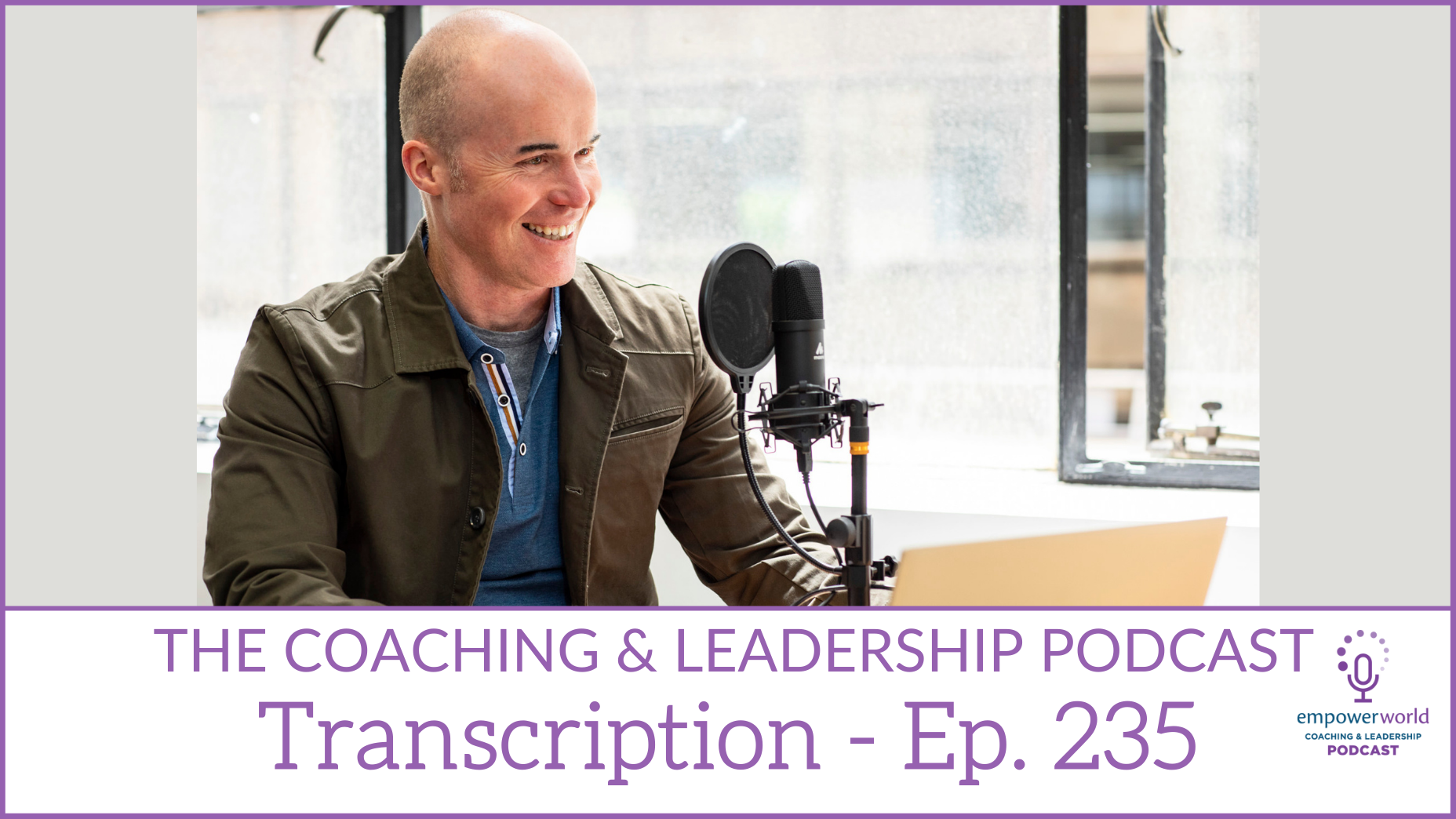
Joe Pane
Emotional Fitness Expert. Author of "Courage To Be You - A Guide to Mastering Uncertainty."
Jeanine Bailey:
Hello, and welcome, listeners, to the next episode of the Empower World Coaching and Leadership Podcast. I am here again, a couple of weeks later, with my wonderful friend, Joe Pane, who I did my coach training with many years ago. You have accredited over 7,000 coaches, which is incredible, and now you’re doing your own thing. I’ll let you introduce yourself, but I’m really pleased to see you here again. We recorded a podcast a few weeks back on Extended Disc.
I’ve brought Joe back again because he has created his own incredible program called the Emotional Fitness Formula, in which he accredits coaches and leaders to utilize five core principles based on emotions, values, and much more. I felt it would be insightful to bring you back, Joe, to share what this program is all about. From my experience of your work, it’s based on some of the wonderful insights I learned from you when I first started to become a coach. It’s great to see that you’ve created this program in your own unique way-how you share core principles of how we live our lives, choose to live them, or not choose to.
So Joe, welcome again. I’ll hand over to you to introduce yourself, because others may not have listened to the Extended Disc episode. A big welcome over to you in Australia.
Joe Pane:
Thank you so much, Janine. I appreciate you having me on again. It’s fantastic, and as I’ve said before, it’s phenomenal to reconnect with you after all these years. I started my coaching and training business back in 2006. My background is in psychology and sociology, which I majored in, and I also worked in occupational health in the manufacturing world back in the 90s, which is another story entirely.
In 2006, I launched my coaching and training business. Like most new ventures, there were ups and downs at the start, but now I’m in my 20th year and loving it more than ever. About four years ago, based on 15–16 years of work, I created frameworks and thought systems that became the Emotional Fitness Formula. Its core mission is to transform people’s relationship with uncertainty.
I believe that outside of our relationships with people, this is the most crucial psychological relationship we can have. Uncertainty is the fabric of life. It’s the seed of growth, like nutrition for a plant. It actually feeds our growth, and growth is crucial to our survival. We need to grow to keep up with who we’re becoming, so we can handle and embrace the responsibilities that life continually expands for us.
The work is based on thousands of coaching hours, trainings, and presentations delivered across different industries and backgrounds. The frameworks have been proven to work, and that’s the brief history of it all.
Jeanine Bailey:
Fantastic, Joe. I love how you’ve brought all of that learning and experience, from psychology through to coaching. You are such an information gatherer, always enhancing your wisdom and knowledge to support coaches. And of course, as coaches, we’re not solving our clients’ problems or leading them to the answer.
What I believe is powerful is having awareness of how humans operate-what lies beneath our thinking. That awareness helps us support clients, not by leading, but by understanding what might be getting in their way. It helps them clarify what they really desire and what they want to experience.
This framework you’ve created helps coaches expand and live their best lives, while supporting their clients. I appreciate how you’ve pulled all this wisdom into a structure that helps us understand ourselves and support our work with clients. So Joe, this Emotional Fitness Formula has five foundations or principles. Can you share more about them for our audience?
Joe Pane:
Absolutely. Getting back to your point about coaching, its purest form is about resolving the thinking that created the problem in the first place. Our thought systems define our lives. The Emotional Fitness Formula has five core focus points or principles. They are five different perspectives that help coaches support people in navigating difficult situations, crises, challenges, adventures, or problems-because uncertainty shows up at all levels of life.
The first part of the Emotional Fitness Formula is identity. Identity is the most powerful force in the human condition. We will do anything to remain consistent with it, and it’s defined by what we allow ourselves to be defined by. What defines us owns our entire psychological landscape. For example, if I define myself by my business results, then wins and losses affect me deeply. Wins go to my head, losses to my heart, making it harder to bounce back.
In the program, we guide clients away from roles that define them and toward character that defines them. This shift makes navigating uncertainty more efficient-not easier, because uncertainty will always be uncertain-but clearer and more purposeful. Identity is a big part of the work, and it explains universal stages individuals, businesses, and leaders go through.
The second part of the Emotional Fitness Formula is life stages. These refer to the universal journey from ambition to meaning. As responsibilities expand and decades pass, our priorities shift. Many people between 40 and 60 go through a crisis point. In Emotional Fitness, this shift from ambition to meaning is a major identity and values evolution.
I experienced it personally around 2003–2004 when I took a 15-month sabbatical, attending retreats and vision quests to navigate it. Essentially, we move away from the egocentric ambition-driven world toward the heart-centered world of meaning, where psychology aligns more with nature. In nature, everything exists because of the value it brings to its community. Humans are the same.
This shift helps explain the confusion people face during identity changes. A crisis, in Emotional Fitness, is defined as the end of something you dearly love that wasn’t your choice-like losing a job, a career, a relationship, or a loved one. The frameworks in EFF don’t make uncertainty easier but provide direction to navigate it.
Jeanine Bailey:
I can really resonate with that journey from ambition to meaning. When I started coaching, I felt something was missing. I knew I was meant to connect and support people but didn’t know how. Coaching helped me realize it was bigger than me-it was about creating something to empower others. That continues to drive me today. Empower World has helped so many people, and that impact brings me joy.
In coaching, we support clients to explore what is bigger than themselves, what gives them meaning. We ask questions that help them think systemically-what’s good for them, good for others, and good for the greater good. That joy is not material, but about connection. And of course, the level of connection differs for introverts and extroverts.
Joe Pane:
That’s such a good point. Many people who come to coaching are themselves in the transition from ambition to meaning. They’re searching for a way to make money meaningfully, where success is about the value you bring to others, not just personal rewards.
The third principle of the Emotional Fitness Formula is values. In EFF, we define a value as an emotional compass that leads us to realize our deepest unconscious desires. Many people confuse values with morals. Morals are behavioral standards like integrity or respect. Values are unique and personal-they are activities that bring joy, fulfillment, and meaning.
This is vital in navigating uncertainty. When we practice hobbies or rituals that bring joy, they give us something to look forward to, reducing anxiety and helping us manage challenges. That’s why values are such a powerful focus point.
Jeanine Bailey:
Yes, and those values that bring joy are our highest values-the ones we want to live into as much as possible. But if we feel lost or confused, we may be living according to someone else’s values or societal expectations. That misalignment creates dissatisfaction.
A lot of coaching is about supporting clients to uncover their highest values-the ones that truly resonate with them-so they can align their choices and live more authentically.
Joe Pane:
Exactly. And this leads us to the fourth part of the Emotional Fitness Formula: emotional fitness itself. In our world, emotions are like a GPS. They guide us toward or away from the experiences we create. Yet most people don’t know how to interpret their emotions properly.
Emotional fitness is about building capacity to feel and process emotions without being hijacked by them. It’s not about suppressing or denying feelings but about embracing them, decoding the message, and then making conscious choices. Every emotion contains valuable data, whether it’s joy, sadness, anger, or fear. When we learn to understand these signals, we can navigate uncertainty much more effectively.
For example, anxiety often signals a lack of clarity. Instead of seeing anxiety as something negative, we can ask, “What clarity am I missing right now?” By reframing emotions as useful information, we move from being reactive to being intentional.
Jeanine Bailey:
That’s powerful, Joe. I know in coaching we often support clients to acknowledge and accept emotions rather than push them away. When they do, it opens up new awareness and opportunities. What you’re sharing is exactly that-teaching people to interpret and use emotions in a way that empowers rather than disempowers.
Joe Pane:
Yes. And then the fifth part of the Emotional Fitness Formula is purpose. Purpose is the glue that holds everything together. It’s the deeper “why” behind our choices, the meaning that transcends personal gain. When people connect with their purpose, they can navigate uncertainty with resilience, because they’re anchored in something bigger than themselves.
Purpose also aligns with values. When our values guide our day-to-day activities and those activities contribute to something meaningful beyond us, life feels fulfilling. Purpose transforms challenges into opportunities to grow and contribute.
Jeanine Bailey:
Yes, and that’s what makes the work so profound. It really is about shifting focus from the ego to the heart, from “what’s in it for me” to “what’s the bigger picture I’m contributing to?” That’s where joy and resilience come from.
Joe Pane:
Absolutely. And what makes this framework so practical is that it’s not just theory. It’s been tested across industries, with leaders, teams, and individuals. Whether someone is going through a personal crisis, a career transition, or even leading through organizational change, these five focus points-identity, life stages, values, emotional fitness, and purpose-provide direction and clarity.
Jeanine Bailey:
Wonderful. And I think this is so needed, especially now when so many people are facing uncertainty at multiple levels-personal, professional, and global. This framework offers hope and practical tools to navigate that.
Joe Pane:
Yes, exactly. The future is uncertain for all of us, but uncertainty itself isn’t the enemy. It’s our relationship with it that matters. With the right tools, we can transform uncertainty into growth, resilience, and deeper fulfillment. That’s what the Emotional Fitness Formula is all about.
Jeanine Bailey:
Fantastic, Joe. Thank you so much for sharing these insights today. I know our listeners will have gained so much from hearing about this framework, and I highly encourage coaches and leaders to explore more of your work. It’s been wonderful reconnecting with you and hearing how you’ve brought your years of experience together into something that supports people to thrive.
Joe Pane:
Thank you, Jeanine. I appreciate the opportunity, and I’m always happy to share what I’ve learned.
Jeanine Bailey:
Thank you again, Joe, and thank you, listeners, for joining us on this episode of the Empower World Coaching and Leadership Podcast. We look forward to being with you again soon.


